Tuesday, September 1, 2026



News and Views from the Global South
AGRICULTURE: Swazi Input Trade Fairs Falling Short
Mantoe Phakathi
- Mary Ntshangase sits under a big umbrella – a packet of beans in one hand and a packet of peanuts in the other – wooing customers to her stall.
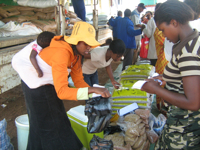
Swazi farmers' experiences with agricultural subsidies offer stark contrast to those in Malawi. Credit: Mantoe Phakathi/IPS
About 30 stalls, all selling seeds of peanuts, beans, jugo beans, pumpkin, mung beans, cowpeas, sorghum, stems of cassava and leaves of sweet potatoes, form a circle around the arena. Most of the vendors are women some with babies on their backs, shouting at the top of their voices to try to get the attention of customers.
Bold banners make the well-decorated stands of well-established companies like Pannar and Farm Chemicals which seem to be attracting more customers. These companies are offering gifts such as watering cans and sickles. The big companies also sell fertilisers, something that the small vendors do not have.
The farm input traders visited 24 communities across the country during the month of October, selling their wares to subsistence farmers. Although it looks like business is booming for the vendors at the trade fair, Ntshangase is not exactly happy with the day's business.
"The market today is not impressive," says 56-year-old Ntshangase. "Last year a lot of people were buying unlike today."
Last year, she made a profit of about $1,666 from selling legumes and sorghum seeds at the different trade fairs hosted throughout the country. This year, she says, she is not likely to even make half of that amount.
"And more women have since realised that there is an opportunity in selling farm inputs which has also cut down on the market," she says. "But I'm happy that through these input trade fairs women are being economically empowered."
Hundreds of farmers from Matsanjeni and surrounding areas are queuing up at the different stalls to buy themselves seeds and fertilisers. In total, 564 poor farmers each carry a voucher worth $72 with which to buy the farm inputs.
But besides the buyers, there are also sullen dozens who stand by with their eyes fixed on the ground as if the world has closed in on them. These bystanders are farmers who have been left out of the fair this year due to funding cuts.
Ntshangase is worried about the drastic slash in the number of beneficiaries of the United Nations Food and Agriculture Organisation (FAO) farm input trade fairs. FAO sponsors poor rural subsistence farmers with farm inputs in trying to fight hunger in the country.
Last year, according to FAO country representative Khanyisile Mabuza, 50,000 farmers benefited from the programme; this year, only 4,888 will receive the coveted vouchers. Mabuza says FAO could not attract donor support for the programme this year, resulting in the organisation digging into its own pockets for $500,000. This is a far cry from the 3 million dollars spent last year – with the European Union Commission on Humanitarian Organisation contributing $1.5 million and the other half coming from the United Nations Central Emergency Fund.
Continued funding for this programme remains on shaky ground.
"This programme has been going on for five years and our sponsors felt that by this time farmers should be able to sustain themselves," says Mabuza.
However, it does not look like Swazi subsistence farmers will be able to stand on their own anytime soon. Most farmers under this programme have nothing to show for being recipients of the farm inputs over the years. According to the area's chief representative, Bomber Dlamini, they remain as vulnerable as before because they sell or eat the farm inputs.
Because of the prevailing food insecurity in the country where 260,000 people are dependent on food aid, most people want immediate relief from hunger. Some people go to the extent of washing away chemicals from treated seeds so that they may be cooked.
University of Swaziland lecturer and researcher in the department of geography, environmental science and planning Dr Nomcebo Simelane warns against considering everybody who resides in the rural areas as farmers. Some people who reside in the rural areas do not even make a living out of agriculture but are employed or are dependent on their relatives who are working.
"It is just mere fate that they reside in rural areas and are poor," says Dr Simelane. "You find most of the poor people working at the factories in town and then they provide income of their families back home."
Dr Simelane says the lack of identification of people who are really interested in farming could be the reason why some farm inputs end up in the pot.
Mabuza's FAO says people who benefit from the farm inputs are selected through community leaders who look at their vulnerability and "their interest in farming." She says most beneficiaries are women because they constitute a high number of poor people in the rural areas.
Although maize does not grow well in times of drought, most farmers still insist that they want to cultivate maize.
But the principal secretary at the Ministry of Agriculture and Cooperatives strongly warns farmers in the drought-stricken Lubombo region against holding on to the country's staple food.
Dr Robert Thwala says sorghum is the ideal crop for dry areas and urges farmers to use their vouchers wisely by investing in a crop that would bring high yields.
This year FAO thinks it has found a solution.
"We told all the traders not to bring maize at this trade fair," says Mabuza.
But it is not that simple.
Although the farmers are told to cultivate drought-tolerant crops taking into account the drought that is prevailing in the Lubombo region, these crops sometimes also do not make it. The scorching heat, according to Cedusizi Ndlovu, the area's Member of Parliament, destroys even the hardiest crops such as sorghum and legumes.
"In the absence of moisture nothing can germinate," says Ndlovu. "The only solution to this problem is the building of dams to store water from the rivers so that people can irrigate their crops." Minah Mbuli (62), a beneficiary under this programme, shares the same sentiments with Ndlovu arguing that it would be too early to consider herself lucky after getting the voucher before the rain decides her fate.
"Last year I cultivated sorghum and sweet potatoes and I did not get any yield because it was too hot – everything was destroyed by the sun," says Mbuli.
The input trade fairs programme does not provide a holistic solution to the problems faced by rural subsistence farmers who lack even the tillage facilities that go with farming. Tractors are expensive to hire while the prices of farm inputs have skyrocketed, leaving farmers with no money to buy fertilisers and tools. A 50 kg bag of fertiliser costs $65 at the trade fair while each farmer receives just $72. The rest of the money is not enough to buy seeds and pesticides.
This is how most farmers end up back to square one.
 Print
|
Print
|



Pictures for this story
This story includes downloadable print-quality images -- Copyright IPS, to be used exclusively with this story.