Wednesday, October 21, 2026



News and Views from the Global South
SRI LANKA: Floods, Fighting, Food Shortages Hit Trapped Tamils
IPS Correspondents
- Incessant rains and flooding in the Vanni, the Tamil rebel stronghold in northern Sri Lanka, are adding to the woes of at least 200,000 people stranded in intensified fighting between the Liberation Tigers of Tamil Eelam (LTTE) and the Sri Lankan army since mid-September.
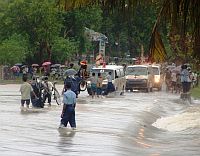
Rains and floods have added to the woes of civilians trapped by the civil war in northern Sri Lanka. Credit: TamilNet
There are now conflicting estimates as to how many people are affected by the floods, fighting and food shortages. Foreign Secretary Palitha Kohona put the figure of the entire Vanni population at 200,000, while the United Nations puts the number of internally displaced persons (IDPs) at 230,000.
Last week, Amnesty International (AI) assessed that ‘’more than 300,000 people face the next few months crowded together in temporary shelters, surrounded by mud, with no promise of regular access to food or adequate sanitation.’’
"The Sri Lankan government must immediately end its policy of blocking humanitarian aid needed to reach an estimated 300,000 displaced people in the Vanni region of northern Sri Lanka," Sam Zarifi, AI’s Asia-Pacific director, said in a statement.
"The Sri Lankan government states that it is distributing aid to displaced families, but AI believes that the government lacks the capacity to uphold international human rights standards and ensure the support is provided to protect the lives of thousands of people,’’ Zarifi said.
Zarifi was also critical of the LTTE role in keeping civilians trapped in the Vanni. ‘’The Tigers continue to forcibly recruit one person per family with recent steep recruitment of younger people. The LTTE have hindered people from moving to safer places by imposing a strict pass system,’’ he said.
"The Sri Lankan government and the LTTE must allow international monitors to assess the needs of the thousands of people trapped in the Vanni and to ensure proper distribution of food and other resources,’’ Zarifi said.
AI’s charges have drawn sharp criticism from the government. "I was shocked at the AI report," Commissioner General of Essential Services S. B. Divaratne, the top ranking government official overseeing supplies to the Vanni, said. "President [Mahinda] Rajapakse has made sure that the food must go to where the [displaced] people remain," he said.
Sri Lankan officials and the Red Cross are now preparing to move 1,700 MT of relief material supplied by the Indian government to the Vanni area.
Indian High Commissioner in Sri Lanka Alok Prasad had officially handed over the consignment of 80,000 ‘family parcels’ containing food, clothing, bedding and hygiene items to the International Committee for the Red Cross (ICRC) at the latter’s warehouse in Colombo on Nov. 20.
"The ICRC will send the supplies to the Vanni -area held by the rebel LTTE – in the coming weeks," ICRC head of delegation in Sri Lanka Paul Castella said at the handover.
The Indian relief came after Basil Rajapakse, member of parliament and brother of President Rajapakse, visited India earlier in the month after protests over the plight of over 200,000 displaced Tamils erupted In India’s southern state of Tamil Nadu.
Prasad said that the relief was a direct outcome of the agreements reached during Rajapakse’s discussions in India. "This is the first of such consignments, we will assess the situation and requirements and decide on future supplies."
The relief supplies are the first to be sent by India to the conflict area since the resumption of hostilities between the Tigers and government forces in mid-2006. Earlier, other countries like Japan, the United States and the EU have helped by way of contributions to agencies, especially the U.N. ones, working in the conflict areas.
The supplies have come at a time when fighting has intensified in areas under Tiger control. "Army shifted its mode of operations from active defence to all out offence in the northern theatre on Saturday (Nov. 15) by running at the LTTE's forward defence lines in Muhamalai and Kilaly (the northern line of control in the Vanni). Heavy clashes prevailed in the areas for five consecutive days," the defence ministry said.
One indication of the intensity of the fighting is that ICRC – the only international organisation left in the Vanni after U.N. and other bodies shifted out on Sep. 16 – was seeking new arrangements with the Sri Lankan government to place its officials at the vital crossover point at Omanthai.
"Until a clear agreement is found, the ICRC will continue to approach both parties to the conflict on a case-by-case basis to facilitate the movement of ambulances and the transfer of dead bodies," Castella said. ICRC officials in Colombo said that the organisation was seeking a similar arrangement to transport the Indian supplies.
Government officials said the main road north of Omanthai remained volatile due to fighting between government forces and the Tigers.
"No one can travel up to Mankulam [about 25 km north of Omanthai], the convoy has to turn east at Puliyankuklam [about 12 km north of Omanthai] and head to where the displaced remain," Divaratne said.
The U.N., which has also transported over 2,500 MT of food supplies to the Vanni since Oct. 3 in five convoys, said there were serious security concerns. But no U.N. food convoy has moved to the area since Nov. 20.
Divaratne said government agents would handle the distribution of the Indian aid with coordination and monitoring by the ICRC. "No foreign organisation can directly go and distribute food [to] anybody there, bypassing the government mechanisms," he said.
This is the biggest intervention by India since 1987 when New Delhi responded to a Sri Lankan army blockade of the LTTE-held northern areas by air dropping food packets to the civilian population.
 Print
|
Print
|