Languages
Sunday, November 15, 2026



News and Views from the Global South
Civil Society

A Voice of Inspiration
More than 700 activists gathered in Suva, Fiji's capital, to explore the latest trends – from climate change to human rights, from innovation to social justice. Anything that can help empower and mobilise citizens. The lively debates in panel discussions, workshops and lectures made the event look like a carnival of creative new ideas and tested knowledge.
The Journey to Oslo
On December 10 in Oslo, the International Campaign to Abolish Nuclear Weapons (ICAN) was awarded the Nobel Peace Prize. ICAN started as a grassroots campaign in 2007. Its aim was to shift the paradigm of discussion about nuclear weapons from security and deterrence to the environmental and humanitarian effects of nuclear explosions. As the prize demonstrates, ICAN has succeeded brilliantly. But, as ICAN acknowledges, this is still only the beginning of the end of nuclear weapons.
Global Initiative to Relieve Pressure on Mountains
International Mountain Day and the Mountain Partnership’s 15th anniversary coincided on December 11, kicking off a three-day Mountain Partnership Global Meeting at the headquarters of the Food and Agriculture Organization of the United Nations (FAO) in Rome.
Pakistan Gets Its First One-Stop Shop for Women Fighting Violence
Sliced noses, broken ribs, fractured fingers, slashed arms, bruised and bloodied faces with teeth missing and eyes swollen... Sana Jawed, 30, has been witnessing these brutalities for over a decade.
“Banging on the Door” – Women Fight for a Voice and Space in Civil Society
The space for civil society organizations is shrinking around the world, with particular impacts on women activists and human rights defenders who face additional barriers due to their gender or sexual orientation.
Debate on Glyphosate Use Comes to a Head in Argentina
In and around the city of Rosario, where most of Argentina's soybean processing plants are concentrated, a local law banned the use of glyphosate, the most widely-used herbicide in Argentina. But two weeks later, producers managed to exert enough pressure to obtain a promise that the ban would be overturned.
New ‘Anti-Hate Law’ Threatens Freedoms in Venezuela
Hate speech in the media or social networks in Venezuela is now punishable with prison sentences of up to 20 years, according to a new law issued by the government-controlled National Constituent Assembly (ANC).
“Will Civil Society & Democracy in India Rise to the Existential Challenges They Face?”
A cursory glance at international funding of the social sector in India reveals that it has grown at over 25% annually over the past three years.
Civil Society Week Puts Spotlight on the Pacific
It's a busy week for movers, shakers and policymakers attending a global gathering of civil society activists here in Fiji. For the first time, the International Civil Society Week (ICSW) is holding its sessions in the Pacific. It's a sign of a growing awareness of the problems facing these remote islands – problems they cannot be ignored any longer.
Build Back Better: The Tiny Island of Dominica Faces New Climate Reality
McCarthy Marie has been living in the Fond Cani community, a few kilometres east of the Dominica capital Roseau, for 38 years. The 68-year-old economist moved to the area in 1979 following the decimation of the island by Hurricane David.
Indigenous People, Guardians of Threatened Forests in Brazil
Indigenous peoples, recognised as the best guardians of the world's forests, are losing some battles in Brazil in the face of intensified pressure from the expansion of agriculture, mining and electricity generation.
Are Rising Attacks On Human Rights Defenders The ‘New Normal’?
At CIVICUS, a global civil society alliance working to strengthen citizen participation, we receive bad news of attacks on compatriots every day.
‘Sparks of Hope’ in a Time of Fear
Out of 300 nominations from across the globe, just four have won an innovation award for their commitment to human rights. Now in its 12th year, the Nelson Mandala-Graça Machel Innovation Awards seeks to celebrate and promote diverse individuals and organizations for their excellence and bravery in creating social change.
Lawmakers Impose Gender Parity in Argentina’s Congress, By Surprise
It was an unexpected move by a group of women in the lower house of the Argentine Congress. At one o'clock in the morning, during a long parliamentary session, they demanded the approval of a stalled bill for gender parity in political representation. There was resistance and arguments, but an hour later, the initiative became law by a large majority.
Women Activists are Targets of Gender-Biased Violence
Veiled and direct threats, defamation, criminalisation of activism, attacks on their private lives, destruction of property and assets needed to support their families, and even murder are some forms of gender violence that extend throughout Latin America against women defenders of rights.
Migrant Promoters and Musicians Spread Message of “One Africa”
The crowd in the park gave out roars of approval as the next act was announced: Mothusi Bashimane Ndlovu, one of Zimbabwe’s most popular singers and actors, who took to the stage with a small axe in hand.
Education, Not Condemnation, Say Women Leaders Who Survived Violence
Sally Mboumien remembers the day she pressed a steaming hot stone against her chest. In Bawock, the rural community of western Cameroon where she grew up, young girls often had their young, sprouting breasts flattened with a hot iron or a hammer or spatulas that had been heated over burning coals.
New Study Concludes Europe’s Mediterranean Border Remains ‘World’s Deadliest’
IOM, the UN Migration Agency’s Global Migration Data Analysis Centre (GMDAC), today (24/11) released a new report reviewing the evidence of Four Decades of Cross-Mediterranean Undocumented Migration to Europe and concludes that Europe’s Mediterranean border is “by far the world’s deadliest.”
Conservative Onslaught Undermines Gender Advances in Latin America
A "conservative and fundamentalist onslaught" in Latin America against a supposed "gender ideology" is jeopardising advances in the fight against violence towards women, feminist activists complain.
The World is Losing the Battle Against Child Labour
The IV Global Conference on the Sustained Eradication of Child Labour, which drew nearly 2000 delegates from 190 countries to the Argentine capital, left many declarations of good intentions but nothing to celebrate.
The Birth of a Dictator
The government had an almost paranoid fear of protests. A square kilometer around the Supreme Court was barricaded and off limits to the public. In faraway provinces, roadblocks were erected to stop demonstrators. Some opposition members were under temporary house arrest. But it turned out to be unnecessary. Nobody dared to protest.« Previous Page — Next Page »


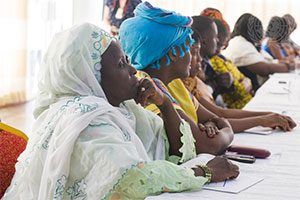 Representatives of Civil Society, Sierra Leone. Credit: UN Photo/Eskinder Debebe
Civil society faces mounting threats worldwide, even as it remains essential for democratic accountability, especially in countries struggling with economic instability and social inequality. However, at the same time, nations with weak democratic governance structures also systemically suppress the power of civil society. Human rights activists across the Global South frequently challenge issues such as political persecution and gender oppression, but in return face state-sanctioned punishment for their advocacy. Imprisonment and exile are common mechanisms of punishment that seek to erode the strength of civil society. The 2026 World Press Freedom Index has reached its lowest level in 25 years, with more than half of the world’s countries now falling into the "difficult" or “very serious” category for press freedom. IPS seeks to highlight the work of civil society across the Global South as well as the challenges that they face.
Updated by Yilan Batista and Shuli Wong August 2026

The Week with IPS

NEXT STOP - SDGs
Tracking global progress towards a sustainable world
Tracking global progress towards a sustainable world
