Languages
Sunday, November 8, 2026



News and Views from the Global South
Education
DEVELOPMENT: A New Breed of Hero
In September 2000, at the United Nations Millennium Summit, world leaders came together and agreed to a set of time-bound and measurable goals and targets for combating poverty, hunger, disease, illiteracy, environmental degradation and discrimination against women.
CULTURE: It All Begins With a Webcam and a Smile
Imagine rolling out of bed, sprinting to class in your pyjamas and meeting face-to-face with friends in Egypt, the Netherlands, Belgium and Morocco.MIDEAST: A Divisive Word Surfaces
Right-wing lawmakers in Israel are fuming over a decision by Israel's education minister to permit use of a textbook in state-run Arab schools that includes the word "nakba" - Arabic for "catastrophe", the term Palestinians use to describe the founding of the Jewish state.
EDUCATION-PAKISTAN: Taliban Orders Girls Into Veils in Border Areas
Threatening letters sent by pro-Taliban rebels in a border area of the North West Frontier Province (NWFP) in Pakistan warning girls to wear a veil or keep away from school have had the desired results.EDUCATION-NICARAGUA: Down, Down with Adult Illiteracy
An adult education programme beginning this month in Nicaragua is part of one of the Sandinista government's most ambitious social projects: to declare this country free from illiteracy in 2009.LABOUR-PERU: Strike Ends as Teachers and Gov’t Sit Down to Talks
Peru's teachers' union, which has been giving the Alan García administration its worst headache, decided to suspend its protests after 15 days of violence that resulted in three deaths and dozens of wounded across the country. But its battle with the government has barely begun.DEVELOPMENT: ‘Aid for Trade’ May Cut Health, Education Funds
African governments are worried that funds from the European Union (EU) to help them increase their countries' share of world trade could be at the expense of other forms of development aid.
SIERRA LEONE: Caught Between Leaving the Kitchen and Putting Food on the Table
When Iyesha Josiah told people last year that after the August 2007 general elections, she would stand before them as a new member of parliament for Sierra Leone, they thought she was joking.RIGHTS-MOROCCO: Childhood Being Stolen
Habiba Hamrouch describes her daughter, Sanaa, as her "revenge" - her blow against the mixture of abuse, tradition and indifference that enables thousands of girls to be exploited as domestic servants in Morocco.AFRICA: Child Bride Symbolises Reasons Why MDGs Will be Missed
The woes of the child bride in many ways illustrate the conditions underlying the failure of African countries to achieve many of the United Nations’ Millennium Development Goals (MDGs).PERU: Escalating Conflicts Put Pres. Garcia on the Spot
Three people dead, several injured, and fire at an airport: the results of a wave of protests in Peru, regarded as the worst social crisis since Alan García became president nearly one year ago. Thousands of teachers, workers and peasant farmers continued the mobilisation Thursday.RIGHTS-IRAN: Students Unfazed by Arrests, Suppression
When six members of Iran’s largest students’ organisation, ‘Office to Foster Unity’, risked arrest and indefinite imprisonment to stage a sit-in demonstration, this week, it was a measure of their determination to take on the suppressive, hard line regime of President Mahmoud Ahmadinejad.DEVELOPMENT-EUROPE: Commission Sets Policy Against Health and Education
The European Commission has decided that its development aid activities should not focus on health and education, a senior official with the EU executive has admitted.
CUBA: Women Combating Shortage of Decent Housing
Juana Hilda Naranjo no longer worries when it rains. For the last three years she has been living in a modern apartment out of reach of the water and wind, thanks to the efforts of the Taller de Transformación (Transformation Workshop) in the poor, predominantly black Havana neighbourhood of Pogolotti.DEVELOPMENT-MOZAMBIQUE: An MDG Temperature Check Gives Mixed Results
Only about 30 percent of Mozambicans think that their quality of life has improved since 2000, the year when the international community agreed on the Millennium Development Goals (MDGs), while about 42 percent believe life has not changed.DEVELOPMENT: EU Failing to Support Health and Education
The European Union is failing to prioritise health and education in its plans for spending aid in poor countries, according to a new study.SRI LANKA: Primary Education in Crisis
The dismal results of Sri Lanka's school-leaving General Certificate of Education (GCE) exams this year, which showed only 48 percent of the 525,000 candidates passing, have left educationists wringing their hands and asking where they went wrong.THAILAND: Schools Prime Targets for Malay-Muslim Rebels
The soldiers assigned to provide security for students and teachers at a school in the violence-torn southern province of Yala on Friday were part of a new plan by the military-appointed government in Bangkok. But they never made it.EDUCATION-AFRICA: Will eLearning Make Teachers Redundant?
Does electronic learning (eLearning) threaten to displace the teacher?EDUCATION-US: A Rough Road From Boot Camp to College
Derek Adams played with his two-year-old son on the grounds of Veterans Upward Bound, an outreach and education programme for former U.S. military service members outside the campus of California State University, Humboldt.EDUCATION-AFRICA: Learning at the Flick of a Switch
The role of information and communication technologies (ICT) in improving education throughout Africa has been in the spotlight over recent days at the e-Learning Africa Conference.« Previous Page — Next Page »





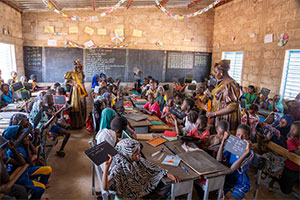 Two teachers work in a classroom in Forces Vives School in Dori, Burkina Faso. Credit: UNICEF/UNI978361
Safe and uninterrupted education is a fundamental right for all children. Education is paramount to global development, as it has been proven that investing in education – especially for girls and children – contributes significantly to economic growth and prosperity. Although more than 1 billion children go to school, many are subjected to conditions that are not conducive to a proper learning environment, including makeshift facilities, a lack of supplies, violence in classrooms, inadequate sanitation, untrained instructors, and widespread school closures. Since 2015, there have been immense gains in education with an increase of 109 million children in school. However, as of 2023, 272 million children are still out of school.
High poverty levels in developing countries also impede children’s access to a proper education. For example, from the early to mid 2000s, Sub-Saharan African nations witnessed a dramatic decline in trained teachers due to inadequate funding in the education sector. Furthermore, major cuts to United States international aid threaten an estimated 23 million additional children's access to education, as USAID‑funded school programmes across Africa and Asia face closure.
Various other factors contribute to the decline of education, notably hunger, which has increased as conflict and climate change interfere with global food production and dissemination. Meanwhile, certain social and cultural practices also impede children’s access to education, with gender inequality, discrimination, child labour, and child marriages preventing millions of children from attending school. Economic conditions such as the inaccessibility of higher education also affect disenfranchised communities across the world. In extreme situations, such as warfare where educational facilities are destroyed in their totality, notably in Gaza and Sudan, entire generations of children might grow up without access to education. Rebuilding educational infrastructure is a long and arduous process, especially when violence persists across generations, and this significantly stunts the development of societal prosperity and stability.
IPS is dedicated to telling the shocking truths about worldwide education through impassioned opinion pieces and comprehensive articles, highlighting global issues that impede worldwide education and the courses of action being taken by organizations such as UNICEF and Education Cannot Wait.

The Week with IPS

NEXT STOP - SDGs
Tracking global progress towards a sustainable world
Tracking global progress towards a sustainable world
