Languages
Sunday, November 8, 2026



News and Views from the Global South
Education
SINGAPORE: ‘Education Hub’ Plans Take a Knock
An ambitious plan by the Singapore government to attract reputable foreign universities to set up off-shore campuses on this island nation took a knock this week when Australia's University of New South Wales (UNSW) announced the closure of its campus here.PAKISTAN: Cleric Turns Heat on NGOs
''These foreign agents are against our religion. How can we allow them to work here when we know they come with an American agenda and support Israel?" asked Maulana Fazalullah, the pro-Taliban cleric, referring to non-governmental organisations (NGOs).BOLIVIA: Faster Internet Connections – For the Few
A varied crowd of academics, civil servants, and university and high school students gathered in the hall of the vice-presidential building to celebrate Internet Day. The main event was the launching of Internet II, a project to incorporate Bolivia into the cutting-edge Latin American Cooperation of Advanced Networks (CLARA).PAKISTAN: Despite Odds Village Girls Get an Education
Shumaila is sitting for her school certificate exam this month. But that does not relieve her from daily chores that include tending to dozen or so head of cattle.VENEZUELA: Museums Throw Open Their Doors to the Disabled
"We drew a fat woman with little dots. I like learning to draw. Maybe I'll be an artist later on," Lisette, a 15-year-old mentally disabled girl who goes every Friday from her school in the south of the Venezuelan capital to the Alejandro Otero Museum, told IPS.RIGHTS-ANGOLA: Beauty Is in the Eye of the Evictor
The Angolan government forcibly evicted 20,000 poor people, including small-scale farmers, and destroyed 3,000 homes between 2002 and 2006 in the capital, Luanda, "to facilitate development and 'beautification' in the public interest".CHINA: Public Health Education Sorely Missing
China's government is trying to fix its ailing rural health-care system by pouring millions into medical infrastructure for the countryside, but its neglect of basic health education for the public could condemn these efforts to failure, health experts here warn.DEVELOPMENT: More in School, But Not Learning Enough
Poor countries are making progress in sending more children to primary school, but the quality of what they learn often leaves much to be desired, according to the World Bank Global Monitoring Report 2007 published Friday.POLITICS-IRAN: Campus Cartoons Trigger Wave of Suppression
A new wave of suppression, following the publication of a cartoon of Iran's Supreme Leader Ayatollah Khamenei in several campus newspapers run by students of the prestigious Amirkabir University of Technology (AUT) ten days ago, has landed several student editors in jail.
EDUCATION-BOLIVIA: Literacy Drive on Full Steam
Coipasa is ahead, with Chipaya on its heels. Right behind them are Urubichá and Guarayos. The competitors are not race horses but rural villages and towns in Bolivia racing to declare themselves free of illiteracy.CUBA: Children Use Art to Learn About Hunger
A Cuban child is drawing a train, heavily loaded with emergency food supplies that are about to be airlifted and dropped into areas where hunger is just a normal part of life. The drawing will be entered in an annual international competition called "WFP in Action," organised by the World Food Programme.GUATEMALA: Indigenous Women Last in Line for MDGs
Guatemala is making slow, uneven progress towards meeting the Millennium Development Goals (MDGs), with maternal mortality and illiteracy remaining the most persistent problems, mid-way to the 2015 deadline.RIGHTS-US: Professor Who Charged Racism Gets the Axe
A premier U.S. research institute agreed earlier this year to address possible racial bias in hiring, but now it is firing the person who raised the complaints.DEVELOPMENT-BOTSWANA: ”Will the MDGs Help Me Find a Job?”
Batswana are divided about the viability of the United Nations' Millennium Development Goals (MDGs). In random interviews, IPS found some arguing that the MDGs are elitist ideas unattainable in reality while others contend that the MDGs can be used to address socio-economic problems.
HEALTH-LATIN AMERICA: Limiting the Junk Food Banquet
Amidst a little pushing and shoving, dozens of girls and boys order fried potatoes, soft drinks, hotdogs and candy at the shop in a private school in Mexico. Similar scenes can be found across Latin America, where junk food sales are strong.TRADE-AFRICA: Microfinance Tackles AIDS Head On
With two-thirds of the world's HIV/AIDS victims living in sub-Saharan Africa, sickness and death is too often a part of doing business in the region. But now microfinance institutions have found ways to reduce financial risk while attacking new infections.DEVELOPMENT-TANZANIA: MDGs a ”Bright Idea” or Scam of the Rich?
While the United Nations' Millennium Development Goals (MDGs) are a ‘‘bright idea'', the ‘‘hidden agenda'' of western countries makes it impossible for African states like Tanzania to achieve the goals, expounds actor Rashid Mkwinda.DEVELOPMENT-AFRICA: The Arrival of ”Homo Urbanus”
The year 2007 marks the birth of a new ''species'': Homo Urbanus. For the first time in history there will be as many city dwellers as rural inhabitants in the world.RIGHTS-SUDAN: Education Can’t Wait Till the Fighting Is Over
The protection and well-being of children in Sudan are at a critical juncture, according to a report released Wednesday by Watchlist on Children and Armed Conflict, a global network of non-governmental organisations.EDUCATION-IRAN: Ahmadinejad Flunks on Teachers' Strike
An attempt to suppress a prolonged teachers' agitation against low wages, through intimidation and mass arrests, may result in the impeachment of education minister Mahmoud Farshidi, a key member of President Mahmoud Ahmadinejad's cabinet.MEDIA-US: Public’s Grasp of Current Issues Unchanged Despite Internet, Cable TV
Despite the emergence of 24-hour cable television news and fast-growing use of internet news sources, the U.S. public's knowledge of national and international personalities and issues is little changed from nearly 20 years ago, according to a new survey released by the Pew Research Centre for the People and the Press.« Previous Page — Next Page »





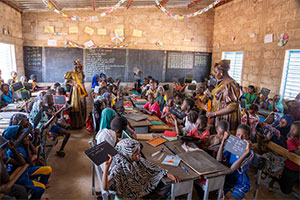 Two teachers work in a classroom in Forces Vives School in Dori, Burkina Faso. Credit: UNICEF/UNI978361
Safe and uninterrupted education is a fundamental right for all children. Education is paramount to global development, as it has been proven that investing in education – especially for girls and children – contributes significantly to economic growth and prosperity. Although more than 1 billion children go to school, many are subjected to conditions that are not conducive to a proper learning environment, including makeshift facilities, a lack of supplies, violence in classrooms, inadequate sanitation, untrained instructors, and widespread school closures. Since 2015, there have been immense gains in education with an increase of 109 million children in school. However, as of 2023, 272 million children are still out of school.
High poverty levels in developing countries also impede children’s access to a proper education. For example, from the early to mid 2000s, Sub-Saharan African nations witnessed a dramatic decline in trained teachers due to inadequate funding in the education sector. Furthermore, major cuts to United States international aid threaten an estimated 23 million additional children's access to education, as USAID‑funded school programmes across Africa and Asia face closure.
Various other factors contribute to the decline of education, notably hunger, which has increased as conflict and climate change interfere with global food production and dissemination. Meanwhile, certain social and cultural practices also impede children’s access to education, with gender inequality, discrimination, child labour, and child marriages preventing millions of children from attending school. Economic conditions such as the inaccessibility of higher education also affect disenfranchised communities across the world. In extreme situations, such as warfare where educational facilities are destroyed in their totality, notably in Gaza and Sudan, entire generations of children might grow up without access to education. Rebuilding educational infrastructure is a long and arduous process, especially when violence persists across generations, and this significantly stunts the development of societal prosperity and stability.
IPS is dedicated to telling the shocking truths about worldwide education through impassioned opinion pieces and comprehensive articles, highlighting global issues that impede worldwide education and the courses of action being taken by organizations such as UNICEF and Education Cannot Wait.

The Week with IPS

NEXT STOP - SDGs
Tracking global progress towards a sustainable world
Tracking global progress towards a sustainable world
