Languages
Sunday, November 8, 2026



News and Views from the Global South
Education
HEALTH-THAILAND: Avian Flu Campaigns Reach Schools
Grade 7 student Sakulrathna Muadkum says she knows what avian influenza is. "I saw posters of it and I will simply not eat chicken that died of the flu," the pupil at Watnuannoradit School, here in Thai capital, said nonchalantly.BRAZIL: Women Turning Backs on Information Technology Studies
Women are increasingly abandoning information technology courses in Brazil, in line with a global tendency, warns the Brazilian Computer Society (SBC) and women professors in the field.EDUCATION-ZIMBABWE: ”It Is All Zero Here. We Have Nothing”
Chippy Ncube, aged 6, jubilantly hurried home as soon as she received her school report. She could not hide her excitement at being the top student in her grade one class when schools closed for the holidays recently in Zimbabwe.DEVELOPMENT: War-Torn Nations in Dire Need of Schools
Children in so-called conflict affected fragile states (CAFS) represent a disproportionate number of the world's out-of-school population largely because these countries are under-funded by international aid donors when compared to other low-income countries, says a report released Thursday.ARGENTINA: Teachers in the Line of Fire
A violent police crackdown on a teachers' protest in the southwestern Argentine province of Neuquén left one teacher in coma and prompted unions to call a nationwide teachers' strike for Monday Mar. 9.BRAZIL: Youth Still in Trouble, Despite Plethora of Social Programmes
The Brazilian government has a total of 45 different programmes targeting young people, according to the National Secretariat of Youth. Nevertheless, young people face high unemployment and are sucked into a spiral of violence in which they are both victims and actors.EDUCATION-SOUTH AFRICA: ”Schooling That Hampers Development”
For 16 years, Themba was proud to be a teacher in South Africa but a wave of violence at her school has proven so nerve-wracking that she may leave the profession.POLITICS-PAKISTAN: Madrasas Resistant to Govt Pressure
Pakistani President Pervez Musharraf's plans to crack down on Karachi's religious schools and the violent sectarian and jihadi groups many of them support has been an outright failure, says a report released Wednesday by the Brussels-based International Crisis Group (ICG).RIGHTS: Objects of “Charity and Pity” No More
A new treaty designed to promote and protect the rights of the world's 650 million persons with disabilities opens for signature at the United Nations on Friday.EDUCATION-THAILAND: Full Marks for Ethnic Tolerance Class
School holidays, which begins here in March and ends in May, have taken on a different ring this year for over 150 teenagers from Thailand's southern provinces, where an increasingly bloody insurgency is raging.
DEVELOPMENT-MOZAMBIQUE: What To Do When a Cyclone Hits
Sandra Alberto (picture) was heavily pregnant when Cyclone Favio struck Mozambique earlier this month on 2 March, ripping the zinc roof off the house she and her two children had taken refuge in.ROMANIA: Young Turn Away from Politics
Students in Romania have gone back to having student-like problems.DEVELOPMENT-AFRICA: MDGs Depend on Power Relations Changing
‘‘The people of Nigeria's oil-rich Niger Delta are poor not because they do not have resources but because they do not have political power. Those who wield power in Nigeria are building skyscrapers in Lagos and Abuja while there is nothing in the Niger Delta. It is the same at the global level.''ARGENTINA: Digital Library for the Blind
Armed with a computer and their passion for literature, a group of blind people in Argentina have created the first digital library for Spanish-speaking people who are visually impaired. It already has some 20,000 volumes and over 3,000 subscribers in 40 countries.BRAZIL-US: Social Activist Declined Invitation to Meet Bush
Rodrigo Baggio, founder of one of the best social inclusion projects in Brazil, which has spread to eight other countries, turned down an invitation to meet President George W. Bush during his recent visit to Sao Paulo.LABOUR-THAILAND/BURMA: Education May Limit Abuse of Migrant Children
Troubled by the exploitation of migrant child on the Thai-Burma border, a labour rights group is seeking an unusual pact with the Thai government. The Migrant Action Programme (MAP) wants support to help educate the victims.CONGO-BRAZZAVILLE: Success Stories Amongst Growing Numbers of Street Kids
Sixteen-year-old Bamanandoki Pitchou hasn't finished his apprenticeship in hairdressing yet, but he already has a small business. A former street child who lives in Kinsoundi - a suburb in the south of the Congolese capital, Brazzaville - Pitchou trains in the morning, and attends to clients in the afternoon.CANADA: Peace Scholars See Shrinking Space for Dissent
Can Canadians have a fair debate on their military mission in southern Afghanistan when so many of the sources quoted in the domestic press are bankrolled by the Department of National Defence (DND)?EDUCATION-US: Ivory Tower Still Blindingly White
A premier U.S. research institute has agreed to address possible racial discrimination in hiring, following a 12-day hunger fast by one of its African American scientists.DEVELOPMENT-ZIMBABWE: A Herculean Effort Is Needed
‘‘You cannot talk of halving poverty when our country is going in the opposite direction. We are totally lost,’’ says Maxwell Tambarare, a teacher in Chiredzi, a region to the south east of Zimbabwe.HEALTH-CHILE: Teen Pregnancy Bucks Global Downward Trend
She is only 24 and has already had three children. The first was born when she was 14, the second when she was 20, and the third, who she gave in adoption, was born just a few weeks ago. Her story is a reflection of teen pregnancy and early motherhood, which are on the rise in Chile.« Previous Page — Next Page »





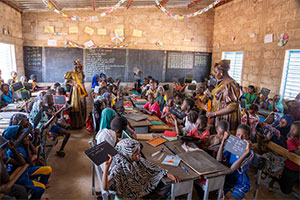 Two teachers work in a classroom in Forces Vives School in Dori, Burkina Faso. Credit: UNICEF/UNI978361
Safe and uninterrupted education is a fundamental right for all children. Education is paramount to global development, as it has been proven that investing in education – especially for girls and children – contributes significantly to economic growth and prosperity. Although more than 1 billion children go to school, many are subjected to conditions that are not conducive to a proper learning environment, including makeshift facilities, a lack of supplies, violence in classrooms, inadequate sanitation, untrained instructors, and widespread school closures. Since 2015, there have been immense gains in education with an increase of 109 million children in school. However, as of 2023, 272 million children are still out of school.
High poverty levels in developing countries also impede children’s access to a proper education. For example, from the early to mid 2000s, Sub-Saharan African nations witnessed a dramatic decline in trained teachers due to inadequate funding in the education sector. Furthermore, major cuts to United States international aid threaten an estimated 23 million additional children's access to education, as USAID‑funded school programmes across Africa and Asia face closure.
Various other factors contribute to the decline of education, notably hunger, which has increased as conflict and climate change interfere with global food production and dissemination. Meanwhile, certain social and cultural practices also impede children’s access to education, with gender inequality, discrimination, child labour, and child marriages preventing millions of children from attending school. Economic conditions such as the inaccessibility of higher education also affect disenfranchised communities across the world. In extreme situations, such as warfare where educational facilities are destroyed in their totality, notably in Gaza and Sudan, entire generations of children might grow up without access to education. Rebuilding educational infrastructure is a long and arduous process, especially when violence persists across generations, and this significantly stunts the development of societal prosperity and stability.
IPS is dedicated to telling the shocking truths about worldwide education through impassioned opinion pieces and comprehensive articles, highlighting global issues that impede worldwide education and the courses of action being taken by organizations such as UNICEF and Education Cannot Wait.

The Week with IPS

NEXT STOP - SDGs
Tracking global progress towards a sustainable world
Tracking global progress towards a sustainable world
