Languages
Sunday, November 8, 2026



News and Views from the Global South
Education
UAE: More Women in College, Fewer Find Jobs
Two out of every three graduates in the United Arab Emirates (UAE) is a woman. Yet, when it comes to finding work, women comprise 50 percent of unemployed citizens in the Gulf Arab state.CULTURE-CAMEROON: Celestial Solutions for Material Problems
Crumbling campuses, inadequate equipment, a lack of bursaries: the problems facing Cameroonian students are numerous - and they're not only compromising the education that students receive. These difficulties have also laid the ground for sects and religious groups to flourish on campuses.EDUCATION-AFGHANISTAN: Schools Shut Down on Taliban Orders
Lack of infrastructure and lawlessness have forced thousands of children out of schools in Afghanistan this year, according to news reports.KENYA: Stopping Pregnancy From Being the End of the Educational Road
Are the effects of teenage pregnancy on the education of girls being addressed with sufficient vigour in Kenya? With statistics indicating that pregnancy accounts for 31 percent* of all school drop-out cases among girls, this is a question that begs asking.BRAZIL: Race Quotas – Accused of Racism
The imminent approval of a law that establishes obligatory quotas for Afro-Brazilians and indigenous peoples at public universities, and of a Racial Equality Statute that defines public policies for promoting ethnic groups who suffer discrimination, has sparked a resurgence of the controversy about how to combat racism and inequality in Brazil.SRI LANKA: Civilians Caught in Tamil Militant Factional Rivalry
The large sign alongside the Batticaloa lagoon in eastern Sri Lanka reads "Vanakam (Welcome) TMVP" in bold, red Tamil letters, proclaiming that the writ of the formidable Liberation Tigers of Tamil Eelam (LTTE) does not run in these parts./REPEAT/EDUCATION: More Schools, but Many Children Aren’t Learning
World Bank investments in education may be sending more children to school across the world, but the quality of learning is poor and many children are not gaining better skills as originally hoped, the Bank's own watchdog says.AFGHANISTAN: Girls’ Schools Under Siege
Despite popular support for girls' education, attacks by a resurgent Taliban and other groups in southern and southeastern Afghanistan are forcing the closure of schools throughout the region and beyond, according to a new report released Monday by Human Rights Watch (HRW).EDUCATION-LATIN AMERICA: Examining the Teachers
What role does teacher expertise play in education quality? How can what teachers do be evaluated? By an internal process involving reflection, or using external mechanisms with rewards for good practice?TSUNAMI IMPACT: Indonesian Kids Put Tragedy Behind Them
''Acehnese children have come alive. They are like horses galloping, full of enthusiasm and conviction,'' wrote ten-year-old Titan Putra Arian, a grade four student at an elementary school here.U.S.-CUBA: Academics Decry Travel Restrictions
As the United States and Cuba fire accusations at each other in the latest tumultuous chapter in their conflictive relationship, some members of U.S. scientific and student communities are working to salvage exchanges between the two nations.HEALTH-URUGUAY: Recovery Arrives on Horseback
Quickly and decisively, Matilde, a hyperactive 12-year-old girl with Down syndrome, seems to bond with a horse at the equine therapy ranch run by Uruguayan physiatrist Néstor Nieves.EDUCATION-LATIN AMERICA: Reading, Writing…and Then What?
María del Carmen Cervantes has learned to read the mysterious signs she couldn't decipher before, and now she wants to "go on reading and studying," a goal that is not always possible for recently literate adults in Latin America, because of deficiencies in the literacy programmes.EDUCATION: Students in a Strange Land
They grow up in the world's most impoverished region with many hardships in life to cope with, yet they are outnumbering their counterparts from the rest of the world who seek higher education abroad.CHILE: Gov’t Removes Police Official after Crackdown on Students
Wednesday was the second day of a strike by some 600,000 secondary students in Chile who are demanding reforms of the educational system, and the second day of their talks with the centre-left administration of President Michelle Bachelet.POLITICS: India in Epic Caste War
An epic battle is in progress in India over the issue of affirmative action in favour of socially disadvantaged groups, in particular those who belong to the lower castes in India's notoriously hierarchical social order.JAPAN: Education Bill Sets Patriotism Over Individualism
Hiroo Miyamoto, 60, a retired businessman, follows with keen interest the ongoing debate on revising Japan's post-war education policy that emphasises individual rights and democracy over patriotism.LABOUR: Decent Work Still the Exception to the Rule
More than a decade after the U.N. World Summit for Social Development in Copenhagen, where leaders first voiced the need to put decent employment at the centre of development, joblessness continues to rise, reaching new heights of nearly 192 million people in 2005.INDIA: High Salaries Can Reverse Brain Drain
Talent hunters from the big global names in business and finance, who regularly scout India's top business schools, are suddenly finding themselves competing with local companies, ready to match the top dollar salaries.HEALTH: Half of World’s Underweight Children in South Asia
Poor nutrition remains a global epidemic that contributes to the deaths of some 5.6 million children under five every year - more than half of all child deaths, according to a new report launched by the U.N. children's agency UNICEF Tuesday.EDUCATION-LATIN AMERICA: A Great Opportunity
The countries of Latin America and the Caribbean should take advantage of the fact that they have achieved virtually universal primary education, and that the school-age population is shrinking, to better orient funding and improve quality, according to United Nations experts.« Previous Page — Next Page »





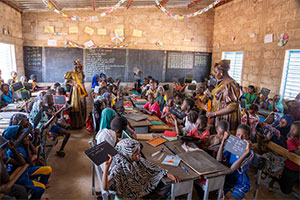 Two teachers work in a classroom in Forces Vives School in Dori, Burkina Faso. Credit: UNICEF/UNI978361
Safe and uninterrupted education is a fundamental right for all children. Education is paramount to global development, as it has been proven that investing in education – especially for girls and children – contributes significantly to economic growth and prosperity. Although more than 1 billion children go to school, many are subjected to conditions that are not conducive to a proper learning environment, including makeshift facilities, a lack of supplies, violence in classrooms, inadequate sanitation, untrained instructors, and widespread school closures. Since 2015, there have been immense gains in education with an increase of 109 million children in school. However, as of 2023, 272 million children are still out of school.
High poverty levels in developing countries also impede children’s access to a proper education. For example, from the early to mid 2000s, Sub-Saharan African nations witnessed a dramatic decline in trained teachers due to inadequate funding in the education sector. Furthermore, major cuts to United States international aid threaten an estimated 23 million additional children's access to education, as USAID‑funded school programmes across Africa and Asia face closure.
Various other factors contribute to the decline of education, notably hunger, which has increased as conflict and climate change interfere with global food production and dissemination. Meanwhile, certain social and cultural practices also impede children’s access to education, with gender inequality, discrimination, child labour, and child marriages preventing millions of children from attending school. Economic conditions such as the inaccessibility of higher education also affect disenfranchised communities across the world. In extreme situations, such as warfare where educational facilities are destroyed in their totality, notably in Gaza and Sudan, entire generations of children might grow up without access to education. Rebuilding educational infrastructure is a long and arduous process, especially when violence persists across generations, and this significantly stunts the development of societal prosperity and stability.
IPS is dedicated to telling the shocking truths about worldwide education through impassioned opinion pieces and comprehensive articles, highlighting global issues that impede worldwide education and the courses of action being taken by organizations such as UNICEF and Education Cannot Wait.

The Week with IPS

NEXT STOP - SDGs
Tracking global progress towards a sustainable world
Tracking global progress towards a sustainable world
