Languages
Saturday, November 7, 2026



News and Views from the Global South
Energy

ENERGY: Protests Greet Nuclear Power Resurgence in US South
Residents and environmental activists are in a bitter dispute with large U.S. energy corporations and the federal government over the safety of nuclear power, as more than a dozen corporations plan to, or have filed, paperwork to open new nuclear power plants, primarily in the U.S. South.CLIMATE-NIGERIA: Inefficient Gas Flaring Remains Unchecked
"The Federal Government policy to stop gas flaring commences on Jan. 1, 2008, and any company which flares gas after that time would be shut down." This was the strong warning from the Nigerian government in October last year to multinational oil companies operating in the country.IRAQ: Fuel Crisis Freezes Life
It's turning out to be about the hardest winter Abu Muslih has known. Too often it's a choice between buying food and medicines, and buying kerosene to keep his children warm.ECONOMY-CHINA: Slipping On High Oil Prices
China’s economic minders have always prided themselves on the fact that despite the country’s insatiable appetite for energy its booming economy has remained largely insulated from fluctuating international oil prices.ENVIRONMENT: U.S. Groups Sue Shell Over Refinery Pollution
U.S. environmentalists took Shell Oil Co. and several of its affiliates to court Monday in a bid to stop pollution from a refining and chemicals plant in the southwestern state of Texas.CENTRAL AMERICA: No Going Back on Growing Trade Ties with China
China is threatening to snatch away Taiwan's last remaining allies in Central America.ENVIRONMENT-SPAIN: Clean Energy, Questionable Business Practices
Renewable energy sources enjoy excellent prospects in Spain, but there are complaints about business practices in the energy sector and the lack of effective enforcement of environmental standards.
ENERGY: German Biodiesel Forced to Compete
Until a few months ago, the production of crop-based fuels was the best energy business imaginable in Germany, thanks to growing demand supported by the government. That's no longer the case.HEALTH: Nuclear Plants Raise Leukaemia Threat
It has been a miserable month for the Brosowskys, a German family in the small city of Marschacht.CHALLENGES 2007-2008: Climate Change Gives Rise to New World Order
Once again, humanity is facing the risk of catastrophe. The terror of destruction by nuclear missiles ready to be launched at the touch of a button has given way to the disturbing possibility of global warming going past the point of no return, and this is turning traditional international coalitions and geopolitical concepts upside down.
CLIMATE CHANGE: Solar Energy Firm Says Carbon Credits Don’t Work
A small but successful solar energy company involved in rural electrification in India is complaining that the Kyoto Protocol’s clean development mechanism (CDM) has been of no practical use to it.INDIA/US: Nuclear Deal – Vienna Has Reservations
As the window of opportunity to complete the United States-India nuclear cooperation deal narrows, the agreement seems to be running into problems with the International Atomic Energy Agency (IAEA), the Vienna-based United Nations body dealing with nuclear matters.CARIBBEAN: Energy Cooperation Sets ‘Example’ for Regional Integration
Cuba and Venezuela are hoping to reinforce their integration strategies at a summit this week through the example of Petrocaribe, a regional energy cooperation agreement that protects less developed countries in the Caribbean from the full impact of today’s soaring oil prices.FINANCE: Prickly Peru Gas Project Gets Key Loan
The Inter-American Development Bank approved key financing Wednesday for a Peruvian bid to become an exporter of gas, over the objections of environmentalists and indigenous people's advocates.ENERGY-SOUTH AFRICA: Food Security Hobbles Biofuel Strategy
Worried that it may be seen as insensitive to the food needs of Africa, the South African government, which is facing a general election in 2009, has chosen food security in framing a biofuel policy.CLIMATE CHANGE: Brazil Announces Voluntary Fund to Protect Amazon
In the context of the United Nations Conference on Climate Change in Bali, Indonesia, Brazil has announced the creation of a voluntary fund to protect the Amazon jungle region, and its decision to adopt national targets to curb deforestation.CLIMATE CHANGE: Biofuels Scarce on Bali Menu
Green groups hoping that the social and environmental cost of biofuels would get an airing at the United Nations climate change conference here are a disappointed lot.CLIMATE CHANGE-MIDEAST: Producers and Victims of Fossil Fuels
As main exporters of greenhouse gas (GhG) producing fossil fuels and potential victims of climate change, the countries of the Middle East find themselves caught in a bind.CLIMATE CHANGE: UN Goes ‘Climate Neutral’
The United Nations announced Wednesday it is joining the growing worldwide effort to go "climate neutral", an acronym for reducing or offsetting any greenhouse gases.CLIMATE CHANGE: Who Pays for Carbon on 'Made in China' Labels?
Standing on the brink of a year when its capital hosts the much-proclaimed ‘Green Olympics’, China is anxious to present a constructive presence at the United Nations climate change conference underway in Bali, Indonesia.ENERGY: Nascent Biofuel Market Has Birth Defects
The development of an international market for crop-based fuels could reduce climate changing gas emissions and mitigate the inflationary impacts of the current euphoria surrounding this energy alternative, but it is a process that will take years.« Previous Page — Next Page »





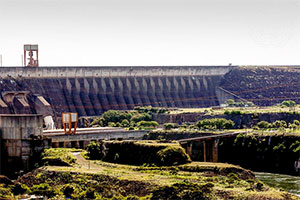 UN Power Plant, Paraguay. Credit: UN Photo/Evan Schneider
Energy has posed a great challenge for economies around the world. As global energy consumption skyrockets throughout the years, so does the need for sustainable solutions. The Sustainable Development Goals are essential in providing people with access to safe, affordable, and sustainable energy sources that minimize harm on the planet. Progress towards these goals opens the door for an advancement in modernization for communities on a global level and allows for a potential mitigation of tensions between nations.
The UN’s Summit of the Future in 2024 offered new initiatives that are being taken to achieve these goals, including a decreased reliance on fossil fuels, a switch to renewable energy sources, and improved climate financing.
IPS is well positioned to provide relevant, insightful, and compelling analysis of recent updates and measures being taken around the world to achieve a cleaner future.

The Week with IPS

NEXT STOP - SDGs
Tracking global progress towards a sustainable world
Tracking global progress towards a sustainable world
