Languages
Saturday, November 21, 2026



News and Views from the Global South
Health
BRAZIL: Controversy Over DWI Law Despite Reduced Deaths
Although Brazil’s tough new drunk driving law has been applauded for cutting traffic deaths in its first month, and is bringing about a change in habits, it continues to face opposition by restaurant and bar owners who will challenge it as unconstitutional in order to get it revoked or at least limit its effects.
CULTURE-SOUTH AFRICA: Made in Khayelitsha, Sold in New York
Entering the Monkeybiz shop, one is confronted with hundreds of brightly coloured beaded animals, dolls, place mats and pictures. You find yourself smiling involuntarily.
HEALTH-SWAZILAND: AIDS Creating a Society in Distress
In a narrow and still winter-brown valley, little more than a crevice between rocky mountains, Gogo Ndlovu looks after her five young orphaned grandchildren.POPULATION-PHILIPPINES: Catholic Church Damns The Pill
As World Population Day was being marked on Jul. 11, Tess and Andy were attending a family planning seminar as a requirement for their forthcoming wedding. It turned out to be window into one of the major problems besetting the Philippine population programme.HEALTH-LEBANON: Cancer On the Rise
Reports of a rising incidence of cancer now worry many families across Lebanon. Over the past 40 years, reported cases of cancer have risen from 3,000 to about 8,000 a year.EGYPT: Locals Step Up Fight Against Factory
Controversy continues to rise over the fate of a Canadian fertiliser plant currently under construction in Egypt's coastal province Damietta. Residents fear it could adversely affect the environment.
HEALTH-MEXICO: Internet Can Be a Dangerous Pharmacy
Mexico is drafting measures to regulate the sales of pharmaceuticals over the Internet: reforms have been announced for laws dating back to the 1980s, when the world wide web did not yet exist, and new monitoring systems are in the works to track the who, how and what of online sales.
Q&A: "Reproductive Rights Can Overcome the Conservative Wave"
This year marks four decades of international recognition of people's right to decide how many children they want to have and when, and for that reason there is a great deal to celebrate, says Brazilian expert Carmen Barroso, of the International Planned Parenthood Federation.HEALTH-TOGO: Increased Drug Use Shadows Growing Trafficking
As the Togolese capital becomes a regional hub for drug trafficking, many drug addicts in Lomé are seeking assistance to kick the habit.HEALTH: Activists Hail US Senate Approval of Major AIDS Bill
AIDS and global health activists are hailing Wednesday's approval by the U.S. Senate of an unprecedented five-year, 48-billion-dollar bill to fight AIDS, malaria, and tuberculosis overseas, particularly in Africa.
DEVELOPMENT: Progress on Water, Less on Sanitation
The number of people globally who lack access to an improved drinking water source has fallen below one billion for the first time since data was compiled in 1990, according to a report released Thursday by the World Health Organisation and UNICEF.DEVELOPMENT-MADAGASCAR: Not Enough Money for Basic Water
Safe drinking water is a scarce resource in Madagascar. Considerable financial investment is needed to improve sanitation and water treatment and distribution for the population of this large island.
POPULATION-INDIA: Emergency Contraception Pill The Answer?
With unintended pregnancies and unsafe abortions continuing to be a serious problem in India, some doctors have begun advocating use of the emergency contraceptive (EC) pill as a possible solution, though conditions in India are regarded far from conducive.
Q&A: Denying Antiretrovirals To Migrants Hurts Us All
South Africa has become a destination for people from across the continent and beyond. But in spite of migrants having a legal right to free antiretroviral treatment (ART) for HIV, they are being turned away from government clinics.HEALTH-US: Unions, Groups Coalesce For Universal Coverage
A coalition of over 100 national and local organisations representing labour unions, doctors, nurses, women, small businesses, religious groups, racial minorities, and think tanks has launched a new campaign in 53 U.S. cities to demand quality, affordable health care for every United States citizen.POPULATION: UN Predicts 12 Billion if Family Planning Falters
The United Nations commemorated World Population Day Friday in the shadow of a staggering array of grim statistics: an estimated 200 million women worldwide want to delay or avoid pregnancy but are not using safe and effective family planning.POPULATION-PAKISTAN: Illegality Inducing Unsafe Abortions
For thousands of Pakistani women, the World Population Day message of ‘Family planning is a right, let’s make it real’’ must sound hollow when they must resort to unsafe, illegal abortions while a debate on whether termination of pregnancy is Islamic or not rages on.
Q&A: Family Planning In Its Infancy in South Sudan
With few roads and almost no health and education infrastructure for the estimated 10 million people of South Sudan - an April census has yet to release any results - health care workers have an enormous task ahead of them.POPULATION-INDIA: One-Child Ideal Catching On
Ponni, 27, lay quiet on a missionary hospital bed in this small town, groggy from the anaesthetic administered to her for a caesarean delivery a couple of hours earlier.
HEALTH-SOUTH SUDAN: Welcome New Attention to Maternal Care
A vast pregnancy has swollen the tiny woman walking South Sudan's shining new maternity ward clutching two pieces of paper stapled together. She looks no more than 16, wide-eyed with recent pain.
ENVIRONMENT: Indians Close Ranks Against Dams in the Amazon
Indigenous communities in Bolivia and Brazil have declared an emergency in response to the construction of the Madera River Hydroelectric Complex, which Brasilia is pursuing even as independent research efforts try to measure the impacts of what will be one of South America's largest energy projects.« Previous Page — Next Page »


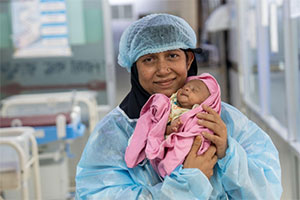 Bangladesh: Sarid, born one month early, receives specialized newborn care and grows stronger every day. Credit: UNICEF/UNI944397/Mojumder
Since the onset of the 2000s, global life expectancy has seen an overall rise, attributed to significant technological and scientific innovations in healthcare. Due to an increased understanding of different conditions as well as a rise in cooperation among healthcare experts around the world, there have been major strides made in ensuring that as few people die from chronic illnesses as possible. Despite the belief that healthcare is a fundamental human right, people from low- or middle-class backgrounds, marginalized groups, and underdeveloped countries have far more limited access to basic healthcare services.
The COVID-19 pandemic showed how marginalized communities are disproportionately affected by health crises, proving that we have much work to do in ensuring that no one dies of terminal conditions. While the global response to the coronavirus saw significant strides in immunization and vaccine development, the global outbreak of mpox in 2022 and its upsurge in parts of Africa in 2024 must remind us to remain vigilant.
Other major disease outbreaks in recent years have been linked to the destruction of infrastructure during warfare. Notably, in 2024, the Gaza Strip witnessed a return of the poliovirus since its eradication in the region 25 years ago. Israel’s blockade on Gaza has resulted in the collapse of the region’s sewage plants and desalination plants, and also destroyed healthcare capacities. The UN stated that this lack of clean water and sanitation would lead to an outbreak of cholera and other deadly infectious diseases. The 2026 OCHA Humanitarian Situation Report confirmed that the over two years of conflict in Gaza has produced a catastrophic health emergency, with millions remaining dependent on relief aid amid tight restrictions and no functioning public health system.
IPS is committed to providing full and comprehensive coverage on healthcare challenges around the world. IPS seeks to address the multifaceted causes of such challenges, including unprecedented pandemics, conflict-driven disease outbreaks, as well as socioeconomic barriers to equal healthcare access. IPS is also dedicated to reporting on innovations in the healthcare industry.

The Week with IPS

NEXT STOP - SDGs
Tracking global progress towards a sustainable world
Tracking global progress towards a sustainable world
