Languages
Thursday, November 19, 2026



News and Views from the Global South
Development & Aid

Governments Cautioned Not to Use COVID-19 Lockdown to Cause Harm
 The United Nations High Commissioner for Human Rights is calling on governments and leaders around the world to ensure that their respective lockdown measurements don’t end up causing harm to people by those enforcing the lockdowns.

Pandemic Lays Bare Africa’s Deficits, but Youth Will Grow the Future
Africa’s frailties have been brutally exposed by the coronavirus pandemic. The virus has reached nearly every country on this continent of 1.3 billion people and the World Health Organization warns there could be 10 million cases within six months. Ten countries have no ventilators at all.
World Press Freedom Day: The Assault on Media Freedom in Asia Worsens During COVID-19 Pandemic
May 3rd marks World Press Freedom Day around the world. During this COVID-19 pandemic, a robust media environment is critical: access to life-saving information is key in the fight against the virus. As governments impose a range of restrictions in attempts to curb the pandemic, journalists help hold authorities to account by providing analysis, engaging in debate about government actions, and creating a space for dialogue about the future we all hope to see.
WORLD PRESS FREEDOM DAY: Journalism Without Fear or Favour
 MEDIA WORLDWIDE is facing crises on multiple fronts, exacerbated by the COVID19 pandemic. Reporters without Borders released its 2020 World Press Freedom Index on April 21st, noting that the Coronavirus is being used by authoritarian governments to implement “shock doctrine” measures that would be impossible in normal times.

Electricity Demand During Lockdown: Evidence from Argentina
Electricity demand normally depends on such variables as retail electricity rates, daytime temperature, time and day of the week, economic activity and consumer type (i.e. residential, commercial, industrial, etc.).
Understanding the Hunger Surge Caused by the COVID-19 Recession to Mitigate It Before It Is Too Late
Many uncertainties haunt the world’s campaign to counter the COVID-19 pandemic, but one thing is now sure: Global economic activity will suffer greatly, with large-scale consequences for the incomes and welfare of all, but especially for the most vulnerable food import-dependent countries.
COVID-19 – How Eswatini’s Garden Farmers are Keeping the Vegetable Supply Flowing
Nobukhosi Cebekhulu (68) and Khetsiwe Tofile (64) are small-scale vegetable farmers who are producing from their permaculture home gardens in Malkerns, Eswatini.Staring at a Human Security Catastrophe
The defining images of South Asia’s battle against Covid-19 are hundreds of thousands of migrants, many with children on their shoulders, trudging from New Delhi, Kathmandu or Dhaka to their far-flung villages. They are daily wage earners engaged in construction, small enterprises, plying rickshaws or street selling in the informal sector. With lockdowns and economic activity shut down to combat the virus, these migrants lost their low-paying jobs and were forced to flee to their rural homes. Those who remained in these cities face food insecurity, rising joblessness and risk falling deeper into poverty.
All-of-Government, Whole-of-Society Involvement Needed to Fight Virus
The Covid-19 pandemic is now widely considered more threatening than any other recent viral epidemic. Most believe that many more have been infected or even died than officially confirmed.
Why Reproductive Rights Must Be a Critical Part of Our Arsenal to Fight Pandemics
Sexual and reproductive health and pandemics might seem to be unrelated topics, but large and dense populations are drivers of the high velocity transmission of COVID-19, and there are lessons to be learned for the future.
COVID-19 Stimulus Measures Must Save Lives, Protect Livelihoods, and Safeguard Nature to Reduce the Risk of Future Pandemics
There is a single species that is responsible for the COVID-19 pandemic - us. As with the climate and biodiversity crises, recent pandemics are a direct consequence of human activity – particularly our global financial and economic systems, based on a limited paradigm that prizes economic growth at any cost. We have a small window of opportunity, in overcoming the challenges of the current crisis, to avoid sowing the seeds of future ones.
Ensuring Russia’s Sex Workers’ Rights Essential for Wider Gender Equality
Despite seeing a shift in attitudes towards them in recent years, Russian sex workers say they continue to struggle with marginalisation and criminalisation which poses a danger to them and the wider public.
Thandika Mkandawire, Pan-Africanist Par Excellence
Thandika Mkandawire (1940-2020) had a wicked sense of humour. But he was so considerate that he often made himself the butt of his jokes which typically had a moral. When others struggled to pronounce his surname, he would help them out, “Me kinda weary”.
SDGs: the Challenge to Improve Lives After the COVID-19 Crisis
The SDGs, with their universal scope, interlinked nature and focus on leaving no one behind will be more essential than ever during and after this crisis.
Coronavirus Shows the Urgency of Ensuring that Research gets into the Public Domain
Following the outbreak and declaration of COVID-19 as a global pandemic, there has been a flurry of scientific research and publications to address challenges posed by the virus. Publications have risen exponentially over the past few months as scientists work tirelessly to find out more about the pandemic, and the SARS-CoV-2 virus causing it.
Post-Pandemic Mental Health Epidemic
The number of Nepalis suffering from mental health issues is increasing with the prolonged COVID-19 lockdown, and the lack of treatment and counselling means the country may be facing an epidemic of psychosocial disorders.
Why Covid-19 Choices Are Critical for Children
Children may escape the worst symptoms of Covid-19 and suffer lower mortality rates, but for millions, the pandemic will have devastating effects.
COVID-19: India’s Harvests also Locked Down
Heartbreaking images of Indian farmers standing amidst swathes of rotting vegetables, fruits and grain have been flooding newspapers and TV screens lately. Crashing prices and transport bottlenecks due to the 40-day coronavirus lockdown in India, on till May 3, have driven some to set their unsold produce ablaze.
Why the International Day of Multilateralism Must Start a New World Order
In our current COVID 19 context of suffering and fear, that may sound like a strange and spooky quote. But let’s be clear: what we have achieved so far in the present is not - and shouldn’t be - indicative of what we can achieve in the future.
Children under Lockdown get a ‘Learning Passport’
Soon schools in Timor-Leste, Ukraine, and Kosovo, where some 6.5 million children are currently at home, will hopefully start teaching their children once again -- albeit online.
Autonomous Resourcing: the Engine Room of Feminist Work Amid a Global Pandemic
Feminist responses to COVID-19 have been swift, insightful, and numerous. There have been webinars (so.many.webinars), twitter threads, illustrations, press releases and policy recommendations, and online house parties. Analysis pieces cover everything from the gendered impacts of COVID-19 to how to work remotely to the role of neoliberal capitalism.« Previous Page — Next Page »


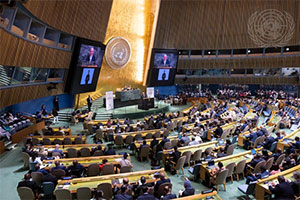 2026 High-level Political Forum on Sustainable Development. Credit: UN Photo/Eskinder Debebe
In 2015, the United Nations and its Member States adopted the Sustainable Development Goals (SDGs) in an effort to make the world a more sustainable and peaceful place for future generations. Progress on the 17 SDGs has been uneven, and inequality persists across the globe. 10 years after adoption, the 2025 UN SDGs Report revealed that only 35% of the SDG targets are on track, with more than half moving too slowly, and 18% moving backwards from the 2015 baseline. Poverty remains one of the world’s most pressing issues, with hunger, violence, and inequality impeding the opportunities for all people to achieve success. In September 2024, the United Nations Summit of the Future introduced a new goal: to eradicate global poverty by 2030, ensure universal rights to basic services, and increase the overall standard of living in terms of industrialization, economic well-being, citizen health, and literacy. Furthermore, recent shifts in United States foreign aid policy – notably, major budget cuts to USAID and the termination of thousands of development programmes– have severely threatened vital lifelines of financial aid to impoverished communities around the world. Additionally, the United States’ withdrawal from the Paris Climate Agreement has undercut international efforts at sustainable development. With the upcoming 2030 deadline, the UN Secretary-General has called for urgent multilateralism across six priority areas: food systems, energy, digital connectivity, education, jobs and social protection, and climate and biodiversity. IPS sheds light on marginalized communities that struggle on a daily basis to survive and have their stories heard and respected.
Updated by Yilan Batista and Shuli Wong August 2026

The Week with IPS

NEXT STOP - SDGs
Tracking global progress towards a sustainable world
Tracking global progress towards a sustainable world
