Languages
Saturday, October 3, 2026



News and Views from the Global South
Population

‘Stone-Age’ Donkey-Drawn Carts Ply Zimbabwe’s Abandoned Remote Routes
From the Masvingo-Beitbridge highway in Zimbabwe at a spot popularly known as Turn-P, the road passing through Neshuro Township has been degraded, disused, and derelict for over two decades, with buses avoiding the route. Now donkey-drawn carts that operate alongside jalopy vehicles have become the new alternative for remote travellers around Mwenezi villages.
Parliamentarians Pledge to Act on Grim Realities of Child Marriage, Gender-Based Violence
Child marriage, gender-based violence (GBV), sexuality education, religion, and tradition came under the spotlight during a conference, Arab and Asian Parliamentarians’ Meeting to Follow-Up on ICPD25 Commitments: Addressing Youth Empowerment and Gender-Based Violence, held in Jakarta, Indonesia.
Pandemic Accord Text Falls Short of Expectations
As countries recently gathered in Geneva for the fourth round of negotiations on the WHO proposed pandemic treaty or accord, close examination of the current text by civil society experts has revealed significant gaps.
Breaking the Link between ‘Polycrisis’ and Poverty
This year marks the halfway point— eight years in and eight years out— of the UN Sustainable Development Goals to end poverty and reduce inequalities.
International Women’s Day, 2023
Women and Girls: Innovation and Higher Education
In September 2020, the Beijing Declaration and Platform for Action for women’s rights celebrated its 25th anniversary. It was, however, a bittersweet commemoration, mixing joy for the progress in gender equality achieved since 1995, and the stark realization about the multidimensional gaps awaiting tackling and the new divides brought by the social consequences of COVID-19.

Parliamentarians Tackle Youth Employment, SRHR in Post-COVID Asia and Pacific
With more than 600 million youth aged between 18 and 24 in the Asia and Pacific region, putting their issues front and center is crucial. Speakers at a recent forum, Youth Empowerment: Education, Employment and Sexual and Reproductive Health and Rights, held in Phnom Penh, Kingdom of Cambodia, agreed that policy development and implementation should be youth-centered.
International Women’s Day, 2023
Digital Inclusion is Vital for Strengthening Women’s Rights in Africa
The internet has a pivotal role to play in empowering women and girls across Africa, but preexisting forms of gender discrimination and marginalization are underpinning a widening digital gender divide.

International Women’s Day, 2023
First Ever Women Council of Elders Making In-roads in North Eastern Kenya
Low literacy levels, a high prevalence of outlawed Female Genital Mutilation, early marriages, forced marriages, low contraceptive usage, multiple births, as well as high maternal, infant and child deaths, define the life of a woman in Kenya’s vast North Eastern region. 
International Women’s Day, 2023
The Power of Technology—& the Increased Exclusion, Inequalities & Gender Discrimination
Since the onset of the COVID-19 pandemic, the tremendous power of technology and innovation has become clear to the world.
However, it has also increased exclusion, discrimination, and inequalities -- especially for women and girls.

International Women’s Day, 2023
Promoting Gender Equality and Closing the Digital Divide
The accelerating pace of digitalization has ushered humanity into a whole different era of information and communication. Today, digitalization permeates every aspect of our lives, socio-economically and politically.

International Women’s Day, 2023
Her Land, Her Rights: Advancing Gender Equality & Land Restoration Goals
When it comes to land, gender inequalities are pervasive. Today, nearly half of the global agricultural workforce is female – yet less than one in five landholders worldwide are women 1.

International Women’s Day, 2023
To Strengthen Women’s Resilience to Disasters, Make Wealthiest Pay Their Fair Share
She will be called Aya. This is the name that nurses gave to the infant baby pulled from the rubble of a five-story building in Jinderis, northern Syria. A miracle. Beside her, the rescuers found her mother, dead.

International Women’s Day, 2023
A New Global Architecture to Defend & Promote Rights of Women & Girls
If you want to have a good reading on women and young girls’ activism, there is a high chance that you have missed an incredibly interesting report.

Rising Food Prices, Ongoing Energy Crisis Place South Africa at Risk
South Africa’s almost record level food price inflation, load shedding, rising energy costs, and further fuel and interest rate hike forecast have eroded workers’ disposable incomes and further disadvantaging the poor – leaving analysts predicting that the country was at heightened risk, including civil unrest.
International Women’s Day, 2023
Unleashing Our Region’s Most Untapped Potential: Harnessing the Digital Age to Empower Women & Girls
New technologies and innovations are reshaping our world and its future, often at a dizzying pace. Yet women and girls continue to be left behind in this burgeoning digital universe. How, then, can we harness these developments to create a better future for all of us?

Venezuela Drafts Legal Stranglehold on NGOs
The Venezuelan parliament, in the hands of the ruling party, is moving towards passing a law to control non-governmental organizations (NGOs) so that, in practice, they could not exist independently.
BRAC ‘Resets’ Program Aimed at Empowering Adolescent Girls in Africa
BRAC’s Empowerment and Livelihood Program (ELA) has benefitted tens of thousands of girls, and its recently released report shows an organization willing to adapt to the circumstances to continue to ensure adolescent girls and young women receive meaningful sexual and reproductive health rights support.
Pakistan’s Free Healthcare Insurance Benefits Women, Poor
A free health insurance initiative started in Pakistan has benefited poor patients, especially women who have outnumbered men in using the cashless health services under the Sehat Card Plus programme. "The initiative is in line with the ICPD25 Programme of Action, under which 4.5 million people have received free services, with 62 percent of them women. In the last three years, we have been able to cut down maternal mortality rate from 186 deaths per 100,000 live births to 172," Dr Muhammad Riaz Tanoli, CEO of the Sehat Card Plus (SCP), told IPS.
A Vital Partnership for the 2030 Agenda
Flexible and predictable funding allows UN agencies to respond promptly and with agility in times of crisis. In countries such as Afghanistan, Yemen, and Ukraine, UNDP implements projects and programmes that help protect livelihoods and enhance the resilience of vulnerable communities.
Fear of Population Ageing
Fear of population ageing is all over the news media and in government offices of country capitals worldwide. Planet Earth is becoming “planet ageing”.
Privilege and Centralism in Lima Goad Protesters in Peru
The current political and social upheaval in Peru is not a temporary problem, but has to do with deeply-rooted inequality and social hierarchies, according to historian José Carlos Agüero.« Previous Page — Next Page »


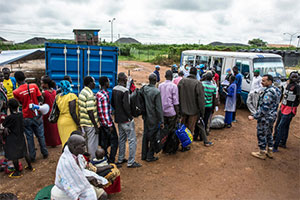 One Thousand Internally Displaced Persons (IDPs) Relocated from Tomping Camp in South Sudan. Credit: UN Photo/Isaac Billy
It took hundreds of thousands of years for the world’s human population to cross one billion in 1804. Approximately 200 years later, the population has multiplied sevenfold. In 2023, the global population crossed 8 billion, and is expected to reach 9 billion before 2050. With the planet more crowded than ever, it is essential to keep track of population trends, urbanization, migration, and reproduction across the world.
Life expectancy has seen significant strides in the past century, largely due to economic development and increased standards of living. On the contrary, trends in global fertility are shifting, with certain regions in Africa and Asia reporting higher rates, while parts of Europe and North America report stagnant or lower rates. This is in part due to differences in sexual and reproductive healthcare, as well as societal and economic conditions around the world. For example, child marriage is prevalent in certain societies, where childbearing is also considered a familial duty. Meanwhile, stagnating economies frequently experience lower marriage and childbearing rates.
The increase in migration and urban development around the world is also linked to global population trends. By 2050, it is expected that approximately 66 percent of all people will live in cities. Furthermore, global crises such as warfare and natural disasters also prompt transnational migration. Transnational migration is linked to a variety of socioeconomic issues in both host and receiving countries: migrants often leave developing countries with less access to educational and economic opportunities and arrive in developed countries where they are frequently the targets of ethnic, racial, and cultural discrimination, and economic exploitation. Recent crises in Europe and the United States demonstrate the importance of advocating for migrants worldwide. As migrants from the Global South are increasingly stripped of their legal and civic rights in unlawful deportations, or targeted in acts of identity-based violence, it is essential to keep track of population trends and protect the human rights of migrant populations. Climate-related disasters are now a major driver of displacement, with nearly half of all new internal displacements in 2025 being disaster-related.
IPS is devoted to covering issues surrounding population trends, migration, and reproduction through its compelling articles, which use both statistics and human stories to provide readers with robust and informative viewpoints.

The Week with IPS

NEXT STOP - SDGs
Tracking global progress towards a sustainable world
Tracking global progress towards a sustainable world
