Languages
Saturday, October 3, 2026



News and Views from the Global South
Population

Bhutan’s Civil Servants are Building a Digital Government System — Here’s How
New UNCTAD software does to digital government what IKEA did to furniture, allowing Bhutan’s government employees to create their own user-friendly services for citizens online.
In Latin America’s Aging Population, 17 Percent Will Be Over 65 by 2050
Latin America and the Caribbean is no longer a young region and it will be one of the regions with the largest aging populations by 2050, which poses great challenges due to the social inequalities the countries face, but also opportunities to overcome them.
Population Decline Hysteria & More Ponzi Demography
China’s announcement on 17 January 2023 that its population had declined for the first time in 60 years has fostered population decline hysteria and promoted more Ponzi demography in many parts of the world.
Demography Doesn’t Care
Demography doesn’t care about such things as national strikes over pension retirement ages, public protests about contraception and abortion rights, sexual orientation, habits and preferences, political ideology and party affiliation, dress codes and head coverings, and religious identity, beliefs and practices.
Africa’s Maternal Deaths Need Urgent Action to Meet SDG Goals
As the effects of COVID-19 on Africa’s health sector become clearer, it looks the continent will need to take urgent steps to overcome the disruptions suffered in the breakdown in antenatal and postnatal care for women and newborns and neonatal intensive care units. The pandemic brought some setbacks to the gains achieved in maternal mortality over the past decade.
Digitizing Africa: Key to Stronger Institutions
I recently overheard a conversation among three young people at a café in an African city. It was a passionate discussion on the management of funds allocated to the COVID-19 response and the effectiveness of the mechanisms in place to manage the money to achieve the intended purposes.
Raising Retirement Age Coming Soon
Despite the objections, resistance and protests taking place in many countries around the world, raising the official retirement age to receive government provided pension benefits is coming soon.
The Digital Divide: Africa the Least Connected with 60 percent of the Population Offline
The digital divide – between the world’s rich and poor nations —remains staggeringly wide. For over 2.7 billion people, many of them living in developing and least developed countries (LDCs), meaningful connectivity remains elusive, according to a UN report released during the 17th Internet Governance Forum in Addis Ababa, last month.
A Little Land Helps Indigenous Venezuelans Integrate in Brazil
A group of Warao families are, through their own efforts, paving the way for the integration of indigenous Venezuelans in Brazil, five years after the start of the wave of their migration to the border state of Roraima.
Illegal Immigration: A Mounting Global Crisis
Illegal immigration has evolved into a mounting crisis for a growing number of countries worldwide and governments appear to be at a loss on how to deal with the crisis.
Digital Human Rights Need to be Enshrined in Law
The upcoming consultation on the Global Digital Compact presents a unique opportunity to ensure that human rights in the digital world are protected in international common standards.
The World Cup of Opportunity
The sun is shining, and the temperature sits at an idyllic 28 degrees Celsius. The Uber driver taking me to work is from Pakistan and devastated about the recent loss to England in the T20 Cricket World Cup final in Australia.
Balancing Diversity and Meritocracy
Countries worldwide, and as different as India, Indonesia, Iraq, Iran, Ireland, Israel and Italy, are struggling with the issue of how best to balance diversity and meritocracy across disparate ethnic, racial, caste, linguistic and religious subgroups in their populations.
As the World’s Population Hits 8 Billion People, UN Calls for Solidarity in Advancing Sustainable Development for All
The global population is projected to reach 8 billion on 15 November 2022, signalling major improvements in public health that have lowered the risk of dying and increased life expectancy. But the moment is also a clarion call for humanity to look beyond the numbers and meet its shared responsibility to protect people and the planet, starting with the most vulnerable.
A World of 8 Billion: Population Growth Will Continue But it’s Slowing Down
Global population is about to reach 8 billion, a mere 11 years after it reached 7 billion. The official Day of 8 Billion is observed by the UN November 15, though it's hard to pinpoint exactly when we pass the actual milestone.
World Population after 8,000,000,000
Contrary to the often-cited hype and nonsense of some celebrities reported in the news media, the world’s population of 8,000,000,000 human beings is not going to collapse any time soon.
A Tale of Cities
For decades, urban practitioners have failed to consider the needs of women in city decision-making and planning. Imagine being a young girl in a bustling metropolis.
U.S. Political Divides on Demographic Issues
Given the upcoming midterm elections in the United States and the consequences of the outcome for domestic legislation and programs as well as the country’s foreign policy, it’s useful and fitting to review fundamental differences between America’s two major political parties on vital demographic issues.
Time is Running Out for Decisions on Debt Relief as Countries Face Escalating Development Crisis
Developing low- and middle-income economies are taking hard hits from global economic developments outside their control. Monetary tightening in advanced economies coupled with increasing fears of a global recession have weakened currencies, sent interest rates soaring, and investors fleeing.
With Planning Aging Population Could Result in a Silver Dividend
An aging population needn’t be a burden, experts told Parliamentarians at a conference co-hosted by UNFPA Asia Pacific Regional Office and the Asian Population and Development Association (APDA).
Demography of the Israeli-Palestinian Conflict
Demography is at the heart of the Israeli-Palestinian conflict as well as the fundamental obstacle to achieving to what each side has long desired: “שָׁלוֹם”, “سلام”, or “peace”.« Previous Page — Next Page »


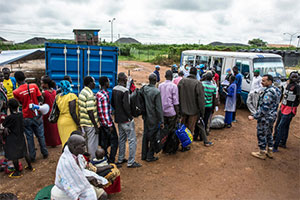 One Thousand Internally Displaced Persons (IDPs) Relocated from Tomping Camp in South Sudan. Credit: UN Photo/Isaac Billy
It took hundreds of thousands of years for the world’s human population to cross one billion in 1804. Approximately 200 years later, the population has multiplied sevenfold. In 2023, the global population crossed 8 billion, and is expected to reach 9 billion before 2050. With the planet more crowded than ever, it is essential to keep track of population trends, urbanization, migration, and reproduction across the world.
Life expectancy has seen significant strides in the past century, largely due to economic development and increased standards of living. On the contrary, trends in global fertility are shifting, with certain regions in Africa and Asia reporting higher rates, while parts of Europe and North America report stagnant or lower rates. This is in part due to differences in sexual and reproductive healthcare, as well as societal and economic conditions around the world. For example, child marriage is prevalent in certain societies, where childbearing is also considered a familial duty. Meanwhile, stagnating economies frequently experience lower marriage and childbearing rates.
The increase in migration and urban development around the world is also linked to global population trends. By 2050, it is expected that approximately 66 percent of all people will live in cities. Furthermore, global crises such as warfare and natural disasters also prompt transnational migration. Transnational migration is linked to a variety of socioeconomic issues in both host and receiving countries: migrants often leave developing countries with less access to educational and economic opportunities and arrive in developed countries where they are frequently the targets of ethnic, racial, and cultural discrimination, and economic exploitation. Recent crises in Europe and the United States demonstrate the importance of advocating for migrants worldwide. As migrants from the Global South are increasingly stripped of their legal and civic rights in unlawful deportations, or targeted in acts of identity-based violence, it is essential to keep track of population trends and protect the human rights of migrant populations. Climate-related disasters are now a major driver of displacement, with nearly half of all new internal displacements in 2025 being disaster-related.
IPS is devoted to covering issues surrounding population trends, migration, and reproduction through its compelling articles, which use both statistics and human stories to provide readers with robust and informative viewpoints.

The Week with IPS

NEXT STOP - SDGs
Tracking global progress towards a sustainable world
Tracking global progress towards a sustainable world
