Languages
Saturday, October 3, 2026



News and Views from the Global South
Population

India’s Rising Population & its March Towards World’s Second Largest Economy
This year, India surpassed China as the world’s most populous nation. China is expected to overtake the US as the world’s largest economy by 2035, but its population will likely continue to decline, while India’s will continue to grow.
Lawmakers’ Vital Roles in Ensuring Dignity for Aging Populations
Countries with falling population growth face twin dilemmas: Ensuring their aging population live healthy and fulfilling lives and removing barriers to parenthood. This was the focus of a recent workshop in Thailand reviewing the ICPD30 process and preparation for the Summit for the Future slated for next year (2024).
The Race Question in America’s Population Census
With preparations for America’s 2030 population census underway and the Census Bureau encouraging additional public input, it’s time to seriously evaluate the continued inclusion of the race question in the U.S. population census.
Wood Smoke Continues to Make Women Sick in El Salvador
Using a few dry sticks as fuel, Margarita Ramos of El Salvador lit the fire in her wood stove and set about frying two fish, occasionally fanning the flame, aware that the smoke she inhaled could affect her health.
Women in Peru’s Poor Urban Areas Combat the Crisis at the Cost of Their Wellbeing
At five in the morning, when fog covers the streets and the cold pinches hard, Mercedes Marcahuachi is already on her feet ready to go to work in Pachacútec, the most populated area of the municipality of Ventanilla, in the province of Callao, known for being home to Peru's largest seaport.
Medical Abortion Expands Women’s Rights in Argentina
Viviana Mazur is a doctor at the Santojanni Hospital in Mataderos, a working-class neighborhood in Buenos Aires. She has witnessed the advances in women's rights in Argentina, where until 2020 abortion was only allowed on two grounds, while it is now available on demand up to 14 weeks of pregnancy.
Addressing the Scandal of Invisibility in Asia & the Pacific
Each year, the births of 64 million children under the age of five and deaths of 8.4 million people are invisible to governments in Asia and the Pacific. Most countries in the region are yet to achieve universal civil registration, leaving many people without a legal identity and, as a result, invisible to the State.
Healthy Homes – A Right of Rural Families in Peru
Adopting a “healthy housing” approach is improving the living conditions of rural Peruvian women like Martina Santa Cruz, a 34-year-old farmer who lives with her husband and two children in the village of Sacllo, 2,959 meters above sea level in the Andes highlands municipality of Calca.
Menstrual Health and Hygiene Is Unaffordable for Poor Girls and Women in Latin America
Menstrual hygiene management is elusive for millions of poor women and girls in Latin America, who suffer because their living conditions make it difficult or impossible for them to access resources and services that could make menstruation a simple normal part of life.
Population Denialism is Reminiscent of Climate Denialism
A new study estimates that global heating will push billions of people outside the comfortable range of temperature and weather in which we have evolved.
Population Growth is Not Good for People or the Planet
India’s population has just reached 1.4 billion people, surpassing China as the world’s most populous nation four years earlier than projected. Spurring this growth is a traditional patriarchal culture in which women’s identity is constrained by the social expectation they bear children.
Parliamentarians Ask G7 Hiroshima Summit to Support Human Security and Vulnerable Communities
Parliamentarians from more than 30 countries agreed to send a strong message to the G7 Hiroshima Summit in Japan later this year, focusing on human security and support of vulnerable communities, including women, girls, youth, aging people, migrants, and indigenous people, among others.
Mercury Project Puts Great UNEP Treaty at Risk
The Minamata Convention on Mercury, a stellar success story to date, has been favorably compared to the prototype success story for a treaty on toxins: the Montreal Protocol. Both had a single focused mission; both gained universal support across the globe; both matched technological innovation with environmental science to discard old polluting methods.
During Ramadan Let’s Focus on Solidarity with Future Generations
As Ramadan continues through next week, the world’s 2 billion Muslims will focus on the core values of the holy month: helping the poor and committing oneself to the service of others.
At the Mercy of the Algorithm
Excessive reliance on algorithmic management has raised concerns regarding its opaque decision-making mechanisms and implication for workers.
Platitudes not Enough: Urgent Investment Needed in Health Workforce
As World Health Worker Week draws to a close on April 7, health organizations from around the world have been celebrating women’s vital role in the health workforce and sharing stories about the enormous value they bring to all areas of health and care.
US Lagging Behind on Funding International Family Planning & Reproductive Health
International family planning and reproductive health (FP/RH) are critical to achieving gender equity, but U.S. investment in them is not nearly sufficient to meet the moment.
Yes, Lower The Retirement Ages!
Yes, lower the retirement ages! That is the key message that workers worldwide are conveying to their governments.
Africa’s Dark Road to Democracy
The dark road to democracy began with the manner in which the Kenyan Presidential election of August 2022 was handled. Today, the Church in Kenya is calling for dialogue between the ruling regime and the opposition. The issue here is not about dialogue, but the legitimacy of the President William Ruto. The situation in Kenya reminds me of a similar situation in Rwanda in early 90s.
Venezuela Makes Timid Headway in Solar Energy
The installation of solar panels in a remote village in the Andes highlands in late February marked a second incursion by the Venezuelan government into the field of solar energy, previously uncharted territory in this country that for a century was a leading global oil producer.
Health – It’s Time for Women to Lead the Sector
Women health workers are more than two thirds of the health workforce and represent 90% of the world’s frontline health workers, yet hold less than a quarter of senior leadership roles - a situation which is unfair and a significant risk for global health security.« Previous Page — Next Page »


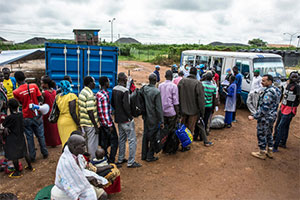 One Thousand Internally Displaced Persons (IDPs) Relocated from Tomping Camp in South Sudan. Credit: UN Photo/Isaac Billy
It took hundreds of thousands of years for the world’s human population to cross one billion in 1804. Approximately 200 years later, the population has multiplied sevenfold. In 2023, the global population crossed 8 billion, and is expected to reach 9 billion before 2050. With the planet more crowded than ever, it is essential to keep track of population trends, urbanization, migration, and reproduction across the world.
Life expectancy has seen significant strides in the past century, largely due to economic development and increased standards of living. On the contrary, trends in global fertility are shifting, with certain regions in Africa and Asia reporting higher rates, while parts of Europe and North America report stagnant or lower rates. This is in part due to differences in sexual and reproductive healthcare, as well as societal and economic conditions around the world. For example, child marriage is prevalent in certain societies, where childbearing is also considered a familial duty. Meanwhile, stagnating economies frequently experience lower marriage and childbearing rates.
The increase in migration and urban development around the world is also linked to global population trends. By 2050, it is expected that approximately 66 percent of all people will live in cities. Furthermore, global crises such as warfare and natural disasters also prompt transnational migration. Transnational migration is linked to a variety of socioeconomic issues in both host and receiving countries: migrants often leave developing countries with less access to educational and economic opportunities and arrive in developed countries where they are frequently the targets of ethnic, racial, and cultural discrimination, and economic exploitation. Recent crises in Europe and the United States demonstrate the importance of advocating for migrants worldwide. As migrants from the Global South are increasingly stripped of their legal and civic rights in unlawful deportations, or targeted in acts of identity-based violence, it is essential to keep track of population trends and protect the human rights of migrant populations. Climate-related disasters are now a major driver of displacement, with nearly half of all new internal displacements in 2025 being disaster-related.
IPS is devoted to covering issues surrounding population trends, migration, and reproduction through its compelling articles, which use both statistics and human stories to provide readers with robust and informative viewpoints.

The Week with IPS

NEXT STOP - SDGs
Tracking global progress towards a sustainable world
Tracking global progress towards a sustainable world
