Languages
Tuesday, November 10, 2026



News and Views from the Global South
Population

POPULATION-US: More People Call the Streets Home
At last November's Republican presidential debate in St. Petersburg, Florida, activists trying to draw attention to the city's homeless problem were discreetly corralled away from the candidates by a perimetre fence.MIGRATION-US: Asylum Cases Hinge More on Luck Than Law
In January 2006, on the heels of reports of widespread incompetence, injustice, and political cronyism among the judges who decide the fate of thousands of immigrants seeking asylum in the United States, then Attorney General Alberto Gonzales announced a sweeping review of the entire asylum process.
AFGHANISTAN: Unable To Cope With Returning Refugees
The rate of return of refugees to Afghanistan from neighbouring countries is causing tremendous stress to the Afghan government and society, government officials here say.IRAQ: ‘Not Our Country To Return To’
More Iraqis continue to flee their country than the numbers returning, despite official claims to the contrary.
DEVELOPMENT: A Humanitarian Disaster Unfolds in Eastern DRC
In a mist-shrouded valley between the Mount Nyiragongo volcano and a pair of its dormant cousins looming in Rwanda to the east, nearly 3,000 souls wait in limbo, having fled a conflict that has succeeded in making this lush corner in eastern Democratic Republic of Congo (DRC) nothing less than hell on earth for its people.
DEVELOPMENT-ZIMBABWE: Full Dams Do Not Translate Into Water Supplies
Heavy rains in Zimbabwe and in the catchment areas of its major rivers in December and January have filled most of the country’s dams to capacity. Yet, many urban households do not have water.RIGHTS-BELGIUM: Bon Voyage, Past That Barbed Wire
Barbed wire is not something most people notice when they take a plane from Brussels International Airport. Yet ominous coils of it surround one cluster of buildings within this vast complex. It is here in Centre 127 that asylum-seekers are welcomed to Belgium with a lock and a key.
AFGHANISTAN: Ousted By Iran, Afghan Refugees Languish At Home
Thousands of Afghan refugees, forcibly repatriated by Iran, have been living in makeshift camps across Afghanistan.RIGHTS-AUSTRALIA: Apology To Stolen Generations – A Good Start
Prime Minister Kevin Rudd’s recent apology to indigenous Australians, for the wrongs and injustices inflicted upon them by the policies of past governments, was momentous. But other indigenous issues are yet to be resolved.RIGHTS: Gender Equality Gets a Drop of the Funding Bucket
The United Nations has never run out of statistics to reinforce its arguments against one of the most troubling issues the world over: gender discrimination.IRAQ: In Tatters Beneath a Surge of Claims
What the U.S. has been calling the success of a "surge", many Iraqis see as evidence of catastrophe. Where U.S. forces point to peace and calm, local Iraqis find an eerie silence.SOLOMON ISLANDS: Demand For Women Legislators High
Women’s rights advocates in the Solomon Islands are urging their government to act on the findings of a recent survey which show that 89 percent of respondents want more women in Parliament.HEALTH: Most Malnourished Children Aided Too Late
Prevention may be the best medicine of all when it comes to tackling childhood malnutrition, according to a study published this week in the leading medical journal The Lancet.HEALTH-ARGENTINA: Juicy Hamburgers Threaten Young Kidneys
Famed as one of the world’s leading beef producers, Argentina holds the unfortunate record for the highest incidence of Hemolytic Uremic Syndrome (HUS), an infectious disease caused by bacteria present in incompletely cooked foods, such as hamburgers.CENTRAL AMERICA: Gangs Flourish as 'Zero Tolerance' Measures Fail
Around 40 percent of the members of youth gangs in El Salvador, Guatemala and Honduras are women, according to a new study that says governments have failed in their struggle against these groups that are employed as "labour power" by drug traffickers and organised crime.CUBA: Socialism Through the Prism of the Generation Gap
A large majority of Cubans have never lived under any system but the government of Fidel Castro, but one-quarter of the population grew up over the last two decades of economic crisis, a period in which enthusiasm for the achievements of the revolution has been dampened by concerns over day-to-day problems, like difficulties in access to basic products.LABOUR: ‘Migrants More Likely To Be Overqualified’
Rich countries must do more to integrate migrants into their societies and labour markets if they want to reap the economic benefits of skilled migration, says an OECD report released in Paris Wednesday.EGYPT: Border Breach Raises Fundamental Questions
Authorities sealed the border with the Gaza Strip earlier this month after more than a half million Palestinians flooded into Egypt's Sinai Peninsula in late January. But while most have since returned home, the episode served to highlight Egypt's tenuous control over its border with the troubled territory next door.LATIN AMERICA: Gender Stereotypes Still Firmly Entrenched, Despite Progress
Constructing gender equality in Latin American societies remains an apparently arduous task. The issue is still confined to the ivory towers of academia, far away from the media, and is seldom included in the debates that really capture people’s attention.PERU: Poverty Provides Growing Number of ‘Drug Mules’
Anti-drug police at Peru’s "Jorge Chávez" international airport in Lima have had their hands full over the last year, arresting nearly two "mules" a day, each carrying an average of five kg of pure cocaine.
CAMEROON: Shelter, Medical Attention for Chadian Refugees
The situation of thousands of Chadian refugees who have fled to the north Cameroonian town of Kousseri continues to be a source of concern to aid workers, although the picture is not uniformly dismal.« Previous Page — Next Page »





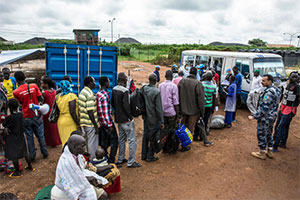 One Thousand Internally Displaced Persons (IDPs) Relocated from Tomping Camp in South Sudan. Credit: UN Photo/Isaac Billy
It took hundreds of thousands of years for the world’s human population to cross one billion in 1804. Approximately 200 years later, the population has multiplied sevenfold. In 2023, the global population crossed 8 billion, and is expected to reach 9 billion before 2050. With the planet more crowded than ever, it is essential to keep track of population trends, urbanization, migration, and reproduction across the world.
Life expectancy has seen significant strides in the past century, largely due to economic development and increased standards of living. On the contrary, trends in global fertility are shifting, with certain regions in Africa and Asia reporting higher rates, while parts of Europe and North America report stagnant or lower rates. This is in part due to differences in sexual and reproductive healthcare, as well as societal and economic conditions around the world. For example, child marriage is prevalent in certain societies, where childbearing is also considered a familial duty. Meanwhile, stagnating economies frequently experience lower marriage and childbearing rates.
The increase in migration and urban development around the world is also linked to global population trends. By 2050, it is expected that approximately 66 percent of all people will live in cities. Furthermore, global crises such as warfare and natural disasters also prompt transnational migration. Transnational migration is linked to a variety of socioeconomic issues in both host and receiving countries: migrants often leave developing countries with less access to educational and economic opportunities and arrive in developed countries where they are frequently the targets of ethnic, racial, and cultural discrimination, and economic exploitation. Recent crises in Europe and the United States demonstrate the importance of advocating for migrants worldwide. As migrants from the Global South are increasingly stripped of their legal and civic rights in unlawful deportations, or targeted in acts of identity-based violence, it is essential to keep track of population trends and protect the human rights of migrant populations. Climate-related disasters are now a major driver of displacement, with nearly half of all new internal displacements in 2025 being disaster-related.
IPS is devoted to covering issues surrounding population trends, migration, and reproduction through its compelling articles, which use both statistics and human stories to provide readers with robust and informative viewpoints.

The Week with IPS

NEXT STOP - SDGs
Tracking global progress towards a sustainable world
Tracking global progress towards a sustainable world
