Languages
Thursday, November 12, 2026



News and Views from the Global South
Population
US: Thousands of Latin American Immigrants Among Katrina’s Victims
Thousands of Latin American immigrants are among those left homeless by Hurricane Katrina in the southern United States, and at least three have died. But although governments and social organisations from the region have offered help, they have run into restrictions set by Washington.MILLENNIUM GOALS: A Step Backwards for Women, Say Activists
Women's rights activists in Brazil say the Millennium Development Goals (MDGs) are narrower than the objectives adopted at international conferences in the 1990s.MILLENNIUM GOALS: Burma Must Tackle TB and HIV
For over 15 years a clinic in Mae Sot, a town along Thailand's north-western border, has offered a glimpse into how widespread tuberculosis (TB) is in neighbouring Burma.POLITICS-US: Katrina Exposes the “Third World” at Home
As thousands of people in New Orleans approach their fifth day without food, water or shelter, the news media and, doubtless, millions of ordinary citizens are wondering how state and particularly federal authorities could have been so slow to respond to one of the worst natural disasters in U.S. history.ECONOMY: U.S. Faces Rising Flood of Poverty
"The rich got richer and the poor got poorer" is a sentence most often used to describe the economic plight of underdeveloped countries.LABOUR-MEXICO: A Step Away from Slavery
Angélica came to the Mexican capital five years ago to work as a domestic. Although her employer says the young indigenous woman is like a "daughter," she was not able to go to school, is given no vacation, earns less than two dollars a day, and is the first to get up in the household and the last to go to bed.HEALTH-BRAZIL: Infertility Linked to Environmental Factors
The alarm is sounding again in Brazil about the impacts of environmental problems on fertility. This time it is coming from Sao Paulo, the country's biggest metropolis, where the Albert Einstein Hospital's sperm bank is seeing a shortage of good donors.DEVELOPMENT: Millennium Goals Should Reflect Racial Disparities, Say Experts
The Millennium Development Goals (MDGs) should be modified to reflect racial and ethnic inequalities, instead of just social and economic disparities, said Brazilian expert Edna María Santos Roland.MIGRATION-AFRICA: In Johannesburg, a Little Maputo
Music pounds from a ghetto blaster underneath the makeshift stall where Mozambican national Simiao Chichava* earns his living fixing radios and selling music cassettes.RIGHTS: For Some, Paris Is Hell
"It's a shame to live here," says 34-year-old West African immigrant Chantal, mother of two.ARGENTINA: The ‘Final Battle’ for Gay and Lesbian Rights
By drawing the media spotlight to five-year-old twins Lucas and Julia and their two "daddies", the Argentine gay and lesbian community is gearing up to fight for the passage of a bill in Congress that would not only legalise same-sex civil unions, but grant these couples the inheritance and adoption rights normally limited to marriage.DEVELOPMENT: Globalisation Driving Inequality, UN Warns
Despite unprecedented economic growth in recent years, the rich have become richer and the poor even poorer, says a new U.N. report that also shows women facing more hardship than men in all walks of life.POLITICS: USAID Sued Over Anti-Prostitution Policy
A U.S.-based family-planning charity is formally challenging Washington's "anti-prostitution" policy, calling it an unconstitutional infringement of speech that is undermining international efforts to stem the spread of HIV/AIDS.POPULATION: Seven Billion in Seven Years
Despite fertility declines in most countries and reduced life expectancy due to the HIV/AIDS epidemic in some African nations, the global population will reach 6.5 billion people by the end of this year and should hit seven billion by 2012, according to a report released here Tuesday by the Population Reference Bureau (PRB).RIGHTS-TOGO: A Valuable Weapon in the Fight Against Trafficking
For children's rights activists like Deleli Kpeglo, efforts to combat child trafficking in Togo have often produced dispiriting results.MIGRATION-ECUADOR: Dreams Drown at Sea
The nearly 100 emigrants who drowned when the badly overloaded fishing boat carrying them on their journey to the United States capsized were the latest victims of the urge to escape Ecuador's ongoing economic crisis at any cost.PAKISTAN: Need for Girls’ Education Felt but Schools are Missing
Ghazala Bibi, 21, considers herself privileged to be studying for a bachelors degree even though she has to do it privately and from her home, a two-hour drive into the hills north-east of the national capital.RELIGION-GERMANY: Committee for Pagan Fun Criticises Catholic ‘Invasion’
The "Committee for Pagan Fun", born out of opposition to the Roman Catholic Church's World Youth Day, was created by organisations and individuals who called for the creation of "religion-free zones."RIGHTS-SOUTH AFRICA: Not Quite the Welcome Mat
They are trends that show little sign of abating: the influx of refugees and economic migrants to South Africa, and the extent to which these persons become the target of xenophobia.CHILE: Despite Decline in Fertility, No Drop in Teen Pregnancies
The life of Yasmín Inostroza, 19, provides a sadly typical portrait of Chile's 85,000 teenage mothers.RIGHTS-INDIA: ‘Human Horses’ Fade Into History
Hand-pulled rickshaws, one of the more abiding symbols of colonialism in Asia, are finally on their way out of this city where a feudal past struggles with communist rule and modern values.« Previous Page — Next Page »





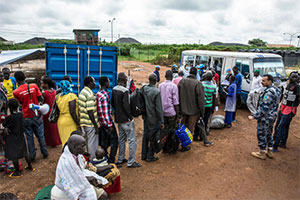 One Thousand Internally Displaced Persons (IDPs) Relocated from Tomping Camp in South Sudan. Credit: UN Photo/Isaac Billy
It took hundreds of thousands of years for the world’s human population to cross one billion in 1804. Approximately 200 years later, the population has multiplied sevenfold. In 2023, the global population crossed 8 billion, and is expected to reach 9 billion before 2050. With the planet more crowded than ever, it is essential to keep track of population trends, urbanization, migration, and reproduction across the world.
Life expectancy has seen significant strides in the past century, largely due to economic development and increased standards of living. On the contrary, trends in global fertility are shifting, with certain regions in Africa and Asia reporting higher rates, while parts of Europe and North America report stagnant or lower rates. This is in part due to differences in sexual and reproductive healthcare, as well as societal and economic conditions around the world. For example, child marriage is prevalent in certain societies, where childbearing is also considered a familial duty. Meanwhile, stagnating economies frequently experience lower marriage and childbearing rates.
The increase in migration and urban development around the world is also linked to global population trends. By 2050, it is expected that approximately 66 percent of all people will live in cities. Furthermore, global crises such as warfare and natural disasters also prompt transnational migration. Transnational migration is linked to a variety of socioeconomic issues in both host and receiving countries: migrants often leave developing countries with less access to educational and economic opportunities and arrive in developed countries where they are frequently the targets of ethnic, racial, and cultural discrimination, and economic exploitation. Recent crises in Europe and the United States demonstrate the importance of advocating for migrants worldwide. As migrants from the Global South are increasingly stripped of their legal and civic rights in unlawful deportations, or targeted in acts of identity-based violence, it is essential to keep track of population trends and protect the human rights of migrant populations. Climate-related disasters are now a major driver of displacement, with nearly half of all new internal displacements in 2025 being disaster-related.
IPS is devoted to covering issues surrounding population trends, migration, and reproduction through its compelling articles, which use both statistics and human stories to provide readers with robust and informative viewpoints.

The Week with IPS

NEXT STOP - SDGs
Tracking global progress towards a sustainable world
Tracking global progress towards a sustainable world
