Languages
Friday, November 13, 2026



News and Views from the Global South
Population
/INT’L MIGRANTS DAY/RIGHTS-U.S.: Administration Enlists Police to Pursue Immigrants
Civil rights and immigrant defence groups filed suit in a federal court here Wednesday to challenge a post-9/11 initiative by U.S. Attorney General John Ashcroft to enlist state and local police to enforce federal immigration laws..RIGHTS-U.S.: Arab, Muslim Immigrants Still Targeted
U.S. immigration officials have dropped parts of a contentious registration programme for Muslim and Arab men, but critics note that thousands are still being deported and many others will face onerous screening procedures when they travel./INT’L MIGRANTS DAY/MIGRATION: The Answer Is Social Equality, Not Walls
Walls, electrified barriers, military operations and police presence are not enough to stop the waves of migrants from impoverished countries to rich, industrialised, or at least less poor nations.POPULATION: West’s Policies Sow Seeds of Internal Conflict – Study
A major new study is suggesting that U.S. policies on family planning and agricultural trade might contribute to setting the stage for conflict in developing countries./INT’L MIGRANTS DAY/JAPAN: Men’s Attitude Key to Curbing Trafficking – Activists
Hiroshi Goto, a 40-year-old secretary to a politician, says he stays single because he is too busy to be married or have a steady relationship.U.S.: Mexican Torch Bearers Want Respect for Culture, Contribution
''Viva la Virgen de Guadalupe!," shouts Gelacio Vargas. ("Long Live our Lady of Guadalupe!"). ''Que viva!'' hundreds of Mexicans shout back in support, standing on the stairs that lead to the front portal of Saint Patrick's Cathedral in New York./INT’L MIGRANTS DAY/INDONESIA: Hard Knocks Turn Migrant Worker into Entrepreneur
Her years as a domestic worker overseas taught Nur Safinah one tough lesson - never to be one again. Returning to Indonesia, she then became an entrepreneur.BRAZIL: Leader in Shooting Deaths Takes First Step Towards Gun Control
Brazil, which has one of the highest murder rates in the world, has taken a big step towards reducing the number of firearms in the hands of civilians.COLOMBIA: Remittances, the Fruits of Exile
The money changers on Jiménez Avenue in the Colombian capital are upset: they haven't seen such a low exchange rate for the dollar in December, a time of year when the dollar is traditionally high, in over a decade.AUSTRALIA: Hunger Strike by Asylum Seekers Worries Supporters
One-legged and blind in one eye, Jarnil Khan Hashimi from Paktia in Afghanistan is on hunger strike in the Australian government-funded detention centre, located on the tiny Pacific island nation of Nauru.DEVELOPMENT: Papua New Guinea Wants to Prove Sceptics Wrong
While Australia is preparing to send a contingent of policemen to restore law and order in the capital Port Moresby, Papua New Guinea (PNG) appears determined to prove sceptics wrong by drawing more from homegrown solutions in issues like poverty and land.EDUCATION: Thailand Has Good Marks, But Needs Improvement
Thailand remains a model for Asian developing countries for its economic development that has brought impressive gains in education, but it has some catching up to do in the fewer number of girls in primary schools./INT’L MIGRANTS DAY/POLITICS: Europe Presses North Africa on Migrants
While the Anglophile world concentrated on the Commonwealth Heads of Government meeting in Abuja, Nigeria last week, the Western Mediterranean basis was engrossed in a summit of its own.EDUCATION: More Girls in School Benefits Everyone, Says UNICEF
Shamim Cairo Atwine, a 15-year-old Ugandan girl, speaks with great pride of the success of the Girls' Education Movement (GEM) at her school in Nakulabye, a poor and densely populated neighbourhood of Kampala.POPULATION-SOUTH AFRICA: Skills, Experience of Refugees Go to Waste
South Africa appears to receive the cream of African refugees seeking safe new homes, in Africa, but their skills and experience go to waste, says a survey released Thursday by the United Nations High Commissioner for Refugees and the Japan International Cooperation Agency.SOUTH PACIFIC: Native Land Rights of No Help to Squatters
Some 40 squatters live on prime real estate on a hilltop overlooking the ocean in this coastal town some 300 kilometres from the Fijian capital Suva, but the beauty of the environment masks the displacement that brought them here in the first place.HEALTH-PAKISTAN: Maternal Services Make All the Difference
Standing at the far corner of the outpatient section of the gynecology and obstetrics ward of the Qatar General Hospital in the southern port city of Pakistan, one can see a million expressions on the numerous faces of the women here./INT’L MIGRANTS DAY/POPULATION: U.N. Says 9 Billion Will Share Planet in 300 Years
After several fluctuations, the world's population will swell to 9 billion people by 2300, according to new projections by the United Nations.POLITICS-INDIA: Diverse Women Prove Female Winnability in Polls
The poll victories of a princess and a saffron clad celibate, who join a growing band of female chief ministers in India, appear to dispel the myth that women lack 'winnability' in the rough and tumble world of electoral politics./INT’L MIGRANTS DAY/BANGLADESH: Dreams – and Hunger – Drive Trafficking into India
Thirty-year-old Safia Begum, a domestic worker at a high-rise apartment in the upwardly mobile Gulshan enclave of the Bangladeshi capital, has a little secret./INT’L MIGRANTS DAY/INDONESIA: Gov’t Draws Lessons from Abuse of Migrant Workers
When Hodijah left Indonesia to become a domestic worker in Saudi Arabia, all that she wanted was a way to stay away from her husband, who had forced her to marry him in exchange for rights to till a piece of land.« Previous Page — Next Page »


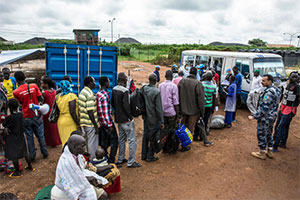 One Thousand Internally Displaced Persons (IDPs) Relocated from Tomping Camp in South Sudan. Credit: UN Photo/Isaac Billy
It took hundreds of thousands of years for the world’s human population to cross one billion in 1804. Approximately 200 years later, the population has multiplied sevenfold. In 2023, the global population crossed 8 billion, and is expected to reach 9 billion before 2050. With the planet more crowded than ever, it is essential to keep track of population trends, urbanization, migration, and reproduction across the world.
Life expectancy has seen significant strides in the past century, largely due to economic development and increased standards of living. On the contrary, trends in global fertility are shifting, with certain regions in Africa and Asia reporting higher rates, while parts of Europe and North America report stagnant or lower rates. This is in part due to differences in sexual and reproductive healthcare, as well as societal and economic conditions around the world. For example, child marriage is prevalent in certain societies, where childbearing is also considered a familial duty. Meanwhile, stagnating economies frequently experience lower marriage and childbearing rates.
The increase in migration and urban development around the world is also linked to global population trends. By 2050, it is expected that approximately 66 percent of all people will live in cities. Furthermore, global crises such as warfare and natural disasters also prompt transnational migration. Transnational migration is linked to a variety of socioeconomic issues in both host and receiving countries: migrants often leave developing countries with less access to educational and economic opportunities and arrive in developed countries where they are frequently the targets of ethnic, racial, and cultural discrimination, and economic exploitation. Recent crises in Europe and the United States demonstrate the importance of advocating for migrants worldwide. As migrants from the Global South are increasingly stripped of their legal and civic rights in unlawful deportations, or targeted in acts of identity-based violence, it is essential to keep track of population trends and protect the human rights of migrant populations. Climate-related disasters are now a major driver of displacement, with nearly half of all new internal displacements in 2025 being disaster-related.
IPS is devoted to covering issues surrounding population trends, migration, and reproduction through its compelling articles, which use both statistics and human stories to provide readers with robust and informative viewpoints.

The Week with IPS

NEXT STOP - SDGs
Tracking global progress towards a sustainable world
Tracking global progress towards a sustainable world
