Languages
Thursday, November 19, 2026



News and Views from the Global South
Population
RIGHTS-BRITAIN: Mixed Response To Asylum Rights Shake-Up
The British government Monday unveiled plans for a "fairer, faster and firmer" system for migrants and asylum seekers coming to Britain, but drew a mixed reception from refugee rights groups.ECONOMY-SENEGAL: Tapping the Entrepreneurial Spirit of Women
Why is wax print cloth from Mali suddenly nowhere to be found in Dakar's sprawling Sandaga market which otherwise has one of the best selections of textiles in the region?RIGHTS-BRAZIL: Home – Not Always so Sweet for Women and Children
The Brazilian government and the United Nations launched a joint campaign Thursday against domestic violence in Brazil, on the fifth anniversary of the "Candelaria massacre" of eight adolescents in the streets of Rio de Janeiro.RIGHTS-JAPAN: Women Still Shackled to the Home
Japan is far from the most progressive nation when it comes to women's status, but a new government report shows that the old obstacles to gender equality may even be more deeply rooted in society than earlier thought.POPULATION-NICARAGUA: Highest Teen Pregnancy Rate in Central America
Norma Solorzano is only 16 years old but she works in a handicraft workshop to maintain her six-month-old daughter.AUSTRALIA: Land Rights at the Core of Uranium Mine Controversy
At first glance, Yvonne Margarula appears an unlikely candidate to be leading a battle against one of Australia's largest mining companies.RIGHTS: UNICEF’s Mixed Feelings Over New Criminal Court
The United Nations Children's Fund (UNICEF), one of the U.N.'s strongest advocates of a permanent war crimes tribunal, has mixed feelings about the new International Criminal Court (ICC) established last week.RIGHTS-HONDURAS: Indians Put Christopher Columbus on Trial
Indigenous groups in Honduras opened a historic trial against Christopher Columbus Monday, the anniversary of the death of Chief Lempira, an indian leader who was betrayed and killed by the Spanish while negotiating peace and the withdrawal of the conquistadors.REFUGEES: UN Agencies Criticised Over Treatment of Burundi Refugees
International humanitarian groups, including the U.N. High Commissioner for Refugees UNHCR), have kept only "distant" relations with local refugee leaders in Burundi, and failed to hold constructive dialogue on problems faced, according to a U.S. non-governmental organisation.RIGHTS-ZAMBIA: Women Slow to Report Sexual Harassment
Zambian women are cheering the recent suspension of a government official for sexual harassment as a step in the right direction to bring more attention to the "hidden crime".POPULATION-BOLIVIA: Dramatic Changes in Demographics
Latest statistics on Bolivia's population show big changes since the last census with a massive increase of people living in urban areas.AUSTRALIA: Uranium Mine is Focus of Major Environmental Clash
A plan to expand uranium mining in Australia's World Heritage-listed Kakadu National Park is shaping up to be the biggest environmental showdown in the country's recent history.POPULATION-BELIZE: What is Development Anyway?
The government and some sections of the indigenous community in Belize are having a difference of opinion on the meaning of the term development these days.CHILDREN-MOROCCO: Helping The Children Of The Streets
When 12-year-old Mohammed Laaraj leaves home in the morning, he knows that this day will be just like all the others: full of hardship, as he wanders the streets of Rabat, selling cigarettes.CHILDREN-VENEZUELA: “Glue Sniffers” at the Core of a Dilemma
The "glue sniffer" children of Venezuela have unleashed controversy over the inclusion of an additive in these cements to put an end to the increasing solvent abuse.POPULATION-CUBA: Contraceptive Factory a Weight off Women’s Minds
Cuban women's concerns over family planning could be considerably lightened if plans go ahead for a factory producing 500 million contraceptive pills per year.MIGRATION-CHILE: Illegal Immigration Leads to Labour Abuse
An estimated 55,000 illegal immigrants in Chile - 40,000 of them from Peru - are working in low-paying jobs that offer no benefits.POPULATION: Human Rights For Women Still Ignored
Four years after the world adopted a global plan of action for women, they continue to be denied a dozen different basic human rights around the globe.POPULATION-CUBA: Slight Rise in Fertility No ‘Trend’, Say Experts
Although 12,000 more babies were born in Cuba in 1997 than in 1996, the increase does not indicate an abrupt shift in the reproductive patterns of this Caribbean nation, where fertility has not even reached replacement levels in the past 20 years.CHILDREN-ASIA: Losing the Fight Against Child Sex Trade?
Governments and international organisations have stepped up efforts to stop the child sex trade, but perpetrators of the social scourge have proved to be formidable foes especially in Asia.HEALTH-SRI LANKA: Devastatingly High Suicide Rate Needs Research
Five times as many people commit suicide in Sri Lanka than kill themselves in Britain. One village of just 400 souls in north west Sri Lanka recorded 25 suicides last year. Two thirds of the dead were aged under thirty.« Previous Page — Next Page »


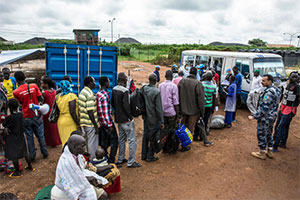 One Thousand Internally Displaced Persons (IDPs) Relocated from Tomping Camp in South Sudan. Credit: UN Photo/Isaac Billy
It took hundreds of thousands of years for the world’s human population to cross one billion in 1804. Approximately 200 years later, the population has multiplied sevenfold. In 2023, the global population crossed 8 billion, and is expected to reach 9 billion before 2050. With the planet more crowded than ever, it is essential to keep track of population trends, urbanization, migration, and reproduction across the world.
Life expectancy has seen significant strides in the past century, largely due to economic development and increased standards of living. On the contrary, trends in global fertility are shifting, with certain regions in Africa and Asia reporting higher rates, while parts of Europe and North America report stagnant or lower rates. This is in part due to differences in sexual and reproductive healthcare, as well as societal and economic conditions around the world. For example, child marriage is prevalent in certain societies, where childbearing is also considered a familial duty. Meanwhile, stagnating economies frequently experience lower marriage and childbearing rates.
The increase in migration and urban development around the world is also linked to global population trends. By 2050, it is expected that approximately 66 percent of all people will live in cities. Furthermore, global crises such as warfare and natural disasters also prompt transnational migration. Transnational migration is linked to a variety of socioeconomic issues in both host and receiving countries: migrants often leave developing countries with less access to educational and economic opportunities and arrive in developed countries where they are frequently the targets of ethnic, racial, and cultural discrimination, and economic exploitation. Recent crises in Europe and the United States demonstrate the importance of advocating for migrants worldwide. As migrants from the Global South are increasingly stripped of their legal and civic rights in unlawful deportations, or targeted in acts of identity-based violence, it is essential to keep track of population trends and protect the human rights of migrant populations. Climate-related disasters are now a major driver of displacement, with nearly half of all new internal displacements in 2025 being disaster-related.
IPS is devoted to covering issues surrounding population trends, migration, and reproduction through its compelling articles, which use both statistics and human stories to provide readers with robust and informative viewpoints.

The Week with IPS

NEXT STOP - SDGs
Tracking global progress towards a sustainable world
Tracking global progress towards a sustainable world
