Languages
Thursday, November 26, 2026



News and Views from the Global South
Poverty & SDGs
POPULATION: Global Food Supply Near the Breaking Point
The world is now eating more food than farmers grow, pushing global grain stocks to their lowest level in 30 years.POLITICS: More for the Military, Less for Development
Rising military expenditure and insufficient resources for development is the hallmark of the present global scenario, says a new report released Tuesday in Bonn.LABOUR: Decent Work Still the Exception to the Rule
More than a decade after the U.N. World Summit for Social Development in Copenhagen, where leaders first voiced the need to put decent employment at the centre of development, joblessness continues to rise, reaching new heights of nearly 192 million people in 2005.ARGENTINA: Transforming Garbage into Decent Jobs
The Argentine capital opened its first municipal plant for classifying solid waste - plastic, glass, paper, metal, cardboard and other materials - for recycling, as part of a project aimed at providing decent jobs for informal garbage collectors and reducing the amount of trash dumped into landfills.AUSTRALIA: ‘Debt Relief, Better Than Aid’
'Jubilee Australia', the faith lobby, called Tuesday for debt relief to be extended to 66 countries and made a strong case for cancelling the debts of Indonesia, the Philippines and Bangladesh.UGANDA: Abstinence Clashes With Reality When Women Are Powerless
Tens of thousands of Ugandan schoolchildren have enrolled in 'True Love Waits' clubs that promote sexual abstinence as the way to stop the spread of HIV/AIDS.MEDIA: Ten Stories That Desperately Need to Be Told
Every year, the U.N.'s Department of Public Information (DPI) unveils its list of the world's 10 most under-reported stories, implying that politics, murder and sex scandals still take precedence over poverty, peace-building or economic development.SCIENCE-SOUTH AFRICA: From "Publish or Perish" to "Publish and Vanish"
"Publish or perish" is the warning given many academics at the start of their careers. But it's publication of a very particular kind that scholarly researchers crave.COLOMBIA: Magistrates Excommunicated for Partially Lifting Abortion Ban
Twenty-seven years after Congresswoman Consuelo Lleras unsuccessfully submitted a bill to legalise abortion in Colombia, the country’s Constitutional Court has recognised the right to terminate a pregnancy in case of rape, a threat to the woman’s life or health, or if the foetus has a deformity that would prevent survival outside the womb.HEALTH-SOUTH AFRICA: The Mystery of Discordance
Silas Masindi* was not entirely surprised by his HIV test results. The dapper garment trader, who discovered earlier this year that he was infected with the AIDS virus, admits to using condoms somewhat erratically before he remarried three years ago.SOUTH AFRICA: OECD Backs Agricultural Reforms
Agricultural development backed by a broad range of policies to boost economic growth and tackle social inequities is critical for alleviation of poverty in South Africa, says an expert at the Paris-based Organisation for Economic Co-operation and Development.DEVELOPMENT: Big Business in Reform School, But Is It Sticking?
The United Nations, which has been trying to keep track of corporate social behaviour, is trumpeting some of the limited success stories in countries such as Canada, Britain, Brazil, Ghana, Nigeria, Kenya, France and the Netherlands.ENVIRONMENT-ARGENTINA: Black Waters in the Tigre Delta
Only 28 kilometres from the Argentine capital, the unique landscape of the Tigre Delta unfolds before the visitor's eyes: a varied labyrinth of rivers and islands at the mouth of the Paraná River where it flows into the River Plate.DEVELOPMENT: It Takes a Village to Save the MDGs
It may be simpler to fight and even end extreme poverty over the next decade than is commonly understood by powerful global policymakers like the World Bank and the International Monetary Fund.BRAZIL: Activists ‘Responsibly Optimistic’ on Child Labour Reduction
Activists in Brazil are somewhat sceptical with regard to the fact that Brazil was held up as an example of what can be done to eradicate child labour.MALAYSIA: Water Falls Under WTO Regime?
Malaysian activists have expressed concern that two bills before parliament could pave the way for giant transnational corporations to corner significant stakes in the country's domestic water sector.LABOUR: Workers Will Suffer from Weakened Andean Community
Free trade agreements with the United States and Venezuela's announced withdrawal from the Andean Community trade bloc will have an impact on workers, the ‘Cinderella' of decades of integration, said trade unionists and experts in the region consulted by IPS.SUDAN: For Vendors, It’s a Case of Struggle – and Struggle Again
Suzie Bernardo arrives at the market in the centre of Sudan's capital, Khartoum, at dawn, after a long bus ride from a remote slum. There she erects her portable charcoal stove, and sets out tea glasses clouded with fingerprints, and jars of tea, coffee and sugar.SPECIAL REPORT-PART II: A World Addicted to Hunger
Famines are almost a regular occurrence in many countries, especially in Africa, and recognisable signs of distress emerge well before people start to die. Why, then, is the response to food emergencies consistently slow?SPECIAL REPORT-PART I: A World Addicted to Hunger
In Ethiopia, some 12.6 million people require food aid, up from 11.3 million... Donors have pledged enough to meet about 82 percent of food needs, but only 54 percent has been delivered... Sound familiar? This alert was issued three years ago by the Famine Early Warning Systems Network, known as FEWS NET. Guess what? Ethiopia appeared again this year on FEWS NET's list of "current emergencies," alongside Somalia, Zimbabwe, and Chad.HEALTH: Half of World’s Underweight Children in South Asia
Poor nutrition remains a global epidemic that contributes to the deaths of some 5.6 million children under five every year - more than half of all child deaths, according to a new report launched by the U.N. children's agency UNICEF Tuesday.« Previous Page — Next Page »


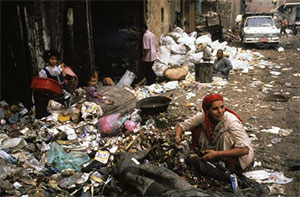 Romani people in Cairo, Egypt, forage through trash. Credit: UN Photo/Armineh Johannes
In 2015, the United Nations adopted the Sustainable Development Goals (SDGs) in an effort to promote “peace and prosperity for people and the planet.” To achieve that goal, it is essential to provide equal opportunities and access to basic services to all people. The 2025 UN SDG Report found that 35% of the 169 SDG targets are on track or making moderate progress, while 18% have reversed compared to the 2025 baseline. One in ten people still live in extreme poverty, one in eleven experience food insecurity, and over 1.1 billion people live in slums without access to clean water and sanitation. It is imperative to acknowledge the societal, technological, economic, and political issues that sustain poverty in countries around the world. Eradicating poverty will require significant frameworks in policy and governance on a national and international scale to ensure that all people will have equal access to basic services and economic opportunities by 2030. Furthermore, a dramatic reduction of United States foreign aid in 2025, including the termination of 83% of USAID programmes, threatens to erode years of fragile development gains.
Throughout the world, violent conflict and natural disasters also contribute to extreme poverty. The complete destruction of infrastructure and blockage of aid has significantly impoverished Palestine since October 7th. The destructive impact of Hurricane Maria in Puerto Rico left $91 billion in damage. An inadequate US government response also revealed significant and enduring questions within the issue of mitigating poverty: how do we rebuild infrastructure after its destruction? How do we restimulate economic development and bring in financial aid after disasters? Similar questions have been raised in the realm of regional cooperation, as devastating floods have wrecked hundreds of thousands of homes across multiple Southeast Asian nations in the past few years. Furthermore, the COVID-19 pandemic has greatly exacerbated the global poverty crisis, particularly in developing countries, setting back the United Nations goal of eradicating poverty by 2030.
IPS is committed to providing comprehensive features that focus on the persisting environmental, sociopolitical, and systemic issues that sustain poverty, and the steps taken worldwide towards poverty eradication.

The Week with IPS

NEXT STOP - SDGs
Tracking global progress towards a sustainable world

