Languages
Thursday, November 26, 2026



News and Views from the Global South
Poverty & SDGs
RIGHTS: Global Anti-Poverty Plan Must Include Native Peoples
At the close of a major United Nations meeting in New York Friday, indigenous leaders urged the world's developed countries to take into account the concerns of native communities living within their borders while implementing the Millennium Development Goals (MDGs).HEALTH: Seeking Answers in the Failed Response to AIDS
The AIDS epidemic, described by the United Nations as the "most destructive in human history" and accounting for more than 25 million deaths so far, is still a growing threat to global progress and stability.DEVELOPMENT: Reconstruction of Haiti – Part II
Brazil has expressed its staunch support for reconstruction in Haiti, signing several agreements with the new democratically elected government of René Préval to contribute to school lunch programmes, the promotion of sports as educational support, the production and use of ethanol fuel produced from sugar cane, and a massive vaccination campaign.ENVIRONMENT: Tropical Forests Protected on Paper Only
Less than five percent of the world's tropical forests surveyed in a new report are being managed in a sustainable way, although this still represents a huge improvement over the situation a decade ago.AFRICA: Cautious Optimism Surfaces
Africa has come to be associated with conflicts, political unrest, famine and disease. A new report says that there is reason to be optimistic about the world's second largest continent.KENYA: Doctors for the Haves, Lions for the Have-Nots
For Nalangu Taki, a simple glass of water can come with a heavy price. This resident of Narok in south-western Kenya says women in the district have to walk long distances to obtain water, sometimes getting attacked by lions.ENVIRONMENT-ARGENTINA: Chronic Problems, Acute Symptoms
In Argentina, an area 10 times the size of the capital is deforested every year, while the burning of forests generates more greenhouse gases than the country's motor vehicles, according to a new report by the Fundación Vida Silvestre Argentina.ARGENTINA: Fair Prices for Indigenous Crafts
"With this purchase, you are helping craftspeople feed their families, educate their children and stay on their land," says the label on products sold by the Silataj fair trade crafts association in Argentina, which is celebrating its 20th anniversary.MEXICO: Millennium Development Goals – Political Cement?
During the Vicente Fox administration, initiatives to obtain political agreement to reform Mexico's economic and social structures have failed. Now, in the midst of an aggressive election campaign, another proposal has emerged, dangling the United Nations Millennium Development Goals (MDGs) as bait.FINANCE: Despite Debt Relief, Poor Nations Back In the Red
A new report by the self-auditing arm of the World Bank has painted a grim picture of the results of a decade-long plan by the Bank and the International Monetary Fund (IMF) to give the world's poorest nations debt relief.BRAZIL: Strides and Continued Challenges for the Disabled
The first national conference for the disabled sponsored by the government in Brazil showed the strides made in the past few decades towards rights for the country's 24.5 million people living with disabilities. But it also made it clear that solutions making life easier for this diverse group are far from evenly available, due to the poverty in which so many Brazilians are steeped.CHINA: Three Gorges Dam Holds Lessons for Green Activists
As the last loads of concrete are poured into the wall of the world's largest dam and the waters behind rise, the long battle against the Three Gorges Dam - spanning generations of Chinese leaders - is considered lost.NEPAL: Drought Prompts First Ever Emergency Food Op
The United Nations World Food Programme is planning its first ever emergency food operation in Nepal to counter a severe drought in the country's northwestern hills and mountains.LATIN AMERICA: Concrete Plans Needed to Reach Zero Hunger
In spite of the enormous amount of food produced in Latin America and the Caribbean, there is still hunger in the region. But each country will have to draw up its own plan to combat it, as the size of the problem and progress towards eradicating it vary considerably from country to country.HEALTH: WHO Assembly to Face Controversies Over Patents, Taiwan
The most controversial debates at the 59th World Health Assembly will involve the question of intellectual property rights and health, and Taiwan's request to participate as an observer.ENVIRONMENT-CARIBBEAN: Fighting Drought Begins with the Young
Beyond the hotels and the bathing suits, the Caribbean landscape bears the scars of drought. To combat soil degradation and desertification, young people from 16 countries in the region will be trained in reforestation and sustainable development techniques as part of an environmental rehabilitation programme.ECONOMY-GUINEA: Micro-Finance, Macro Interest Rates
Since being introduced in Guinea in 1989, micro- credit organisations have made their mark. Take the case of Batouly Diallo.CARIBBEAN: Regional Bank Lagging in Poverty Reduction
Every year, Caribbean governments lavish praise on the Barbados-based Caribbean Development Bank (CDB) for its efforts to improve socio-economic conditions in the region.PORTUGAL: Brazilian Families Resettle the Heartland
Four Brazilian families came to live in Portugal this month, as the advance party of another 250 families intent on fulfilling their European dream, and at the same time to stem the depopulation of rural areas in this country.GUATEMALA: Indigenous Groups Sceptical about Social Dialogue
Labour and campesino organisations in Guatemala are sceptical of recent government calls for a formal national dialogue to address the social agenda set out in the 1996 peace accords that officially ended the country's 36-year civil war.ENVIRONMENT-RWANDA: Park Fencing to Protect the Mountain Gorillas
Authorities in Rwanda have announced that the "Parc national des volcans" (National Volcano Park) will soon be fenced off to stem the killing of endangered mountain gorillas, and prevent further destruction of the park forest.« Previous Page — Next Page »


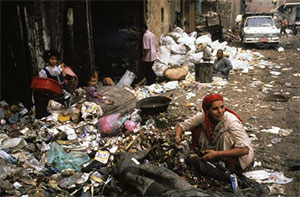 Romani people in Cairo, Egypt, forage through trash. Credit: UN Photo/Armineh Johannes
In 2015, the United Nations adopted the Sustainable Development Goals (SDGs) in an effort to promote “peace and prosperity for people and the planet.” To achieve that goal, it is essential to provide equal opportunities and access to basic services to all people. The 2025 UN SDG Report found that 35% of the 169 SDG targets are on track or making moderate progress, while 18% have reversed compared to the 2025 baseline. One in ten people still live in extreme poverty, one in eleven experience food insecurity, and over 1.1 billion people live in slums without access to clean water and sanitation. It is imperative to acknowledge the societal, technological, economic, and political issues that sustain poverty in countries around the world. Eradicating poverty will require significant frameworks in policy and governance on a national and international scale to ensure that all people will have equal access to basic services and economic opportunities by 2030. Furthermore, a dramatic reduction of United States foreign aid in 2025, including the termination of 83% of USAID programmes, threatens to erode years of fragile development gains.
Throughout the world, violent conflict and natural disasters also contribute to extreme poverty. The complete destruction of infrastructure and blockage of aid has significantly impoverished Palestine since October 7th. The destructive impact of Hurricane Maria in Puerto Rico left $91 billion in damage. An inadequate US government response also revealed significant and enduring questions within the issue of mitigating poverty: how do we rebuild infrastructure after its destruction? How do we restimulate economic development and bring in financial aid after disasters? Similar questions have been raised in the realm of regional cooperation, as devastating floods have wrecked hundreds of thousands of homes across multiple Southeast Asian nations in the past few years. Furthermore, the COVID-19 pandemic has greatly exacerbated the global poverty crisis, particularly in developing countries, setting back the United Nations goal of eradicating poverty by 2030.
IPS is committed to providing comprehensive features that focus on the persisting environmental, sociopolitical, and systemic issues that sustain poverty, and the steps taken worldwide towards poverty eradication.

The Week with IPS

NEXT STOP - SDGs
Tracking global progress towards a sustainable world

