Languages
Friday, November 27, 2026



News and Views from the Global South
Poverty & SDGs
BRAZIL: Harnessing Creativity to Boost Developing Economies
The Brazilian minister of culture, renowned singer-songwriter Gilberto Gil, has a new passion: the creative industries, which he believes can play a key role in boosting the economies of developing countries.DEVELOPMENT: Microcredit Makes Strong Inroads in Latin America and Caribbean
Reaching 75 percent of the world's poor families with microloans and helping to boost the incomes of those living in extreme poverty were the two major challenges assumed at the regional microcredit summit for Latin America and the Caribbean.TRADE-SOUTHERN AFRICA: Textile Firms Fight for Survival
Southern African textile firms are feeling the effects of the quota system which was scrapped by the World Trade Organisation in January.DEVELOPMENT: Treaty Urged to Protect Human Right to Water
Alarmed by corporate moves to treat water as just another market commodity, leading civil society groups are urging the international community to adopt a new universal treaty to protect the right to water.DEVELOPMENT: A Subsidy North and South Can Agree On?
The United Nations, which aggressively campaigns for the elimination of some 300 billion dollars in annual subsidies doled out to Western farmers, claims that unfair agricultural tariffs are killing the livelihoods of farmers in the world's poorer nations.HEALTH-KENYA: From Bangkok, They Brought Hope for Millions Living With AIDS
Smoke from open fires roasting slabs of meat and maize cobs rises alongside a rutted, dusty road in Kangemi, a slum north-west of Kenya's capital Nairobi.ARGENTINA: ‘Piquetero’ Groups Take Chunk Out of Social Assistance Payments
Rain or shine, Soledad, with her toddler in her arms, never misses a roadblock or "piquete" - but not because she is fanatically devoted to the protests staged by the movement of unemployed workers to which she belongs.POLITICS: Annan Calls on Asian-African Leaders to Back U.N. Reforms
United Nations Secretary-General Kofi Annan on Friday made an emotional plea to Asian and African leaders urging them to be bold and support his push to reform the world body, which has been mired in scandals and plagued by corruption.ENVIRONMENT-CHILE: A Mega-Trail for Ecotourism
Twelve environmental projects will promote ecotourism along the ''Sendero de Chile'', the Chilean Trail, which at 8,000 kilometres will be one of the longest pathways in the world for hiking or tours on bicycle or horseback.NEPAL: New School Year Sees Private Schools Targetted by Maoists
As the new school year began this week, the latest targets in Nepal's bloody Maoist insurgency are private schools that the rebels have threatened to bomb if they defy a call to close. This prompted a strong United Nations rebuke, which stated unequivocally that an attack on education and educational institutions is an attack on the next generation of Nepalis.HEALTH-SOUTHERN AFRICA: Teenage Suicides on Upswing
Passions of the heart rather than financial woes account for a growing number of suicides in Southern African nations as diverse as prosperous and well-developed South African and small, traditional Swaziland.DEVELOPMENT: Is Water a Human Right, or Just Another Widget?
Despite strong opposition from the world's leading civil society groups, multinational corporations in the Western hemisphere continue to push the international agenda on sustainable use and distribution of water toward privatisation.DEVELOPMENT: Making Every Drop Count
For years, the Yellow Quill First Nation, a small indigenous community of 1,000 people located in the south-central region of Canada's Saskatchewan province, was forced to boil all its drinking water because the local water sources were limited and despicable.POLITICS: Africa Awash with Small Arms, Misery
Around 30 million illegal arms are in circulation in sub-Saharan Africa, fuelling conflicts and destroying lives and property across the continent, says a campaigner.CHILDREN: Educating Girls – A Wise Investment
If you truly want a significant return on your investment, first of all invest in education, and particularly invest in making sure girls obtain an education, recommends Carol Bellamy.DEVELOPMENT: Three Decades of Missed Aid Targets
The world's 22 rich nations claim that their collective official development assistance (ODA) to developing countries has risen significantly: from an average of about 55 to 60 billion dollars in the late 1990s to 69 billion in 2003 and 78.6 billion dollars in 2004.HEALTH: The Best Defence against AIDS, In the Long Run, Will Be Economic
If one wants to find out how AIDS is increasing hunger and malnutrition, one can expect to harvest an abundance of depressing information. But soon, this may change.RIGHTS-SOUTHERN AFRICA: The Missing Link in the Fight against AIDS
A group of traditional dancers, donning colourful artificial animal skins and headgears, formed a circle around a drummer, entertaining guests heading to an AIDS event.EDUCATION-NEPAL: Schools Still Beyond Reach for Girls
As the United Nations urged Nepal's government and Maoist rebels to leave school children out of the insurgency that has claimed over 11,000 lives since 1996, UNICEF said Monday the Himalayan kingdom would have difficulty meeting a global goal of getting an equal number of girls and boys in schools./CORRECTED REPEAT*/HEALTH-ZIMBABWE: Only a Few Can Afford Life-prolonging AIDS Drugs
Emily Muronda, 55, spent seven months in hospital in 2003. She had been down with AIDS-related complications, which saw her in and out of the hospital, that year. Muronda's ailments included tuberculosis, severe vaginal thrush and pneumonia.FINANCE: Three-Piece Suits Populate This Secretive Conclave
Two of the world's most influential financial institutions, the World Bank and the International Monetary Fund (IMF), will hold their semi-annual meetings this year amid worries about uneven global growth and long-time accusations by development groups that they cater to rich countries at the expense of the poor.« Previous Page — Next Page »


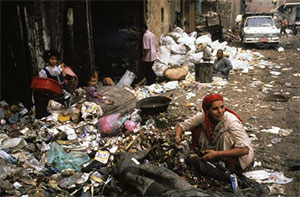 Romani people in Cairo, Egypt, forage through trash. Credit: UN Photo/Armineh Johannes
In 2015, the United Nations adopted the Sustainable Development Goals (SDGs) in an effort to promote “peace and prosperity for people and the planet.” To achieve that goal, it is essential to provide equal opportunities and access to basic services to all people. The 2025 UN SDG Report found that 35% of the 169 SDG targets are on track or making moderate progress, while 18% have reversed compared to the 2025 baseline. One in ten people still live in extreme poverty, one in eleven experience food insecurity, and over 1.1 billion people live in slums without access to clean water and sanitation. It is imperative to acknowledge the societal, technological, economic, and political issues that sustain poverty in countries around the world. Eradicating poverty will require significant frameworks in policy and governance on a national and international scale to ensure that all people will have equal access to basic services and economic opportunities by 2030. Furthermore, a dramatic reduction of United States foreign aid in 2025, including the termination of 83% of USAID programmes, threatens to erode years of fragile development gains.
Throughout the world, violent conflict and natural disasters also contribute to extreme poverty. The complete destruction of infrastructure and blockage of aid has significantly impoverished Palestine since October 7th. The destructive impact of Hurricane Maria in Puerto Rico left $91 billion in damage. An inadequate US government response also revealed significant and enduring questions within the issue of mitigating poverty: how do we rebuild infrastructure after its destruction? How do we restimulate economic development and bring in financial aid after disasters? Similar questions have been raised in the realm of regional cooperation, as devastating floods have wrecked hundreds of thousands of homes across multiple Southeast Asian nations in the past few years. Furthermore, the COVID-19 pandemic has greatly exacerbated the global poverty crisis, particularly in developing countries, setting back the United Nations goal of eradicating poverty by 2030.
IPS is committed to providing comprehensive features that focus on the persisting environmental, sociopolitical, and systemic issues that sustain poverty, and the steps taken worldwide towards poverty eradication.

The Week with IPS

NEXT STOP - SDGs
Tracking global progress towards a sustainable world

