Languages
Monday, November 16, 2026



News and Views from the Global South
Labour
PARAGUAY: Nurses Seeking Greener Pastures in Italy
Graciela Samaniego has her bags packed. Along with a number of fellow nurses, she is ready to leave her job at a public hospital in the Paraguayan capital and fly to a city in northern Italy, where she will work in a nursing home.SOUTH AFRICA: ‘My Body, My Business’: Sex Workers Seek Protection from the Law
The steps of the Cape Town High Court, a frequent site of protest, have seen it all, but Mar. 6, was the first time, sex workers openly stood up for their rights there.US-COLOMBIA: "Drug Lords" Getting Free Pass on Worse Crimes?
Yet another of Colombia’s top paramilitary leaders was extradited to the U.S. Thursday to be brought up on drug trafficking charges despite the objections of some rights groups and questions raised by Colombian politicians visiting Washington.LABOUR-THAILAND: Meltdown Leaves Women in Dire Straits
"Please help me find a way to have some money for milk," pleaded Benjawan Marongthong, mother of two young boys and former worker in a garments factory.LABOUR-MEXICO: “They First Asked if I Was Pregnant”
When Paulina was interviewed for a job at a local Wal-Mart in the Mexican capital, the first thing she was asked was whether she was pregnant – a question she did not know at the time was illegal.ECONOMY: Trickle Down Misery
The world's poorest people had nothing to do with the financial gimmickry that has brought the global economy to its knees but they are paying a heavy price for it and relief seems a long way off.LABOUR-MEXICO: Bad News for Thousands of Workers
Mario Verdugo heard the bad news after finishing an exhausting 12-hour shift making Jettas at the sprawling Volkswagen plant in central Mexico.SPAIN: Economic Renaissance Over
At one of the busiest unemployment offices in central Madrid, people have been standing in line since six in the morning.LABOUR-PHILIPPINES: Meltdown – Women Most Vulnerable
Shaynar Bacon was working as a cashier in a shopping mall in Mindanao, southern Philippines, when she learned that an electronics manufacturing firm in Taiwan was looking for workers.DEVELOPMENT: Financial Crisis Threatens Women’s Meagre Gains
The spreading global financial crisis - which has taken a heavy toll of international bankers, investors and speculators - is also having a devastating impact on some of the most vulnerable and marginalised groups in society, including women and children.LABOUR: Women’s Household Chores Unpaid, Unrecognised
The 1983 Hollywood comedy 'Mr. Mom' portrayed the story of a laid-off auto-worker reluctantly forced to play the role of a housewife and homemaker after losing his job.RIGHTS-US: Few Safety Nets for Women of Colour
As hundreds of activists from around the world descend on the United Nations Monday for a major two-week meeting on women's rights and equality, the economic crisis here in the host country is continuing to have an especially heavy toll on women of colour.POLITICS: Shadow Meet to Challenge Elites at Americas Summit
The organisers do not expect newly elected U.S. President Barack Obama to attend their parallel three-day meeting, even though he is likely to be in Trinidad and Tobago at the official Fifth Summit of the Americas in April.SOUTH-EAST ASIA: Burma's Muslim Rohingyas – The New Boat People *
It happened decades ago when this region was gripped by the fallout of the United States’ war in Vietnam. But the ‘boat people’ phenomenon is back, and this time it has to do with Burma’s Muslim Rohingyas fleeing harsh realities at home.
ENVIRONMENT: Fighting for the Right to Fish
"When my belly is crying I must fill it. I can sit on the side of the road and beg for bread, but there is the bread right there," says Hahn Goliath, a fisherman in the small village of Doring Bay on South Africa's West Coast, as he points furiously at the Atlantic Ocean.
LATIN AMERICA: Recession Challenges Fair Trade
The world economic recession is threatening the progress Latin America has made in fair trade. The leaders of this alternative form of exchange are making emergency contacts in order to assess the situation and come up with strategies to confront it.LABOUR-ASIA: Airlines Turn Modern Day Slavers
The presence of East Asian human trafficking victims in places as far-removed as Southern Africa and Central and South America confirm the ease with which modern merchants of slavery exploit international air travel.RIGHTS: Human Slavery Thriving in the Shadows
"Dora", a young Mexican woman, was helped by another Mexican woman to cross the U.S. border in the promise of a good job there. She ended up in Texas, working in a sweatshop and not allowed to go out or even take a shower.
LABOUR: Women At the Helm, Literally
Shipping used to be for men. Now women are starting to be seen commanding merchant vessels, oil tankers and cruisers, "manning" ships and operating liner engines.LABOUR-JAPAN: Brazilian Japanese Organise Against Joblessness
Rodney Freitas, 24, is happy to see Brazilians of Japanese descent organising themselves at time when Japan’s economy is cooling down and many are in danger of losing jobs or are already unemployed.ZIMBABWE: Unity Govt – Guarded Optimism At Local Level
Zimbabwe's power sharing deal comes as the country's Movement for Democratic Change (MDC) controlled urban councils are facing a multitude of challenges after years of what they claim is interference in the running of their affairs by the Zimbabwe African National Union-Patriotic Front (ZANU-PF).« Previous Page — Next Page »


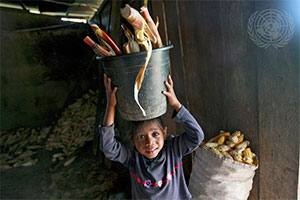 Timorese Girl with Fresh-Picked Corn. Credit: UN Photo/Martine Perret
A global common denominator is the need for a decent job. The economic realities of each country determine just how difficult it is to find one. Despite the labour movement's achievements, serious challenges persist: gender discrimination, child labour, worker migration, the digital divide and AI automation, evaporating pensions, unsafe workplaces, corporate pressure against union organising, negative impacts of trade agreements, and the precariousness of informal employment. The 2025 UN SDG Report identifies jobs and social protections as one of the six priority areas requiring urgent action, with progress either stalled or reversing in many developing nations.
In recent years, the fight to protect labour equality has taken on new dimensions with the rise of Environmental, Social and Governance standards. With the Social aspect aiming to promote equality and human rights, ESG principles have strengthened labour advocacy within corporate and governmental regulatory landscapes. In particular, ESG has become much more institutionalized in emerging economies such as Brazil and China. IPS follows the world’s workers as they confront these challenges - their setbacks and their successes.

The Week with IPS

NEXT STOP - SDGs
Tracking global progress towards a sustainable world
Tracking global progress towards a sustainable world
