Languages
Monday, October 26, 2026



News and Views from the Global South
Trade & Investment

Regressive Taxation Must Be Reversed
With many in the world experiencing declining living standards, there has been growing frustration. Many hope that progressive taxation will improve things. While some economies once had progressive tax systems, recent decades have seen regression.
COVID-19: Lessons from the Losses
If countries considered Universal Health Coverage (UHC) a central policy in their health systems, the COVID-19 has surely demonstrated the need for its urgent and widespread roll out. The pandemic has upended world systems in a manner that no scientists or sophisticated global intelligence could have foreseen.
Trump Undermines WHO, UN System
After accusing the World Health Organization (WHO) of pro-China bias, President Donald Trump announced US withdrawal from the UN agency. Although the US created the UN system for the post-Second World War new international order, Washington has often had to struggle in recent decades to ensure that it continues to serve changing US interests.
World Bank’s ‘Mobilizing Finance for Development’ Not Financing Development
The World Bank leadership must urgently abandon its ‘Maximizing Finance for Development’ (MFD) hoax. Instead, it should resume its traditional multilateral development bank role of mobilizing funds at minimal cost to finance developing countries.
A Not-To-Do List for Guyana’s New Administration When It Comes to Oil
Just over five years ago, a major oil discovery occurred on the northeastern coast of South America. There have been a series of additional discoveries ever since. But this time it was not Venezuela. It was Guyana.
Lack of Human Capital is Holding Back Latin America’s Growth
In 1990, Latin America’s average GDP per capita was a little over a quarter of the United States’ income level, while emerging and developing Asian countries’ GDP per capita was only 5 percent. In 2019, Asian countries had grown fourfold, but Latin America was still at the same level.
ISDS Enables Making More Money from Losses
With the Covid-19 contagion from late 2019 spreading internationally this year, governments have responded, often in desperation. Meanwhile, predatory international law firms are encouraging multimillion-dollar investor-state dispute settlement (ISDS) lawsuits citing Covid-19 containment, relief and recovery measures.
CPTPP Trade Liberalization Charade Continues
The Trans-Pacific Partnership (TPP) Agreement should be dead and buried after President Trump announced US withdrawal immediately after his inauguration in January 2017. After all, most major US presidential candidates in the last election, including Hillary Clinton, had opposed the TPP.
Why the African Free Trade Area Could be the Game-Changer for the Continent’s Economies
Most economists see structural transformation as one of the main routes to Africa’s sustainable development. What it means is changing the share of agriculture, manufacturing and services in an economy. It is a central aim of the African Union’s Agenda 2063.
Dead Rats Can Raise GDP, Economists Have Lowered It
GDP has been increasingly challenged on many grounds as a measure of economic and social progress. Clearly, GDP does not take account of other dimensions of wellbeing, natural resource depletion or environmental damage.
Pros and Cons of a Super Regulator – The case of the Spanish Regulator
On June 10, 2020, Senator Ricardo Monreal, President of the Political Coordination Board of the Senate of Mexico, presented a legislative initiative to reform Article 28 of the Political Constitution of the United Mexican States, in order to cluster in a single regulator of economic competition, the Telecommunications, Broadcasting and Energy sectors.
Financialization: Tackling the Other Virus
The 1971 Bretton Woods (BW) system collapse opened the way for financial globalization and transnational financialization. Before the 1980s, most economies had similar shares of trade and financial openness, but cross-border financial transactions have been increasingly unrelated to trade since then.
Global Economic Recovery must Prioritise Restructuring of Debt for Developing Countries
Unless there is a restructuring of debt for developing countries, the servicing for this debt will take away valuable resources from these nations that are needed to prevent the further suffering of people during the coronavirus pandemic -- particularly with regards to safeguarding the health systems, and protecting the “integrity and resilience of economies”.
Put Climate at the Heart of COVID-19 Economic Recovery Plans
Cast your mind back. Six months ago—it seems like a lifetime—the world’s attention was on Madrid. The United Nations was meeting to take stock of international progress in fighting climate change. Headlines were dominated by young people pointing out—rightly—that governments were still not doing enough. They demanded urgent and ambitious action to cut emissions and help the most vulnerable.
African Countries Need to Seize Opportunities Created by US-China Tensions
The unfolding US-China power rivalry bears a striking resemblance to the tensions between the US and the Soviet bloc during the Cold War years. Back then, African countries were positioned like pawns on a grand chessboard. Their social and economic progress was hampered because they expended energy aligning themselves with either of the superpowers in the battle for world supremacy between communism and capitalism.
This Year of Living Dangerously
Indonesia’s founding President Sukarno delivered his annual Independence or National Day address on 17 August 1964 anticipating the forthcoming year as Tahun vivere pericoloso, the ‘year of living dangerously’. 2020 may well be the world’s turn, and not only due to the obvious Covid-19 threat to the world.
How a Post-COVID-19 Revival Could Kickstart Africa’s Free Trade Area
The African Continental Free Trade Area was launched two years ago at an African Union (AU) summit in Kigali. It was scheduled to be implemented from 1 July 2020. But this has been pushed out until 2021 because of the impact of COVID-19 and the need for leaders to focus on saving lives.
Africa Needs a DOVE Fund: Or Should We Starve So We Can Pay our Debts?
Sub-Saharan Africa has a debt problem. According to the most recent World Bank debt statistics, in 2018 the region had about $493 billion in long term external debt.
Covid-19 Straw Breaks Free Trade Camel’s Back
Economic growth is supposed to be the tide that lifts all boats. According to the conventional wisdom until recently, growth in China, India and East Asian countries took off thanks to opening up to international trade and investment.
COVID-19: Developing Countries Must Not be Left Behind
Globalization has been a driver for increased prosperity world-wide, but it has been in reverse in the last years due to the growth of populism in the USA and Europe. The COVID-19 pandemic may well provide further momentum to increasingly national-interest oriented policies in the west.
Has COVID-19 Reversed Progress for India’s Small Tea Growers?
As the sun sets over the hills, Prafulla Debbarma, a small tea grower in Dhanbilash village in north eastern India, walks along the labyrinth path of his farm and past a thick blanket of well-grown tea plants. In the fading light, the farmer appears deeply worried. This tea farm, the sole source of his livelihood, remains unharvested thanks to the ongoing COVID-19 crisis.« Previous Page — Next Page »





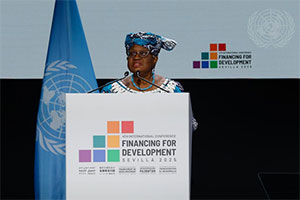 Opening of 4th International Conference on Financing for Development. Credit: UN Photo/Mariscal
International trade and investment are crucial elements of the world economy. While they can be powerful stimulators of development, they can also lead to global imbalances and dynamics of exploitation. In 2025, international trade entered a period of immense disruption, driven in part by a new wave of United States tariffs that reshaped global supply chains and investment flows. The increase in the US tariff rate, the highest since the 1930s, has forced bilateral renegotiations with global trading partners. Furthermore, the debt crisis in developing nations has accelerated while Official Development Assistance (ODA) has substantially dropped 7.3% in 2024.
In the 21st century, advancements in economic diversification in formerly colonized nations have propelled them into more central roles in the global economy. For example, both China and Mexico were able to develop their manufacturing sector and channel this development into booming export flows, thus advancing into the position of emerging economies. Foreign investment also plays an essential role in providing capital for developing countries, although they are oftentimes accompanied by social and environmental exploitation. For example, rising Chinese investments in natural resources in Latin America have often been met with tension as these investment projects fail to properly mitigate environmental risks and protect workers’ rights. In a more multifaceted vein, Sino-African relations have led to infrastructure development in Sub-Saharan Africa while also heightening the region’s economic dependency on China. IPS reports on global news in trade and investment, while shining a light on the nuanced nature of these endeavors.

The Week with IPS

NEXT STOP - SDGs
Tracking global progress towards a sustainable world
Tracking global progress towards a sustainable world
