Languages
Saturday, October 24, 2026



News and Views from the Global South
Trade & Investment

TNCs Reviving TPP Frankenstein
The incoming Biden administration is under tremendous pressure to demonstrate better US economic management. Trade negotiations normally take years to conclude, if at all. Unsurprisingly, lobbyists are already urging the next US administration to quickly embrace and deliver a new version of the Trans-Pacific Partnership (TPP).
Keeping Climate Ambition Alive: Challenges Remain but Signs of Progress Abound
For those of us in the international climate action community, 2020 isn’t ending the way we expected when we rang in the new year. Even before 2020 dawned, countries were hard at work planning for their first updated Nationally Determined Contributions (NDCs), in line with the Paris Agreement’s five-year NDC revision cycle. NDCs are official statements, prepared by countries themselves, outlining the commitments they are making to reduce national emissions and adapt to climate change’s impacts. They are at the heart of putting the Paris Agreement into practice and pursuing action on a global scale.
Autocracy on the Rise: Should we Expect Military Spending to Follow?
Autocracies are once again the global majority. The 2020 Democracy Report of the Varieties of Democracy Institute (V-DEM), ‘Autocratization surges, resistance grows’, raises the alarm that while the world in 2019 was substantially more democratic than it was in the 1970s, an ongoing trend of autocratization may reverse this scenario.
Can Africa’s Third Industrial Development Decade Deliver?
Industrialization and development go hand in hand. There is hardly a country in the world that has developed without building a strong manufacturing base. But for Africa – sometimes referred to as the continent of the future – the fruits of industrialization have often seemed just out of reach.
Q&A: Mro Indigenous Community Plea for Halt of Construction of 5-Star Hotel
The construction of a five-star hotel in the Chittagong Hill Tracts, Bangladesh, could lead to the forced eviction of the Mro indigenous community from their ancestral lands and destroy “the social, economic, traditional and cultural fabric of the community”, warns Amnesty International.But local activist Reng Young Mro told IPS that the international community must rally behind the Mro indigenous community to halt the construction.

CARE Offers Policies That Engender Success for Young People in Agribusiness
Often cited as Africa’s greatest asset, its youth are also among the most vulnerable and volatile. A large and growing population of talented young people has the potential to drive economic growth and well-being of societies across the continent but, as the African Development Bank warns, current conditions of severe unemployment are translating into poorer living conditions, higher flows of migration, and greater risks of conflict – in short, a social disaster in the making.
It’s Time for Results as Sudan Enters Second Year of NDC Partnership
Earlier this year, when heavy rains caused massive flooding in Sudan, a three-month state of emergency was declared in September. The floods which began in July, were the worst the country experienced in the last three decades and affected some 830,000 people, including 125,000 refugees and internally displaced people.
World Bank Urges Governments to Guarantee Private Profits
The World Bank has been leading other multilateral development banks (MDBs) and international financial institutions to press developing country governments to ‘de-risk’ infrastructure and other private, especially foreign investments.
Is Development for the World Bank Mainly Doing Business?
The World Bank has finally given up defending its controversial, but influential Doing Business Report (DBR). In August, the Bank “paused” publication of the DBR due to a “number of irregularities” after its much criticized ranking system was exposed as fraudulent.
Solving the Challenge of Food Security Key to Peacebuilding in the Sahel
In 2013, when Jamila Ben Baba started her company, the first privately owned slaughterhouse in Mali, she did so in the midst of a civil war as Tuareg rebels grouped together in an attempt to administer a new northern state called Azawad. Ben Baba, who is originally from Timbuktu, in northern Mali — where much of the civil war conflict took place — based the business in the country’s western region of Kayes and grew it into what is considered the largest private slaughter house in the West African nation.
Driving Climate Change from the Top in the Dominican Republic
When President Luis Abinader arrived at his inauguration in an electrically driven car as a symbolic gesture of his Government’s intentions to make sustainable development one of its main objectives – he signalled the start of addressing climate change commitments in the country.
In the Face of a Pandemic, the World Turns to Trade
Greatly affected by the coronavirus pandemic, international trade can play a key role in the economic recovery, but it must overcome obstacles, such as protectionism and commercial disputes, especially between the United States and China.
Enhanced Social Protection an Opportunity Asia Pacific Must Grasp
In the fight against COVID-19, success has so far been defined by responses in Asia and the Pacific. Many countries in our region have been hailed as reference points in containing the virus. Yet if the region is to build back better, the success of immediate responses should not distract from the weaknesses COVID-19 has laid bare. Too many people in our region are left to fend for themselves in times of need. This pandemic was no exception. Comprehensive social protection systems could right this wrong. Building these systems must be central to our long-term recovery strategy.
Milton Friedman Versus Stakeholder Capitalism
Milton Friedman was arguably the most influential economist of the second half of the 20th century, associated with promoting ‘neo-liberal’, free-market, shareholder capitalism. Friedman’s monetarist economics is now widely considered irrelevant, if not wrong, especially with the low inflation associated with ‘unconventional’ monetary policies following the 2008-2009 global financial crisis.
Stop Blaming Industrial Policy
Industrial policy – or the promotion of particular investments, technologies, industries, regions and enterprises – has been practiced by a variety of governments to try to accelerate economic growth and transformation.
Shareholder Capitalism’s Ugly Legacy
Milton Friedman’s libertarian economics advocating shareholder capitalism has influenced generations trying to understand the economy, not only in the US, but all over the world.
No More Excuses – Time for Global Economic Solutions
On 29 September, the world’s heads of state will come together (virtually) at an extraordinary meeting to discuss financing for development during the 75th UN general assembly. This will be crucial in the battle to address the Coronavirus crisis.
Scientists Draw up Guidelines to Help Agri-food Companies Align with 2030 Agenda
In Amuru district, 47 kilometres from Gulu town in northwestern Uganda, the Omer Farming Company has proven that it is possible to farm on thousands of acres of land using methods that conserve the environment and its biodiversity.
COVID-19 – Possible Human Rights Crisis in Asia as Disparities Expected to Widen
The negative impact of the coronavirus pandemic is likely to be felt long after the COVID-19 health risk is resolved, a high-level meeting under the auspices of the Asian Population and Development Association (APDA), heard.
Failing Africa’s Farmers, Starving the Continent
African organizations are demanding answers after a recent report found that Alliance for a Green Revolution in Africa (AGRA) strategies have failed spectacularly to meet its goals of increasing productivity and incomes for millions of small-scale farming households by 2020 while reducing food insecurity on the continent.
Regressive Taxation Must Be Reversed
With many in the world experiencing declining living standards, there has been growing frustration. Many hope that progressive taxation will improve things. While some economies once had progressive tax systems, recent decades have seen regression.« Previous Page — Next Page »





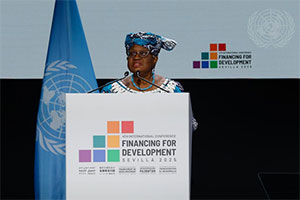 Opening of 4th International Conference on Financing for Development. Credit: UN Photo/Mariscal
International trade and investment are crucial elements of the world economy. While they can be powerful stimulators of development, they can also lead to global imbalances and dynamics of exploitation. In 2025, international trade entered a period of immense disruption, driven in part by a new wave of United States tariffs that reshaped global supply chains and investment flows. The increase in the US tariff rate, the highest since the 1930s, has forced bilateral renegotiations with global trading partners. Furthermore, the debt crisis in developing nations has accelerated while Official Development Assistance (ODA) has substantially dropped 7.3% in 2024.
In the 21st century, advancements in economic diversification in formerly colonized nations have propelled them into more central roles in the global economy. For example, both China and Mexico were able to develop their manufacturing sector and channel this development into booming export flows, thus advancing into the position of emerging economies. Foreign investment also plays an essential role in providing capital for developing countries, although they are oftentimes accompanied by social and environmental exploitation. For example, rising Chinese investments in natural resources in Latin America have often been met with tension as these investment projects fail to properly mitigate environmental risks and protect workers’ rights. In a more multifaceted vein, Sino-African relations have led to infrastructure development in Sub-Saharan Africa while also heightening the region’s economic dependency on China. IPS reports on global news in trade and investment, while shining a light on the nuanced nature of these endeavors.

The Week with IPS

NEXT STOP - SDGs
Tracking global progress towards a sustainable world
Tracking global progress towards a sustainable world
