Languages
Sunday, October 11, 2026



News and Views from the Global South
Trade & Investment

Washington Rules Change, Again
Over the last four decades, the Washington Consensus, promoting economic liberalization, globalization and privatization, reversed four decades of an earlier period of active state intervention to accelerate and stabilize more inclusive economic growth, associated with Franklin Delano Roosevelt and John Maynard Keynes.
Mistrust Hindering Global Solutions, says Secretary General
The global lack of confidence and trust is undermining the ability to solve the world’s complex problems, said UN Secretary-General during an international conference.
Major Crisis, Minor Reforms
The 2008-2009 financial breakdown, precipitated by the US housing mortgage crisis, has triggered an extended stagnation in the developed economies, initially postponed in much of the developing world by high primary commodity prices until 2014. Yet, the financial crisis and protracted economic slowdown since has not led to profound changes in the conventional wisdom or policy prescriptions, especially at the international level, despite global economic integration since the 1980s.
US, EU Food Standards Major Hurdle for Caribbean Exporters
As Caricom countries struggle to move away from their traditional reliance on a single industry or major crop in the face of growing economic uncertainty worldwide, they are finding it increasingly difficult to enter markets in the EU and North America with new types of food products.
US Trade Hawks and the China Bogey
New US President Donald Trump has long insisted that its major trading partners having been taking advantage of it. Changing these trade terms and conditions will thus be top priority for his administration, and central to overall Trump economic strategy to ‘Make America Great Again’.
Demonstrating the Power of Partnerships: The Potential for Universal Health Care in Kenya
Even as the global community set out the 17 Sustainable Development Goals last year, a realization that stood out is that no single unit has the wherewithal to achieve such lofty goals – they will only be achieved through partnerships.Ecuador Revives Campaign for UN Tax Body
The Republic of Ecuador, currently chair of the largest single coalition of developing countries at the United Nations, is reviving a longstanding campaign for the creation of an inter-governmental UN tax body and the elimination of tax havens and illicit financial flows.
Trade War Threat Grows
New American President Donald Trump has long insisted that the United States has been suffering from poor trade deals made by his predecessors. Renegotiating or withdrawing from these deals will be top priority for his administration which views trade policy as key to US economic revival under Trump. What will that mean?
Learning Alliances Help Climate-Smart Agricultural Practices Take Root
Development advocates and professionals are very keen on harnessing the power of agriculture to promote the cause of climate change these days. And rightly so, because agriculture is both a major emitter of greenhouse gases and so a potential force for mitigation, and because billions of people will need to eat, and so adaptation is an absolute necessity.
Harvesting Peace: How Rural Development Works for Conflict Prevention
The year 2016 has seen a massive population flow, unprecedented in its range and reach. Millions of people have fled war-torn communities, natural disasters and violence, some overflowing neighboring countries’ refugee camps, some crossing perilous seas and walking hundreds of miles to reach safer grounds, others seeking refuge in countries half a world away. Thousands have died on their way to safety, countless more were victims of violence and abuse, among them many women and children.
Regional Solutions Key for Asia-pacific’s Transition to Sustainable Energy
The Asia-Pacific region is at a turning point in its energy trajectory. The energy solutions that have fuelled growth in the region over the past few decades are no longer compatible with the sustainable development aspirations of our nations and their people. In transitioning to a new era of sustainable energy, policymakers across the region face complex decisions. Supplies must be secure and affordable, and they must fill the energy access gap which leaves half a billion people across the region without access to electricity. At the same time mitigating the local impacts of energy generation and use will be vital in resolving problems such as the air pollution choking our cities and the global consequences of greenhouse gas emissions causing climate change. Solutions exist, but only through regional cooperation and integration can Asia and the Pacific transition to sustainable energy in time to meet the ambitious 2030 Agenda for Sustainable Development and its Goals.
Trump Trade Strategy Unclear
US President-elect Donald Trump has announced that he will take the US out of the Trans-Pacific Partnership (TPP) Agreement on the first day of his presidency in January 2017. Now, it is widely expected that Trump’s presidency will increase US trade protectionism, and consequently by others in retaliation, possibly triggering serious trade conflicts with difficult to predict consequences.
Free Trade Agreements Promote Corporate Interests
So-called free-trade agreements (FTAs) are generally presumed to promote trade liberalization, but in fact, they do much more to strengthen the power of the most influential transnational corporations of the dominant partner involved. While FTAs typically reduce some barriers to the international trade in goods and services, some provisions strengthen private monopolies and corporate power.
Lessons from the Demise of the TPP
President-elect Donald Trump has promised that he will take the US out of the Trans-Pacific Partnership Agreement (TPPA) on the first day of his presidency. The TPP may now be dead, thanks to Trump and opposition by all major US presidential candidates. With its imminent demise almost certain, it is important to draw on some lessons before it is buried.
Poor Darwin – Robots, Not Nature, Now Make the Selection
When British naturalist Charles Darwin published in 1859 his theory of evolution in his work On the Origin of Species, he most likely did not expect that robots, not nature, would someday be in charge of the selection process.
Stop worrying about ‘Doing Business’ ranking
Without any hint of irony, the World Bank’s most recent Doing Business Report 2017 promises ‘Equal Opportunity for All’. Bangladesh ranked 176th among 190 economies, below civil war-ravaged Iraq and Syria! Bangladesh even slipped two places from 174 in the 2016 ranking and is three places below its 2015 ranking.
More of the Same: World Bank Doing Business Report Continues to Mislead
The World Bank’s Doing Business Report 2017, subtitled ‘Equal Opportunity for All’, continues to mislead despite the many criticisms, including from within, levelled against the Bank’s most widely read publication, and Bank management promises of reform for many years.
Why Achieving Sdg Goal 8 on Decent Work and Economic Growth Is Critical for Kenya
In Kenya the Gini coefficient of inequality is at around 0.45%. Therefore, the economic growth statistics present an unequivocal picture of a highly unequal society, whose development strategy is largely leading to accumulation of wealth by a few and worsening the poverty of the majority.
Fiscal Austerity Has Been Blocking Economic Recovery
Instead of concerted and sustained efforts for a strong, sustained economic recovery to overcome protracted stagnation, the near policy consensus on fiscal austerity in the G7 and the G20 OECD countries, except for the US and Japan, has dragged down economic recovery in developing countries.
Rethinking trade policy and protectionism in the Trump era
What kind of trade policy will the United States have under President Donald Trump? This is a hot issue, as Trump has made unorthodox pronouncements on trade issues during and after the election campaign. If he acts on even some of the positions he took, it will create a sea change in trade policy in the US and possibly the world.
Unleashing Africa Full Potential
Africa, the cradle of mankind and home to the youngest population in the world, has a historic opportunity to realise its full potential, in sharing our potential prosperity, by enhancing economic growth, promoting and entrenching democratic ideals. That is why I am so passionate to be running for the coveted African Union Commission (AUC) Chairperson.« Previous Page — Next Page »





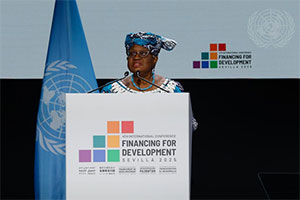 Opening of 4th International Conference on Financing for Development. Credit: UN Photo/Mariscal
International trade and investment are crucial elements of the world economy. While they can be powerful stimulators of development, they can also lead to global imbalances and dynamics of exploitation. In 2025, international trade entered a period of immense disruption, driven in part by a new wave of United States tariffs that reshaped global supply chains and investment flows. The increase in the US tariff rate, the highest since the 1930s, has forced bilateral renegotiations with global trading partners. Furthermore, the debt crisis in developing nations has accelerated while Official Development Assistance (ODA) has substantially dropped 7.3% in 2024.
In the 21st century, advancements in economic diversification in formerly colonized nations have propelled them into more central roles in the global economy. For example, both China and Mexico were able to develop their manufacturing sector and channel this development into booming export flows, thus advancing into the position of emerging economies. Foreign investment also plays an essential role in providing capital for developing countries, although they are oftentimes accompanied by social and environmental exploitation. For example, rising Chinese investments in natural resources in Latin America have often been met with tension as these investment projects fail to properly mitigate environmental risks and protect workers’ rights. In a more multifaceted vein, Sino-African relations have led to infrastructure development in Sub-Saharan Africa while also heightening the region’s economic dependency on China. IPS reports on global news in trade and investment, while shining a light on the nuanced nature of these endeavors.

The Week with IPS

NEXT STOP - SDGs
Tracking global progress towards a sustainable world
Tracking global progress towards a sustainable world
