Languages
Monday, October 12, 2026



News and Views from the Global South
Trade & Investment

ISDS Corporate Rule of Law
Investor-state dispute settlement (ISDS) provisions in ostensible free trade agreements (FTAs) and bilateral investment treaties (BITs) have effectively created a powerful, privileged system of protections for foreign investors that undermine national law and institutions. ISDS allows foreign corporations to sue governments for causing them losses due to legal or regulatory changes.
Ensuring Shared Progress for Sustainable Development and Peace
International inequality has grown over recent centuries, especially the last two. Before the Industrial Revolution, between-country inequalities were small, while within-country inequalities accounted for most of overall global income inequality. Now, inter-country income inequalities account for about two-thirds of world inequality with intra-country inequality accounting for a third.
Initial Global Effects of Trump Even Before Taking Office
Even before taking office, President-Elect Donald Trump and the policies he promised during his campaign are already having a worldwide impact in at least three areas -- global finance, trade and climate change.
Kenya’s Youth Unemployment Challenge Presents Opportunities
Consider this paradox. Every year 1 million young people join the job market in Kenya, yet Kenya has the largest number of jobless youth in East Africa. As the government puts in place measures for addressing the issue of high youth unemployment and poverty, The private sector needs to join forces to sustainably grow its business and markets. Businesses and the societies that they operate in are symbiotic and it is now an established maxim that business cannot succeed in societies that fail.
Rural Job Creation Holds the Key to Development and Food-Security Goals
Harvesting the benefits of core agricultural research, which often bears on improved crop varieties and plant diseases, increasingly depends on the social and economic conditions into which its seeds are sown. It is a sign of the times that Kanayo F. Nwanze, the president of the International Fund for Agricultural Development who started off as a cassava entomologist when ITTA posted him to Congo in the 1970s, was recently hailed for his efforts to create African billionaires.
Inequality and Its Discontents
Global income inequality among different regions began to increase about five centuries ago, before accelerating about two centuries ago, according to the great economic historian Angus Maddison. After the brief reversal during the ‘Golden Age’ quarter century after the Second World War, higher commodity prices in the decade until 2014, despite protracted slowdowns in most rich countries following the 2008 financial crisis, reduced international disparities between North and South.
Thriving Rural Communities Is a Recipe for Healthy Cities
As the dust has settled on Habitat III and the summit in Quito, Ecuador, we now have a clear vision and a concrete road map for how to transform our cities into inclusive, safer and more productive environments. The New Urban Agenda comes at a propitious time. Urbanization is growing at a fast pace, particularly in developing countries, where the urban population is expected to double by 2050. In South Asia alone, the urban population grew by 130 million between 2001 and 2011, according to recent World Bank study. Another 250 million are expected to join them by 2030.
Why Kenya’s Engagement with the UN Is a Big Deal
President Uhuru Kenyatta warmly welcomed dozens of U.N Agencies, development partners and senior Government officials to the State House on 02 November 2016 to discuss the joint development plan from 2014 – 2018.
Convincing Investors to Unlock Africa’s Green Energy Potential
Lowering investment risks in African countries is key to achieving a climate-resilient development pathway on the continent, say experts here at the U.N.-sponsored Climate Conference.
A Cuban Economy Facing Grim Forecasts Awaits Impact of Trump
Cuba’s economic difficulties will be aggravated by the uncertainty regarding how U.S. president-elect Donald Trump will deal with the thaw inherited from President Barack Obama.
Changing Determinants of Global Income Inequality
Global income inequality among different regions began to increase about five centuries ago, before accelerating two centuries ago. The data suggest a brief reversal during the Golden Age quarter century after the Second World War, and in the last decade, with higher primary commodity prices once again, and protracted stagnation in much of the North following the 2008-2009 financial crisis.
Privatization Cure Often Worse Than Malady
Privatization of SOEs has been a cornerstone of the neo-liberal counterrevolution that swept the world from the 1980s following the economic crisis brought about by US Fed’s sharp hike in interest rates. Developing countries, seeking aid from the International Monetary Fund (IMF) and the World Bank, often had to commit to privatization as a condition for credit support.
Are Public Enterprises Necessarily Inefficient?
From the 1980s, various studies purported to portray the public sector as a cesspool of abuse, inefficiency, incompetence and corruption. Books and articles with pejorative titles such as ‘vampire state’, ‘bureaucrats in business’ and so on thus provided the justification for privatization policies. Despite the caricature and exaggeration, there were always undoubted horror stories which could be cited as supposedly representative examples. But similarly, by way of contrast, other experiences show that SOEs can be run quite efficiently, even on commercial bases, confounding the dire predictions of the prophets of public sector doom.
UN Cuba Embargo Vote: United States Abstains for First Time
After 25 years of voting against a United Nations resolution condemning the United States (U.S.) embargo on Cuba, the U.S. Wednesday chose for the first time to abstain from voting. An overwhelming 191 UN member states voted for the resolution, with only Israel joining the United States in abstention.
Stronger Collaboration for Greater Energy Access in Asia Pacific
The emergence of new ideas, technological advancements and innovative market-driven financing solutions has lent confidence to the idea that universal access to energy services is attainable. This is particularly good news in the Asia and the Pacific region, where, despite making significant contributions to global growth and poverty reduction since 2000, nearly half a billion citizens still have no access to modern energy, principally in rural and far-flung areas. Three-quarters of these people live in South Asia alone. Some 70% of the Pacific island households are un-electrified, a level similar to sub-Saharan Africa. The lack of electricity and clean cooking options marginalizes predominantly remote and slum communities who are trapped in energy poverty, preventing them from stepping on the first rung of the ladder to prosperity.
Privatization the Problem, Rarely the Solution
Privatization has been one of the pillars of the counter-revolution against development economics and government activism from the 1980s. Many developing countries were forced to accept privatization as a condition for support from the World Bank while many other countries have embraced privatization, often on the pretext of fiscal and debt constraints.
Trump, Clinton, Obama and the TPP
The Trans-Pacific Partnership (TPP) agreement between the US and eleven other Pacific Rim countries was under negotiation for the first seven years of the Obama presidency. For the first four years, Hilary Clinton was the Secretary of State, directly supervising the negotiations. Even after she quit her cabinet position to launch for her second presidential bid, she continued to tout it in superlative terms.
$90tn Infrastructure Investment Could Combat Climate Change: Report
The world will need to more than double its current infrastructure stock over the next 15 years - a massive undertaking which could either contribute to or combat catastrophic climate change - according to a new report.
Coffee Producers in Costa Rica Use Science to Tackle Climate Change
“Our coffee production per hectare has dropped due to early ripening of the fruit and diseases,” Maritza Cal[related_articles][related_articles] coffee farmer in the mountains in southern Costa Rica, told IPS.
Closing the Broadband Divide to Connect People in Asia and the Pacific
Advances in Information and Communication Technology (ICT) have been instrumental in shaping and leading socioeconomic transformations across Asia and the Pacific. One key to this transformation is the technology bundled around the “Internet of Things” (IoT), which enables billions of devices and appliances to connect over the Internet for more accurate, real time data collection and analysis in an unparalleled scale. For instance, through Internet-connected sensors attached to equipment, facilities and infrastructure, early-on maintenance alarms can be raised for potential problems, such as defects or wear and tear, thereby potentially saving the lives of those using them. Another example is devices on farms that remotely monitor soil conditions, weather and pesticide use for more rapid and better-informed decision making.
Jobs Are Crucial for Peace, Stem Radicalization and Violent Extremism in Kenya
Today 21 September 2016 is the International Day of Peace. Kenya has the largest number of jobless youth in East Africa, putting a strain on the economy’s growth and also threatening peace and security when hopeless youth gravitate towards violent extremist groups.« Previous Page — Next Page »





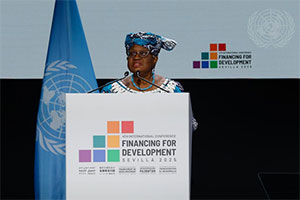 Opening of 4th International Conference on Financing for Development. Credit: UN Photo/Mariscal
International trade and investment are crucial elements of the world economy. While they can be powerful stimulators of development, they can also lead to global imbalances and dynamics of exploitation. In 2025, international trade entered a period of immense disruption, driven in part by a new wave of United States tariffs that reshaped global supply chains and investment flows. The increase in the US tariff rate, the highest since the 1930s, has forced bilateral renegotiations with global trading partners. Furthermore, the debt crisis in developing nations has accelerated while Official Development Assistance (ODA) has substantially dropped 7.3% in 2024.
In the 21st century, advancements in economic diversification in formerly colonized nations have propelled them into more central roles in the global economy. For example, both China and Mexico were able to develop their manufacturing sector and channel this development into booming export flows, thus advancing into the position of emerging economies. Foreign investment also plays an essential role in providing capital for developing countries, although they are oftentimes accompanied by social and environmental exploitation. For example, rising Chinese investments in natural resources in Latin America have often been met with tension as these investment projects fail to properly mitigate environmental risks and protect workers’ rights. In a more multifaceted vein, Sino-African relations have led to infrastructure development in Sub-Saharan Africa while also heightening the region’s economic dependency on China. IPS reports on global news in trade and investment, while shining a light on the nuanced nature of these endeavors.

The Week with IPS

NEXT STOP - SDGs
Tracking global progress towards a sustainable world
Tracking global progress towards a sustainable world
