Languages
Tuesday, October 13, 2026



News and Views from the Global South
Trade & Investment

Jobs Are Crucial for Peace, Stem Radicalization and Violent Extremism in Kenya
Today 21 September 2016 is the International Day of Peace. Kenya has the largest number of jobless youth in East Africa, putting a strain on the economy’s growth and also threatening peace and security when hopeless youth gravitate towards violent extremist groups.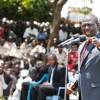
The Public Benefit Organisations Act Will Help Kenya’s March Towards the Sustainable Development Goals
The Sustainable Development Goals (SDGs) in Kenya was launched on 14 September 2016, Representing President Uhuru Kenyatta, the Cabinet Secretary of the Ministry of Devolution and planning Mr Mwangi Kiunjuri, said Kenya was way ahead of implementing the SDGs through its Vision 2030, and the devolved system of Governance
European Security with or Without Russia?
Consequences of the Chinese-Russian Alliance on the Relationship Between USA and EU
The joint military manoeuvres between the Russian and Chinese navies, armies, and air forces has kicked off. It's a clear message for Washington, which has recently strengthened its action in Asia, indicating that as a country that overlooks the Pacific, it wants to play an important role in the continent, aimed at containing the Chinese expansion.

Drought Deals Harsh Blow to Cameroon’s Cocoa Farmers
Tanchenow Daniel fears he will lose more than half a tonne of his cocoa yield during the next harvest at the end of this month.
Asia, Looking Beyond the Green Revolution
 More than 2.2 billion people in Asia rely on agriculture for their livelihoods, but the Asian Development Bank warns that stagnant and declining yields of major crops such as rice and wheat can be ultimately linked to declining investments in agriculture. Public investments in agriculture in India, for instance, have been roughly the same since 2004.

Nurturing African Agriculture
While agriculture could be the driving force to lift millions of Africans out of poverty and alleviate hunger, its full potential remains untapped. For example, only between five and seven percent of the continent’s cultivated land is irrigated, leaving farmers vulnerable to climate shocks like the devastating El Nino-driven drought in southern Africa. That's why international agencies like the U.N. Food and Agriculture Organization (FAO) are forging key partnerships to enhance agricultural production, sustainable natural resource management and increased market access. 
Ships Bring Your Coffee, Snack and TV Set, But Also Pests and Diseases
“Every evening, millions of people all over the world will settle into their armchairs to watch some TV after a hard day at work. Many will have a snack or something to drink…
Uruguay’s Victory over Philip Morris: a Win for Tobacco Control and Public Health
In a landmark decision that has been hailed as a victory of public health measures against narrow commercial interests, an international tribunal has dismissed a claim by tobacco giant company Philip Morris that the Uruguay government violated its rights by instituting tobacco control measures.
TPPA could be discarded due to US political dynamics
No country was more active in pushing for the Trans Pacific Partnership (TPP). In the five years of negotiations, the United States cajoled, persuaded and pressurised its trade partners take on board its issues and positions.
Arable Lands Lost at Unprecedented Rate: 33,000 Hectares… a Day!
Humankind is a witness every single day to a new, unprecedented challenge. One of them is the very fact that the world's arable lands are being lost at 30 to 35 times the historical rate. Each year, 12 million hectares are lost. That means 33,000 hectares a day!
The Economic Partnership Agreement has never made much sense for Tanzania
The EPA issue has once again re-emerged when, in early July, Tanzania informed East African Community( EAC) members and the European Union (EU) that it would not be able to sign the Economic Partnership Agreement (EPA) between European Union (EU) and the six EAC member states.
Youth Key to the Success of the SDGs in Kenya
Consider this: in 1956 Sweden and Kenya’s population was roughly at 7 million. Today Sweden has about 9.8 million, while there are about 44 million Kenyans. Fertility levels are declining gradually and Kenyans are living longer. It is estimated that there will be 85 million people in Kenya by 2050, with three quarters of these being below 35 years. While Kenya’s median age is 19, Sweden’s is 42.
Youth Employment: Turning Workplace Partnerships into Opportunity
Many of us can remember the difficulties of getting our first job – the searching, the frustration of rejection, the nervous wait for an interview or the first day of work. Today’s staggering unemployment rates in many countries make it an especially difficult time for young job-seekers.
War on Climate Terror (II): Fleeing Disasters, Escaping Drought, Migrating
"No one can deny the terrible similarities between those running from the threat of guns and those fleeing creeping desertification, water shortages, floods and hurricanes.”Expansionary fiscal consolidation myth
The debt crisis in Europe continues to drag on. Drastic measures to cut government debts and deficits, including by replacing democratically elected governments with ‘technocrats’, have only made things worse. The more recent drastic expenditure cuts in Europe to quickly reduce public finance deficits have not only adversely impacted the lives of millions as unemployment soared. The actions also seem to have killed the goose that lay the golden egg of economic growth, resulting in a ‘low growth’ debt trap.
The Wild Cards
The Rio Olympics began with the signature fanfare that accompanies the Games every four years. However, unlike every year, the nature and size of the spectacle, the synchronised dancers, over-the-top fireworks and the millions spent brought a new set of disappointments with them.
Kenya’s Health Sector Challenges Present the Ideal Setting for Creating Shared Value
The increased budgetary allocations to the health sector by county governments point to an acknowledgement not only of the enormous challenges facing the sector, but also of good health as a prerequisite to overall development.
War on Climate Terror (I): Deserts Bury Two Thirds of African Lands
Two-thirds of the African continent is already desert or dry-lands. But while this vast extension of the second largest continent on Earth after Asia is “vital” for agriculture and food production, nearly three-fourths of it is estimated to be degraded to varying degrees.
Blame It on Cronyism, Not the Free Market
The current condition of global economic inequality should be of concern to all. An Oxfam report published this year titled, An economy for the 1%, revealed that “the richest 1% now have more wealth than the rest of the world combined.” It also said that "62 of the richest people now own more wealth than the bottom half of the world's population. In 2015 it was the 80 richest, in 2014 it was 85 and in 2010, only six years back, it was 388 richest that owned similar wealth”, showing that inequality is actually growing at an increasing rate. This is also made evident by the fact that “the wealth of the poorest half of the world's population has fallen by a trillion dollars since 2010, a drop of 38 percent" while “the wealth of the richest 62 has increased [during the same period] by more than half a trillion dollars to $1.76 trillion.”
African Farmers Can Feed the World, If Only…
Can African farmers feed the world?. Apparently the answer is “yes.” Bold as it may sound, this statement is based on specific facts: Africa is home to 60-65 per cent of the world’s uncultivated arable land and 10 per cent of renewable freshwater resources, and it has registered a 160 per cent increase in agricultural output over the past 30 years.
Developing Nations Seek Tax Body to Curb Illicit Financial Flows
Despite Western opposition, the 134-member Group of 77 is continuing to pursue a longstanding proposal for an inter-governmental UN-affiliated tax body aimed at combating corporate tax dodging and curbing illicit financial flows, including money laundering and off-shore banking.« Previous Page — Next Page »





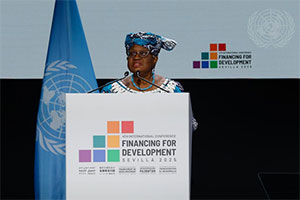 Opening of 4th International Conference on Financing for Development. Credit: UN Photo/Mariscal
International trade and investment are crucial elements of the world economy. While they can be powerful stimulators of development, they can also lead to global imbalances and dynamics of exploitation. In 2025, international trade entered a period of immense disruption, driven in part by a new wave of United States tariffs that reshaped global supply chains and investment flows. The increase in the US tariff rate, the highest since the 1930s, has forced bilateral renegotiations with global trading partners. Furthermore, the debt crisis in developing nations has accelerated while Official Development Assistance (ODA) has substantially dropped 7.3% in 2024.
In the 21st century, advancements in economic diversification in formerly colonized nations have propelled them into more central roles in the global economy. For example, both China and Mexico were able to develop their manufacturing sector and channel this development into booming export flows, thus advancing into the position of emerging economies. Foreign investment also plays an essential role in providing capital for developing countries, although they are oftentimes accompanied by social and environmental exploitation. For example, rising Chinese investments in natural resources in Latin America have often been met with tension as these investment projects fail to properly mitigate environmental risks and protect workers’ rights. In a more multifaceted vein, Sino-African relations have led to infrastructure development in Sub-Saharan Africa while also heightening the region’s economic dependency on China. IPS reports on global news in trade and investment, while shining a light on the nuanced nature of these endeavors.

The Week with IPS

NEXT STOP - SDGs
Tracking global progress towards a sustainable world
Tracking global progress towards a sustainable world
