Languages
Monday, November 23, 2026



News and Views from the Global South
Global Geopolitics
WORLD: Fair Trade – An Old Idea That’s Become a Fashion Statement?
The idea of making trade fair is as old as ethics itself.
ECONOMY: It Pays to Go Green
A new report shows how a greener economy could eradicate poverty by creating tens of millions of new jobs. But it will not happen solely through the market's "magic hand".POLITICS: Financial Crisis Likely to Further Erode U.S. Influence
While the White House and U.S. lawmakers hash out final terms of a proposed 700-billion-dollar Wall Street bailout, foreign policy analysts are warning that the current financial crisis could very well hasten the decline of U.S. power and influence overseas.DEVELOPMENT: Home Stretch for MDGs Looks Bumpier Than Ever
At a time when the world's cash-strapped developing nations, particularly in Africa, have admitted their inability to meet most of the U.N.'s eight Millennium Development Goals (MDGs), one Latin American country stands apart - confident it could even beat the deadline set by the United Nations.DEVELOPMENT: Matching Struggling Farmers with the World’s Hungry
In a significant policy shift, the Rome-based World Food Programme (WFP) announced Wednesday that it will start buying food directly from local farmers' associations in developing countries.CLIMATE CHANGE: Denmark, Norway Grapple with Growing CO2
Even as Scandinavian leaders have assumed a prominent role in international efforts to cut greenhouse gas emissions and combat climate change, both Norway and Denmark have failed to reduce their own emissions.EUROPE: Uncertain over Containing 'Crazy' Markets
The turmoil in the financial markets and the resulting slump in the global economy has highlighted the stark inequality in the European Union.ECONOMY: Global Investment Feels Impact of Crisis
The international turmoil and economic slowdown triggered by the U.S. financial crisis are having a major impact on global investment, which will drop 10 percent this year from last year’s record level of 1.8 trillion dollars.
RIGHTS: Oil Companies’ “Self-Policing” a Dismal Failure
The intersection of human rights, the environment and corporate responsibility was highlighted today at a Capitol Hill hearing featuring activists from Burma and Nigeria who underlined the failure to date of "voluntary" controls over major oil companies operating in their countries.
ENVIRONMENT: No Hope for MDGs Without Climate Plan
With 2.6 billion of the world's poor affected daily by climate change, the linkages between environment, health and poverty cannot be questioned any longer, U.N. experts say.
IRAN: Ahmadinejad Open to U.S. Talks, Denounces Threats
At a press conference following his speech to the U.N. General Assembly Tuesday, Iranian President Mahmoud Ahmadinejad said he would welcome discussions with the U.S. presidential candidates, but added that "the condition is that our meeting should be open so that all media know what happens."DEVELOPMENT: IBSA Summit – Will South-South Cooperation Regain Clout?
The India-Brazil-South Africa (IBSA) Dialogue Forum will hold its third annual summit on Oct. 15 in New Delhi, India, the first such meeting after this trilateral body of countries of the developing South met with a serious setback at the World Trade Organisation (WTO) negotiations.
Q&A: 'Corruption Nourishes Poverty'
A new report by Transparency International (TI) lashes out at some of the world's poorest countries for an "ongoing humanitarian disaster", and deplores the wealthiest for not doing enough to stem graft.POLITICS-PAKISTAN: No Military Solutions to Suicide Bombings
Political analysts have long been warning the United States and Pakistan governments that there are no easy military solutions in prosecuting the global ‘war on terror’ which may now have become inextricable from ‘home-grown’ militancy.AUSTRALIA: Wary of Asia Pacific’s Modernising Militaries
Australian Prime Minister Kevin Rudd has warned that Australia needs to prepare for "the increased militarisation" of the Asia-Pacific.
IRAN: Activists Spotlight Rights Abuses on Eve of U.N. Meet
A day before Iranian President Mahmoud Ahmadinejad addresses world leaders at the United Nations, human rights activists criticised his government's record and urged the international community to hold the president accountable during his visit to New York.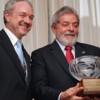
MEDIA: Lula a "Tireless Advocate" for the Poor and Landless
Brazilian President Luiz Inacio Lula da Silva, who rose from a poor childhood to lead a growing economic powerhouse that has placed the ideal of inclusive prosperity at the centre of its development policies, received the Inter Press Service (IPS) International Achievement Award 2008 Monday.DEVELOPMENT: Poverty Reduction Claims Under Scrutiny
The World Bank's recent estimates on global poverty, particularly in relation to China, are being challenged by an international non-governmental organisation (NGO) which monitors poverty eradication and gender equality.ENVIRONMENT: Push for Biofuels Losing Energy
The European Union's only directly elected body has urged that a contentious target for using agricultural crops to meet one-tenth of the bloc's transport demands should be reduced.
POLITICS-INDIA: Polls Uncertain With Jammu Divided From Kashmir
Plans by the central government to conduct elections in Jammu and Kashmir, due originally in November, remain uncertain because of the serious regional and religious differences that have cropped up between the two main regions that make up the composite territory.INDIA/AUSTRALIA: Sticking to Uranium Export Ban – For Now
The Rudd government has reiterated its refusal to sell uranium to countries which have not signed up to the Nuclear non-Proliferation Treaty (NPT), such as India, despite supporting the decision by the Nuclear Suppliers Group (NSG) to back the United States-India nuclear cooperation agreement.« Previous Page — Next Page »


Is the world dominated by three great empires -- the U.S.A, China and the European Union? How much power do the great behemoths of the south -- India, Brazil, and South Africa -- wield? And where does Russia fit in that equation? Are we in the middle of a new Cold War? What are the implications of the armed conflict with Georgia? What about the new axis: Venezuela-Russia? And what role does Turkey play? What about issues like Climate Change and other global forces like the food crisis and the high energy prices? How is all this reshaping the world's forces? IPS looks for some answers.

The Week with IPS

NEXT STOP - SDGs
Tracking global progress towards a sustainable world
