Languages
Thursday, November 19, 2026



News and Views from the Global South
Active Citizens
ZAMBIA-POLITICS: Grumbling Over Constitutional Review
Two years into its work, the Zambia's National Constitutional Conference (NCC) is finding it difficult to get wide public acceptance.
MEDIA-SOUTH AFRICA: Battle Over Future of Public Broadcaster
A powerful coalition of civic organisations is calling for a complete overhaul of the legal framework of the South African Broadcasting Corporation (SABC) to force it to fulfil its public broadcasting mandate.EDUCATION-ZAMBIA: Communities Doing it For Themselves
"My mother has no job and she cannot afford the cost of educating me and my sister at the government school," says 12-year-old Muyunda Nyamba. But the little boy is one of 37,000 children from Zambia's poorest neighbourhoods beginning the new school year calendar at community-run schools.
EAST AFRICA: Increasing Women's Participation in Government
Kenya’s poor record of improving percentage of women in decision making positions has come under scrutiny, but its neighbours are doing significantly better.
Q&A: World Social Forum is Not a Static Platform
Onyango Oloo was the national coordinator of the Kenyan Social Forum in 2007 when the last global World Social Forum (WSF)took place in Nairobi. As another gathering of activists from around the world unfolds in Belém, Brazil, IPS asked Oloo for his views on the Forum's past and future.
MAURITIUS-RIGHTS: Sceptical Welcome for Equality Law
Nobody shall suffer prejudice in his social life or his place of work because of his or her ethnic origin, religion, age, sexual orientation, political conviction or physical handicap. This is the challenge of Mauritius's new Equal Opportunities Act (EOA).RIGHTS-ETHIOPIA: Strangling Criticism
The Ethiopian parliament has voted into law a controversial bill which bars any civil society organisation receiving more than 10 percent of its funding from foreign sources from engaging in human rights issues.RIGHTS-ZAMBIA: Vulnerable Children Must Fend For Themselves
There will be as many as one and a half million orphaned children in Zambia by 2010. Deprived of adult guardians by the AIDS pandemic, many of these children will end up living in the streets of the country's major towns and cities.RIGHTS-AFRICA: Extending Constitutional Justice
Jurisprudence in Africa has improved a lot since the early 1990s, but a lot of work still has to be done to improve justice structures across the continent.
Q&A: Unlocking the Power of Constitutional Rights
South Africa's constitution is often celebrated for its protection of social and economic rights; but how readily can this protection be invoked by the most vulnerable?ZAMBIA: Corruption: Two Steps Forward, Two Steps Back
Zambia's Anti-Corruption Commission (ACC) received more than 2,000 corruption complaints from the public for 2008, the ACC yearly report states.DR CONGO: Speak of the Real Authors of the War
Each episode of the Democratic Republic of Congo's long-running civil war has weighed particularly heavily on women, yet women have relatively little voice in the negotiations for peace.ETHIOPIA: Political Space Narrowing
Bertukan Mideksa has a reputation in Ethiopia as a competent politician, but voters will not be able to cast ballots for her in the next national election. The revocation of her 2007 pardon has sent a chill through Ethiopia's opposition parties.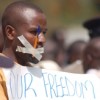
KENYA: Press Freedom: Going, Going, Gone
Dark clouds are forming against freedom of expression in Kenya, following the recent passing of a controversial Bill by parliament. The Kenya Communications (Amendment) Bill, awaiting presidential assent to become law, gives the state powers to invade media houses, seize broadcast equipment, control broadcast content, even taking a station off air.ANGOLA: Deadly Countdown for Small Parties
Angola’s vast, confusing party landscape is about to undergo a major transformation: as of January, 22 parties and coalitions will simply vanish from the political map.
Q&A: Failure to Translate Women’s Legal Rights into Action
Each year, for 16 days in December, the world’s focus shifts towards taking action against gender-based violence. Governments and civil society organisations raise awareness around women’s rights and lobby for gender equality. But activists lament that little action is taken throughout the rest of the year and women’s legal rights often fail to be implemented and put to action.GENDER-KENYA: Renewed Campaign to Protect Women's Land Rights
Pressure is mounting to include a National Land Policy that ensures equal access to land between women and men in Kenya's new constitution.POLITICS-AFRICA: Constitutions Affirmed as Essential for Democracy
One of Africa's main challenges is ensuring that constitutions reflect a consensus amongst all sectors of the population, including vulnerable groups such as women, are rarely taken into account in constitutional strengthening initiatives.ZAMBIA: Violence Against Women on the Rise
"There will be no peace, security and sustainable economic development in Zambia as long as women’s rights continue to be treated as a secondary issue," said Non-Governmental Organisation Coordination Committee (NGOCC) chairperson Marian Munyinda.Q&A: "How Are We Going to Sustain Gender Approaches?"
The negative aspects of Africa's experience with structural adjustment programmes beginning in the 1990s have been well-documented - facing high debt loads, African governments agreed to liberalise their economies, privatise public enterprises, and sharply reduce social spending with often painful effects on the most vulnerable.
GENDER-AFRICA: "Where Is The Money?"
"Investing in women pays off. It is an effective means to reduce poverty and accelerate the achievement of the rest of the MDGs," says Danish minister for development cooperation Ulla Tørnæs.« Previous Page — Next Page »


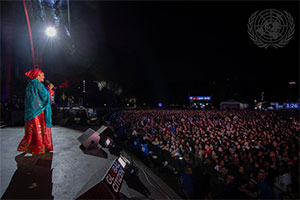 Global Citizen Festival in New York. Credit: UN Photo/Eskinder Debebe
Active citizens are committed to social change because they know that it is achievable. However, major political challenges face active citizens across the world. For example, in authoritarian regimes in Latin America where the hegemonic party has been in power for decades on end, protestors and human rights activists face enormous repression and struggle to materialize their advocacy into concrete results. The same can be said for Africans, where a shift towards elected government in recent decades has yet to translate into an effective voice in decision-making. Now, the Strengthening Citizen Demand for Good Governance, which uses evidence-based approaches – funded by DFID's Governance and Transparency Fund – seeks to raise their voices.
In 2025, the CIVICUS Monitor’s People Power Under Attack report revealed that civic freedoms are severely limited in 122 of 198 countries and territories, and only 7.2% of the global population now lives in countries where civic space is open. Through partnership with the Overseas Development Institute (ODI) and CIVICUS, IPS reporters across the continent will seek to define the extent and limits of state capability, government accountability and the responsiveness of leaders to the needs of citizens.

The Week with IPS

NEXT STOP - SDGs
Tracking global progress towards a sustainable world
Tracking global progress towards a sustainable world
