Saturday, September 26, 2026



News and Views from the Global South


Climate Change Brings Opportunities for Caribbean Entrepreneurs
 Ruth Spencer, a solar energy pioneer in Antigua and Barbuda, says small non-governmental organisations (NGOs) have a crucial role to play in “the big projects” aimed at tackling the problems caused by the burning of fossil fuels, such as coal, oil and gas.
Antigua Faces Climate Risks with Ambitious Renewables Target
Ruth Spencer is a pioneer in the field of solar energy. She promotes renewable technologies to communities throughout her homeland of Antigua and Barbuda, playing a small but important part in helping the country achieve its goal of a 20-percent reduction in the use of fossil fuels by 2020.
Climate Change an “Existential Threat” for the Caribbean
When it comes to climate change, Prime Minister Ralph Gonsalves doesn’t mince words: he will tell you that it is a matter of life and death for Small Island Developing States (SIDS).
Boosting the Natural Disaster Immunity of Caribbean Hospitals
When floods overwhelmed the Eastern Caribbean in December last year, St. Vincent’s new smart hospital, completed just a few months earlier, stood the test of “remaining functional during and immediately after a natural disaster.”
Blue Halo: A Conservation Flagship, or Death Knell for Fishermen?
Local fishermen are singing the blues over a sweeping set of new ocean management regulations, signed into law by the Barbuda Council, to zone their coastal waters, strengthen fisheries management, and establish a network of marine sanctuaries.
For Caribbean, no Climate Policy without Water Policy
Amidst growing concern over the impact of climate change on water resources worldwide, Caribbean stakeholders are working to ensure it is included in the region’s plans for Integrated Water Resources Management (IWRM). 
Climate Policy Goes Hand-in-Hand with Water Policy
Concerned that climate change could lead to an intensification of the global hydrological cycle, Caribbean stakeholders are working to ensure it is included in the region's plans for Integrated Water Resources Management (IWRM).
Island States to Rally Donors at Samoa Meet
Amid accelerating climate change and other challenges, a major international conference in the South Pacific island nation of Samoa next month represents a key chance for Small Island Developing States (SIDS) in the Caribbean to turn the tide.
Putting the Littlest Disaster Victims on the Caribbean’s Climate Agenda
Children are often the forgotten ones when policy-makers map out strategies to deal with climate change, even as they are least capable of fending for themselves in times of trouble.
Bringing “Smart” Building Technology to Jamaica’s Shantytowns
Buildings are among the largest consumers of earth’s natural resources. According to the Sustainable Buildings and Climate Initiative, they use about 40 percent of global energy and 25 percent of global water, while emitting about a third of greenhouse gas emissions.
Antigua Weighs High Cost of Fossil Fuels
Caught between its quest to grow the economy, create jobs and cut electricity costs, and the negative impacts associated with building an oil refinery, the Antigua and Barbuda government is looking to a mix of clean energy and fossil fuels to address its energy needs.
St. Lucia Builds Resilience to Drought and Flooding
As unpredictable weather patterns impact water availability and quality in St. Lucia, the Caribbean island is moving to build resilience to climate-related stresses in its water sector. 
Caribbean Grapples with Intense New Cycles of Flooding and Drought
As unpredictable weather patterns impact water availability and quality in St. Lucia, the Caribbean island is moving to build resilience to climate-related stresses in its water sector.
OPINION: The Caribbean: A Clean Energy Revolution on the Front Lines of Climate Change
Lefties Food Stall, a pint-sized eatery serving Barbados’ signature flying-fish sandwiches, recently became the first snack shack on the Caribbean island to be fitted with a solar panel.
El Niño Triggers Drought, Food Crisis in Nicaragua
The spectre of famine is haunting Nicaragua. The second poorest country in Latin America, and one of the 10 most vulnerable to climate change in the world, is facing a meteorological phenomenon that threatens its food security.
New Data Sends Wake-Up Call on Caribbean Reefs
Marine environmentalist Eli Fuller, who for the past two decades has been exploring the coastline of Antigua and Barbuda, warns that while there has been “dramatic changes” to coral reefs since he was a little boy, “it’s getting worse and worse.”
At the Crucial Nexus of Water and Energy
Global institutions are still in the learning phase when it comes to successfully managing water and energy in an integrated manner as part of the quest for sustainable development.
For the Caribbean, a United Front Is Key to Weathering Climate Change
As the costs of climate change continue to mount, officials with the Commonwealth grouping say it is vital that Small Island Developing States (SIDS) stick together on issues such as per capita income classification.
Tiny Barbuda Grapples with Rising Seas
The 1,800 residents of the tiny Caribbean island of Barbuda are learning to adapt as climate change proves to be a force to reckon with, disrupting not just the lives of the living but also the resting places of those who died centuries ago.

Adapting to a Dry Season That Never Seems to End
The Caribbean region’s bid to become food secure is in peril as farmers struggle to produce staple crops under harsh drought conditions brought about by climate change.« Previous Page — Next Page »


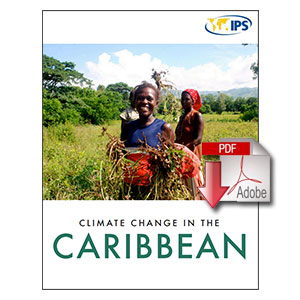
As the world moves to implement the Paris Climate Change Agreement, the Caribbean—one of the most vulnerable regions to rising sea levels—faces a host of challenges, including accessing funding for adaptation and mitigation, protecting key sectors like tourism and agriculture, building resilience to natural disasters, and moving to a low-carbon development path. Much of the world’s most interesting work in addressing climate change, adopting clean energy and coming up with plans to stem deforestation has its roots in the developing world, where climate change impacts are often felt first and strongest. IPS looks at the wide variety of local, national and regional initiatives in the Caribbean that offer creative solutions to these problems.
 |
|||
 |
 |
 |
 |

Caribbean Climate Wire