Tuesday, September 29, 2026



News and Views from the Global South


Disaster-Prone Caribbean Looks to Better Financing
A freak storm, followed by heavy floods in December 2013, will go down in history as the most destructive natural disaster to have hit the Caribbean island nation of St. Vincent and the Grenadines, with reported total damages and losses of at least 103 million dollars.
Carbon Neutral Tourism Falters in Tobago
An initiative to reduce the carbon footprint of Tobago’s tourism sector may be stymied by “bread-and-butter issues” and the failure of government authorities to vigorously pursue the initiative.
Permaculture Poised to Conquer the Caribbean
Erle Rahaman-Noronha is not a revolutionary, not in any radical sense at least. He is not even that exciting. In truth, Rahaman-Noronha is merely a man with a shovel, a small farm, and a big dream. But that dream is poised to conquer the Caribbean.
Caribbean Forced to Choose Between Climate Change Impact and MDGs
Climate change is forcing the nine-member Organisation of Eastern Caribbean States (OECS) to choose between expending scarce resources to deal with its impact or other pressing development goals.
VIDEO: Mangroves Could Be Saviour of Guyana’s Shrinking Coastline
 With climate change robbing Guyana of some of its prime agricultural land, the government is looking to mangroves as a natural barrier to the rising seas.
Mangroves Could Be Saviour of Guyana’s Shrinking Coastline
Agriculture has always played an important role in the socioeconomic development of Guyana, one of just two Caribbean Community (CARICOM) member states that straddle South America.

Petrotrin Aims to Shrink Its Carbon Footprint
Trinidad and Tobago holds the dubious distinction of being among the top 10 emitters of carbon dioxide per capita in the world, much of it due to the petrochemical industry that is the main driver of its economy.
Caribbean Fears Loss of “Keystone Species” to Climate Change
A marine biologist has cautioned that the mass deaths of starfish along the United States west coast in recent months could also occur in the Caribbean region because of climate change, threatening the vital fishing sector.
Saving Caribbean Tourism from the Sea
Faced with the prospect of losing miles of beautiful white beaches – and the millions in tourist dollars that come with them - from erosion driven by climate change, Barbados is taking steps to protect its coastline as a matter of economic survival. 
In Eastern Caribbean, Chronicle of a Disaster Foretold
Christmas 2013 was the most “dreary and depressing” Don Corriette can remember in a very long time.
Going Green Without Sinking into the Red
Most Caribbean countries are famous for their sun, sand and warm sea breezes. Far fewer are known for their wide use of solar, wind and other forms of renewable energy.
Hard-Hit CDM Carbon Market Seeks New Buyers
Since they first emerged as a result of the 1997 Kyoto Protocol, carbon offset markets have been a key part of international emissions reductions agreements, allowing rich countries in the North to invest in “emissions-saving projects” in the South while they continue to emit CO2.
For Guyana, Energy Plus Efficiency Equals Common Sense Development
Guyana is shaping up to set a gold standard for the Caribbean in implementing a national energy efficiency strategy to curb greenhouse gas emissions from fossil fuels.
Commonwealth Works to Raise Climate Resilience on Global Agenda
As they fine-tune preparations for the Small Island Developing States (SIDS) Conference in Samoa and the United Nations post-2015 development framework meeting in September, Commonwealth states are focusing on getting the international community to pay more attention to the challenges they face.
Putting Climate Polluters in the Dock
Can Caribbean governments take legal action against other countries that they believe are warming the planet with devastating consequences?
Caribbean to Forge United Front on Elusive Climate Finance
Dr. Ralph Gonsalves, the prime minister of St. Vincent and the Grenadines, says the promises of money by the “biggest polluters in the world” for small island developing states (SIDS) like his to adapt to climate change are a mostly a “mirage".
Heavy Rainfall Washing Out Honey Production
Allan Williams, 32, is an agriculture extension officer in St. Vincent and the Grenadines. But as a trained apiculturist, he has also been involved in beekeeping as a hobby for the past seven years.
Shifting Rainy Season Wreaks Havoc on Barbuda’s Crops
Water rationing has become a way of life for the 1,800 residents of the tiny island of Barbuda, which has been experiencing prolonged dry periods, especially in the Highlands area near the main agricultural lands.
Indoor Mini-Farms to Beat Climate Change
Industrial engineer Ancel Bhagwandeen thinks that growing your food indoors is a great way to protect crops from the stresses of climate change. So he developed a hydroponic system that “leverages the nanoclimates in houses so that the house effectively protects the produce the same way it protects us,” he says.
The Race to Save the Caribbean’s Banana Industry
When Dean, the first storm of the 2007 Atlantic hurricane season, lashed Dominica on Aug. 16, it left behind a trail of destruction, claimed the lives of a mother and son, and decimated the island’s vital banana industry.
“Blessed” Rains Become a Curse in Antigua
Antigua is one of the most drought-prone countries in the Caribbean. So whenever it rains, the inhabitants generally regard the weather as “showers of blessing”. « Previous Page — Next Page »


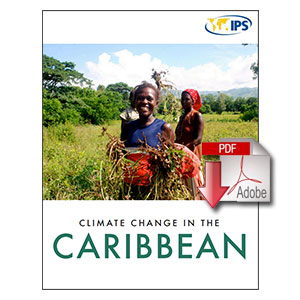
As the world moves to implement the Paris Climate Change Agreement, the Caribbean—one of the most vulnerable regions to rising sea levels—faces a host of challenges, including accessing funding for adaptation and mitigation, protecting key sectors like tourism and agriculture, building resilience to natural disasters, and moving to a low-carbon development path. Much of the world’s most interesting work in addressing climate change, adopting clean energy and coming up with plans to stem deforestation has its roots in the developing world, where climate change impacts are often felt first and strongest. IPS looks at the wide variety of local, national and regional initiatives in the Caribbean that offer creative solutions to these problems.
 |
|||
 |
 |
 |
 |

Caribbean Climate Wire