Wednesday, September 30, 2026



News and Views from the Global South


Saving the Tiny Island of Petite Martinique
Sanchez is a small central business district in Petite Martinique, the tiny island that forms part of the tri-nation state of Grenada, Carriacou and Petite Martinique.
Gender Counts in the Aftermath of Disaster
The rise in natural disasters in the Caribbean due to climate change has led to increased suffering for both men and women, much of it as a consequence of socially constructed roles based on gender, experts say.
Caribbean Walks the Talk on Clean Energy Policy
Despite having an abundance of wind and sunshine, Caribbean countries have found that going green is requiring significant shifts in policy, and most importantly, significant financing.
Caribbean Sees Worrying Rise in Climate-Sensitive Diseases
Caribbean countries, struggling to emerge from a slump in exports and falling tourist arrivals brought on by the worldwide economic crisis that began five years ago, have one more thing to worry about in 2014.
Christmas Storm Underlines Caribbean’s Vulnerability
Guyanese President Donald Ramotar says the death and destruction caused by intense rainfall in three Caribbean Community (CARICOM) countries over the Christmas holidays is a sign that the region has no time to lose in fortifying its resiliance to climate change.
Farm Forecasts Try to Decode a Capricious Climate
In the southwest peninsula of Cedros, one of Trinidad’s driest areas, Jenson Alexander grows the cocoa used for many years by the British chocolate giant Cadbury.
Tallying Losses, St. Vincent Begins Repairs After Deadly Flood
Ralph Gonsalves fought to hold back tears as he shared how his cousin was killed the night before Christmas.
Christmas Deluge Brings Disaster to Eastern Caribbean
Colleen James arrived in St. Vincent and the Grenadines from Canada two days before Christmas hoping to enjoy the holiday season with her family. Now she’s getting ready to bury her two-year-old daughter and 18-year-old sister.
Taste Test Stymies Caribbean’s Climate-Resistant Crops
Ramdeo Boondoo, a root crop farmer in Caroni, Trinidad, understands better than most the challenge of developing crops that are both climate resilient and marketable.
Nevis Embarks on Geothermal Energy Journey
The tiny island of Nevis in the northern region of the Lesser Antilles is one of the few remaining unspoiled places in the Caribbean. It is now seeking to become the greenest, joining a growing list of Caribbean countries pursuing clean geothermal power.
Developing Countries Still Waiting for a Global Response to Climate Change
As president of the Council of Ministers of the African, Caribbean and Pacific states, Samoa's Prime Minister Tuilaepa Lupesoliai Sailele Malielegaoi had the perfect forum to voice his concerns about the effects climate change has had on his island nation.
“We in the Caribbean Are Living Climate Change”
The Mocho Mountains that run through the centre of Jamaica were once covered by lush tropical forests that helped control rainfall. Now, much of the forests and farmlands have been destroyed and the community is hard hit by the resultant extreme weather.
Storms, Flooding Can Unleash a Toxic Soup
It’s a dirty, smelly business, but wastewater is gaining prominence across the Caribbean as countries from Jamaica in the west to Guyana in the south increasingly recognise its effects on the environment and the importance of improving its management.
Today’s Forecast Is for Climate-Proof Farming
Even as weather extremes bedevil Caribbean farmers, Ramgopaul Roop has turned his three-acre fruit farm into a showcase for how to beat climate change.
U.N. Climate Meet Becomes About “Not Losing Ground”
Diann Black-Layne grew up in a single parent home with nine siblings on the tiny Caribbean island of Antigua. Still, life was easygoing and enjoyable, she recalls. For her, it was paradise.
New Hope for Haiti’s Decimated Forests
Small farmers could play an important part in making Haiti – where just two percent of trees are still standing – green again.
Fishing Communities Will Face Warmer, Acid Oceans
Eating fish has been an integral part of the Caribbean's cultural traditions for centuries. Fish is also a major source of food and essential nutrients, especially in rural areas where there are scores of small coastal communities.
U.N. Climate Meet: “It’s About Survival”
For the small island developing states of the Caribbean, there is nothing more important than the United Nations Climate Change Conference taking place here at the national stadium of Poland from Nov. 11-22.
St. Vincent’s Volcano Holds More Promise Than Peril
Weary of sky-high electricity prices, St. Vincent is following in the footsteps of another, decidedly un-tropical island nearly 4,000 miles away in its quest to harness clean geothermal power.
Mining Takes a Bite Out of Guyana’s Amazon
Guyana is engaged in a balancing act to save its rainforest, regarded as a living treasure, from the destructive activities of miners digging their way to another kind of treasure buried beneath this fragile ecosystem.
Waiting for the Next Superstorm
One year ago, Hurricane Sandy ravaged the Northeast United States, causing an estimated 68 billion dollars in damage and paralysing the world’s financial nerve centre.« Previous Page — Next Page »


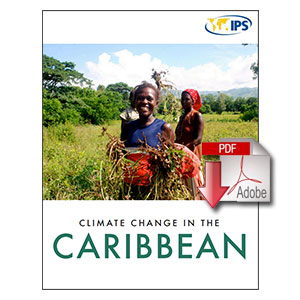
As the world moves to implement the Paris Climate Change Agreement, the Caribbean—one of the most vulnerable regions to rising sea levels—faces a host of challenges, including accessing funding for adaptation and mitigation, protecting key sectors like tourism and agriculture, building resilience to natural disasters, and moving to a low-carbon development path. Much of the world’s most interesting work in addressing climate change, adopting clean energy and coming up with plans to stem deforestation has its roots in the developing world, where climate change impacts are often felt first and strongest. IPS looks at the wide variety of local, national and regional initiatives in the Caribbean that offer creative solutions to these problems.
 |
|||
 |
 |
 |
 |

Caribbean Climate Wire