
Sunday, November 29, 2026



News and Views from the Global South
Environment
ENVIRONMENT: Climate of Change Confronts Wall Street
Stockholders, investors and financial analysts are now demanding to know how climate change will affect companies' bottom line, and a new report reveals large corporations' risks and opportunities.
ENVIRONMENT-SOUTH ASIA: Superstition May Yet Save Marine Reserve
India’s plans to dredge a navigable canal between the Gulf of Mannar (which separates India from Sri Lanka) in the face of strong economic and ecological objections have now run, of all things, into a religious obstacle.ENVIRONMENT: Ozone Deal to Cut Down CO2 Emissions
More than 190 nations agreed this week to combat global warming and accelerate the healing of the ozone layer, although critics say more could have been accomplished.TRADE-CANADA: Losing Water Through NAFTA
Under the North American Free Trade Agreement, Canada lost control over its energy resources. Now, with "NAFTA-plus", it could also lose control over its freshwater resources, say experts.Ecobreves – CHILE: Mapuches Denounce Government at the UN
The Chilean government should turn in the report about the denunciation presented by ecologists and Mapuche Indians of the central region of Araucanía "if it wants to hold a post in 2008 on the UN Human Rights Council."Ecobreves – VENEZUELA: A Plan to Save the Amphibians
Scientific and environmental institutions drafted a plan to protect the 320 species of toads, frogs and salamanders (five percent of the world's total) that live in Venezuela.
Ozone Treaty Cools Down Global Warming
The United States was the protagonist in talks for moving faster to eliminate gases that damage the atmospheric ozone layer and aggravate climate change.
Algae Against Climate Change?
Scientists are testing the capacity of algae to absorb carbon dioxide and to produce from their own biomass a fuel that is less polluting than gasoline.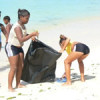
Ecobreves – CUBA: Kids and Adults in Nature Clean-Up
Hundreds of people in Cuba took part in the campaign "To Clean the World", sponsored by the United Nations Environment Program, reforesting and cleaning up coastal areas.SURINAME-GUYANA: Maritime Settlement Sparks Oil Rush
Late Thursday afternoon a United Nations court settled once and for all a simmering maritime border row between two of the smallest nations in South America, opening the way for international companies to exploit suspected vast oil and gas resources below the sea.
AGRICULTURE-BRAZIL: Using Alternative Methods to Adapt to Drought
"It is painful to think that global warming will further aggravate the lack of rainfall" in Brazil’s semiarid northeast, said Luiz Tomacheski, who was stunned to see firsthand the dry landscape of twisted thorny shrubs and patches of brown grass in this region.POLITICS-BURMA: Buddhist Clergy on Collision Course With Junta
Burma’s Buddhist monks are threatening to turn an on-going protest against steep hikes in fuel prices into a religious and moral showdown with the country’s oppressive military regime.
ENVIRONMENT-SRI LANKA: In Denial Mode on Sanitation Issues
Compared to the rest of South Asia, Sri Lanka has impressive sanitation statistics with 90 percent of the population having access to latrines. But what happens to human waste thereafter is another story.
AGRICULTURE-BRAZIL: Green Revolution on the Savannah
Joao Venancio Soares is a living example of the prosperity of this town in west-central Brazil and the process that turned this country into an agricultural powerhouse over the last three decades.ENVIRONMENT: Women Demand Voice in Climate Debate
Calls for increased participation of women in policy-making decisions are on the rise as world leaders prepare to attend an international meeting on climate change to be held at U.N. headquarters next week.ENVIRONMENT-BRAZIL: Earth Summit Score Card, 15 Years On
Fifteen years after the 1992 Earth Summit, Brazil is again playing host to representatives from around the world who are assessing the results of the actions that arose from that landmark conference.LABOUR-US: Mine Tragedy Spurs Calls for Reform
The worst mine disaster in the United States this year, which occurred in mid-summer, has highlighted what appears to be a pattern of lackadaisical inspection and enforcement by the agency charged with overseeing safety compliance in the industry.ENERGY-ARGENTINA: Handing Out Concessions ‘In Perpetuity’
Political leaders and activists have asked the justice system in Argentina to rule on the legality of the Chubut provincial government’s extension until 2047 of a foreign corporation’s concession to the country’s largest oil reserve. The decision was taken 10 years before the current concession expires.
ENVIRONMENT: Scramble for Resources Driving Sudan Conflicts
A U.N. Environment Programme (UNEP) report released here this week emphasises strong linkages between environmental stresses and the ongoing conflict in Sudan.ENVIRONMENT: The Chemical That Must Not Be Named
Delegates from 191 nations are on the verge of an agreement under the Montreal Protocol for faster elimination of ozone-depleting chemicals, but the United States insists it must continue to use the banned pesticide methyl bromide.
ECONOMY-IRAN: Petrol Rationing – Bumpy Ride
Two months after the government of President Mahmoud Ahmadinejad began rationing petrol to ‘’vaccinate’’ itself against possible sanctions, critics say the plan has failed to cut down gasoline consumption. Instead it has hurt the agriculture, tourism, transportation and other sectors of the economy.« Previous Page — Next Page »


Through our global network of local writers, we are continuing our award-winning coverage of global and local environmental challenges, with a focus on the people for whom the ecosphere matters in a direct way: rural dwellers who have little means to protect themselves against adverse conditions; communities that need to switch to sustainable development in order to survive; poor women and children, who are the most vulnerable in natural disasters. Sponsored by the United Nations Environment Program (UNEP), the United Nations Development Program (UNDP) and The World Bank (WB), IPS also maintains the award-winning Tierramérica, a specialised information service on environment and development.

The Week with IPS

Tracking global progress towards a sustainable world


