Languages
Monday, October 12, 2026



News and Views from the Global South
Financial Crisis

Mounting Illicit Financial Outflows from South
Although quite selective, targeted, edited and carefully managed, last year’s Panama Papers highlighted some problems associated with illicit financial flows, such as tax evasion and avoidance. The latest Global Financial Integrity (GFI) report shows that illicit financial outflows (IFFs) from developing countries, already at alarming levels, continue to grow rapidly.
Deliberate Famine Should Be a War Crime, UN Expert Says
The deliberate starvation of civilians could amount to a war crime and should be prosecuted, said an independent UN human rights expert.
Why 1997 Asian Crisis Lessons Lost
Various different, and sometimes contradictory lessons have been drawn from the 1997-1998 East Asian crises. Rapid or V-shaped recoveries and renewed growth in most developing countries in the new century also served to postpone the urgency of far-reaching reforms. The crises’ complex ideological, political and policy implications have also made it difficult to draw lessons from the crises.
Austrian Elections: The Crisis of Europe Continues
The Austrian elections show clearly that media have given up on contextualising events. To do that, calls for a warning about Europe’s future, as a vehicle of European values is required. Europe has been weakened by all the recent elections, with the notable exception of France. Common to all, France included, were some clear trends, that we will hastily, and therefore maybe imperfectly, examine.
Can the Kenyan Lion Kick High Enough to Be the South Korean Tiger of Africa?
In 1953 South Korea emerged from the ravages of a debilitating war, yet the total gross domestic product in nominal terms has surged 31,000 fold since 1953.
World Bank Must Stop Encouraging Harmful Tax Competition
One of the 11 areas that the World Bank’s Doing Business (DB) report includes in ranking a country’s business environment is paying taxes. The background study for DB 2017, Paying Taxes 2016 claims that its emphasis is “on efficient tax compliance and straightforward tax regimes”.
Alternative Financing Strategies to Boost Small Businesses in Africa
A few years ago, more than half a century after the concept was first proposed, the government of Côte d’Ivoire completed construction of the Henri Konan Bédié Bridge, a span over the Ébrié Lagoon linking the north and south of Abidjan, the country’s main city. The project became a reality after the government received development bank and private capital financing.
Why American Overseas Aid Should Focus on SDGs?
The average American believes the US spends a whopping third of its federal budget on foreign aid. Consequently, a majority of people think that too much is spent on foreign aid. That is one reason US President Donald J. Trump, who has campaigned on putting the needs of Americans first, has proposed deep cuts to foreign aid in his 2018 budget.
Greater Cooperation To Strengthen Taxation
Since the 1950s, there has been a popular dance called the ‘limbo rock’, with the winner leaning back as much as possible to get under the bar. Many of today’s financial centres are involved in a similar game to attract customers by offering low tax rates and banking secrecy.
Merkel’s Defeat Confirms Dismal Trend for Europe
Generally, media have failed to analyse why the result of German elections is the worst possible. Merkel is not a winner, but a leader now in a very fragile position, who will have to make many compromises and pay now for her mistakes. Let us make at least the most important four points of analysis.
More Public Spending, Not Tax Cuts, for Sustainable, Inclusive Growth
The Trump administration’s promise to increase infrastructure spending should break the straightjacket the Republicans imposed on the Obama administration after capturing the US Congress in 2010. However, in proportionate terms, it falls far short of Roosevelt’s New Deal effort to revive the US economy in the 1930s.
Scaling up Development Finance
The Business and Sustainable Development Commission has estimated that achievement of Agenda 2030 for the Sustainable Development Goals will require US$2-3 trillion of additional investments annually compared to current world income of around US$115 trillion. This is a conservative estimate; annual investments of up to US$2 trillion yearly will be needed to have a chance of keeping temperature rise below 1.5°C.
Venezuela’s Government Is Following a “Policy to Repress,” the UN Says
After sending a team to investigate the human rights conditions in Venezuela amid growing political and economic crisis, the UN Human Rights Office has reported that the crushing of anti-government protests point to the “the existence of a policy to repress political dissent and instil fear in the population to curb demonstrations.”
Quantitative Easing for Wealth Redistribution
Following the 2007-2008 global financial crisis and the Great Recession in its wake, the ‘new normal’ in monetary policy has been abnormal. At the heart of the unconventional monetary policies adopted have been ‘asset purchase’ or ‘quantitative easing’ (QE) programmes. Ostensibly needed for economic revival, QE has redistributed wealth – regressively, in favour of the rich.
Leadership Failure Perpetuates Stagnation
What kind of leadership does the world need now? US President Franklin Delano Roosevelt’s leadership was undoubtedly extraordinary. His New Deal flew in the face of the contemporary economic orthodoxy, begun even before Keynes’ General Theory was published in 1936.
Why New US Cold War with Russia Now
Even before the imposition of new sanctions on Russia by Donald Trump and the ongoing fuss over Russian hackers undermining US democracy, Russian-American relations had deteriorated to a level not seen since the 1950s. Why?
UN Analytical Leadership in Addressing Global Economic Challenges
The United Nations recently released the 70th anniversary issue of its flagship publication, the World Economic and Social Survey (WESS). First published in January 1948 as the World Economic Report, it is the oldest continuous publication analyzing international economic and social challenges. The 2017 issue reviews 70 years of WESS policy recommendations, many of which remain relevant today to address global challenges and to achieve the 2030 Agenda or Sustainable Development Goals.
Asian Financial Crisis: Lessons Learned and Unlearned
Debates are taking place on whether there will be another financial crisis, whether in some part of the world or that is global in scope. Governments draw lessons from financial crises to adopt measures to prevent their recurrence. However, such measures are often designed to address the root causes of the last crisis but not the next one. More importantly, they can actually become the new sources of instability and crisis.
Migrant Contributions to Development: Creating a “New Positive Narrative”
Despite the “undeniable” benefits of migration, barriers including public misconceptions continue to hinder positive development outcomes, participants said during a series of thematic consultations here on safe, orderly, and regular migration.
Alcoholism Cannot Explain Russian Mortality Spike
The steep upsurge in mortality and sudden fall in life expectancy in Russia in the early 1990s were the highest ever registered anywhere in recorded human history in the absence of catastrophes, such as wars, plague or famine. The shock economic reforms in the former Soviet economies after 1991 precipitated this unprecedented increase in mortality, shortening life expectancy, especially among middle-aged males.
The G20 Needs To Go Back to its Roots
When the finance ministers of the G7 countries proposed the G20 in the late 1990s, a good sense of realism prevailed. They recognized that addressing issues of global finance required the political support from—and involvement of—emerging market economies.« Previous Page — Next Page »





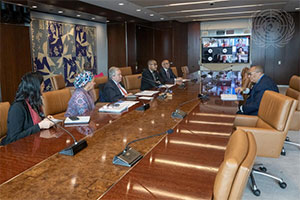 Secretary-General Meets with Members of Debt Expert Group. Credit: UN Photo/Eskinder Debeb
Financial crises are often defined by banking panics, recession, loss of market value, and deflation. Various financial crises at the turn of the 20th century, such as the Asian Crisis of 1997-1998 and the 2007-2008 Global Financial Crisis, have had immense impacts on the world economy. The COVID-19 pandemic also caused a financial crisis when mass lockdowns triggered staggering unemployment rates, a stagnation of economic growth, and led to the 2020 stock market crash. With the Russian invasion of Ukraine, the world has also witnessed a global energy crisis with shortages and increased prices in oil, gas, and electricity markets. According to UNCTAD’s World of Debt 2025, global public debt surpassed $100 trillion in 2024, with developing country debt growing twice as fast as developed economies since 2010. Burdens of debt servicing come with economic slowdowns and demands of austerity from lenders, with some economists arguing that this will lead to a new “lost decade” for the Global South. IPS brings you worldwide coverage of these financial developments and how we should manage these crises.

The Week with IPS

NEXT STOP - SDGs
Tracking global progress towards a sustainable world
Tracking global progress towards a sustainable world
