Languages
Friday, November 27, 2026



News and Views from the Global South
Financial Crisis

‘Noboa Did Not Receive a Blank Cheque: He Will Have to Show Tangible Results’
CIVICUS discusses Ecuador’s presidential election with Jorge Tapia de los Reyes, Coordinator of the Democracy and Politics Department and the Political Funding Observatory of the Citizenship and Development Foundation (FCD). FCD is an Ecuadorian civil society organisation that promotes participation, citizen monitoring and open government.

African Countries Still Underfunding Health by as Much as 50 Percent
The majority of African countries are yet to commit 15 percent of their GDP to funding the health sector, despite the growing disease burden weighing down the continent and two decades after the coming into force of the Abuja declaration on health sector funding.
Trump Wants World to Subsidise US Empire
Donald Trump’s top economic advisor claims the President has weaponised tariffs to ‘persuade’ other nations to pay the US to maintain its supposedly mutually beneficial global empire.
Trump’s ‘Shock and Awe’ Tariffs
US President Donald Trump has again seized global attention by arbitrarily imposing sweeping tariffs on the rest of the world. He reminds us America is still boss, claiming to ‘make America great again’ (MAGA) by ensuring ‘America first’ at everyone else’s expense.
Turkey’s Democratic Uprising: A Generation Takes a Stand
In the heart of Istanbul, a remarkable transformation is underway. What began as student protests following the politically motivated arrest of Mayor Ekrem İmamoğlu has evolved into Turkey’s most significant pro-democracy mobilisation in years. The streets that once pulsed with the routine of daily life now throb with the energy of millions demanding a return to democratic governance.
A Pressure on Silicon Valley: Is the U.S. Ready for a Shift in Tech Dominance?
While the U.S. argues over tariffs, China, Japan, and South Korea are quietly reshaping their tech markets, shifting towards regional dominance – signaling a potential turning point in global tech leadership.
Malnutrition Not Due to Cash Poverty Alone
The World Bank set its US ‘dollar-a-day’ poverty line using its 1990 data. Despite many doubts and criticisms, its poverty numbers fell until the COVID-19 pandemic began in 2020.
International Day of Forests
‘Now is the time for decisive, collaborative action’
The Forest Declaration Assessment Partners have called for urgent reforms to the international financial system to halt deforestation and protect biodiversity. It has also pitched for redirecting the public subsidies to mitigate the direct and indirect environmental risks from both public and private finance. 
Funding Disruptions Are a Systemic Failure – Philanthropy Must Do What’s Right and Support Local Leadership
The slashing of US aid funding by Donald Trump and Elon Musk, and cuts or planned cuts in international support by several European states, threaten to cut off the oxygen supply to a civil society already in a critical condition. At CIVICUS, the global civil society alliance, activists and grassroots groups have shared with us time and again that shifting and volatile donor priorities are one of the top funding challenges they face, alongside limited resources for strategy and restricted funding.
Agriculture for Economic Resilience During Political and Financial Crisis – The Case of Bangladesh
The recent student movement in Bangladesh demanding reform of the quota system for public jobs led a ‘march of the people’ towards the official Residence of the Prime Minister Sheikh Hasina on 5th of August 2024. The security forces of the country, including the army, refused to open fire on the marching crowd. Fearing an imminent attack on her residence without the protection of the army, Sheikh Hasina fled to neighbouring India after being in power continuously since 2008. With Sheikh Hasina fleeing to India on 5th of August 2024 her authoritarian and corrupt rule of 15 years just melted away.
America First Deepens World Stagnation
Donald Trump’s Make America Great Again (MAGA) appeal captured US mass discontent against globalisation. In recent decades, variations of America First have reflected growing ethnonationalism in the world’s presumptive hegemon.
Civil Society at the Finance in Common Summit Calls for Community-led, Equitable, and Human Rights-based Development
As public development banks gather for the Finance in Common Summit (FiCS) in Cape Town, South Africa, civil society and community activists from across the world are demanding a shift to a community-led, equitable, and human rights-based development approach, that prioritise people and planet over profit, and a reform of the global financial architecture.
An ‘Exorbitant Privilege’ for All?
Ending US dollar dominance alone will not end monetary imperialism. Only much better multilateral arrangements to clear international payments can meet the Global South’s aspirations for sustainable development.
African Countries Urged to Plug Wealth Loss, Stop Illicit Financial Flows
Africa loses billions of dollars annually through illicit financial flows, resulting in the continent failing to improve the lives of millions of people despite vast mineral wealth, according to experts. Agencies say more needs to be done to turn the continent's natural resources into prosperity at a time governments are struggling to address challenging economic conditions that have spawned high poverty levels.
Unlocking SDG Success: How Better Data Can Develop Africa
That one in three Africans will not be counted as countries failing to meet census deadlines is a huge setback for development planning.
Geopolitical Uncertainties Cloud World Economic Prospects, UN Report Says
In the past few years, the world economy has made significant strides in mitigating inflation, unemployment, and poverty. Despite this, global growth has yet to regain its pace from before the pandemic.
Financing for Development Priorities Today
The forthcoming fourth United Nations Financing for Development conference must address developing countries’ major financial challenges. Recent setbacks to sustainable development and climate action make FfD4 all the more critical.
New Geopolitics Worse for Global South
The new geopolitics after the first Cold War undermines peace, sustainability, and human development. Hegemonic priorities continue to threaten humanity’s well-being and prospects for progress.
Bangladesh in Crisis: Which way out?
This piece is not about the crisis or the chaos that the country is now facing after successfully toppling the autocratic regime of Sheikh Hasina. Rather, it is about the crisis of confidence and social capital or trust — interlinked, nonetheless.
New Approaches Urgently Needed to Tackle Resurgent Social Crises
Despite uneven economic recovery since the pandemic, poverty, inequality, and food insecurity continue to worsen, including in the Asia-Pacific region, which used to fare better than the rest of the Global South.
Western Finance Ruining Economies of the Rest
Western financial policies have been squeezing economies worldwide. After being urged to borrow commercial finance heavily, developing countries now struggle with contractionary Western monetary policies.« Previous Page — Next Page »


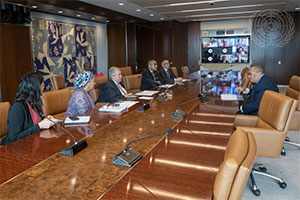 Secretary-General Meets with Members of Debt Expert Group. Credit: UN Photo/Eskinder Debeb
Financial crises are often defined by banking panics, recession, loss of market value, and deflation. Various financial crises at the turn of the 20th century, such as the Asian Crisis of 1997-1998 and the 2007-2008 Global Financial Crisis, have had immense impacts on the world economy. The COVID-19 pandemic also caused a financial crisis when mass lockdowns triggered staggering unemployment rates, a stagnation of economic growth, and led to the 2020 stock market crash. With the Russian invasion of Ukraine, the world has also witnessed a global energy crisis with shortages and increased prices in oil, gas, and electricity markets. According to UNCTAD’s World of Debt 2025, global public debt surpassed $100 trillion in 2024, with developing country debt growing twice as fast as developed economies since 2010. Burdens of debt servicing come with economic slowdowns and demands of austerity from lenders, with some economists arguing that this will lead to a new “lost decade” for the Global South. IPS brings you worldwide coverage of these financial developments and how we should manage these crises.

The Week with IPS

NEXT STOP - SDGs
Tracking global progress towards a sustainable world
