Languages
Tuesday, November 17, 2026



News and Views from the Global South
Financial Crisis
ECONOMY: Another G20 Takes Centre Stage
The Group of 20 (G20) that will meet this Saturday and Sunday in Brazil could have a more defining role in shaping a new global order than any of the alliances forged in past international negotiations - like the other G20 formed by developing countries in the Doha Round of multilateral trade talks.
US: Don't Be Afraid to Spend, Economists Tell Obama
President-elect Barack Obama will inherit an ailing economy and the way to help right it is to spend - and spend some more, independent economists say.FINANCE: China Cements Partnership with Latin America
China's evolving commercial and political affiliations with Latin America and the Caribbean are once again in the spotlight, with the entrance of China to the Inter-American Development Bank (IDB) in late October.VIETNAM: Good Harvests Don’t Bring Good Sales
Farmers in the Mekong Delta, who produce most of the rice responsible for making this country a top exporter of the staple, are unable to negotiate good prices for their produce.ECONOMY-BRAZIL: Crisis Delays Threat of ‘Venezuelan Disease’
The global financial crisis has corrected the extreme overvaluation of Brazil's local currency, caused by the policies of its Central Bank, thus temporarily chasing away fears of "Dutch disease", which in the developing world could well be called "Venezuelan disease".ECONOMY-US: Congress Gives a Nod to Anxious “Main Street”
U.S. consumers are in no mood to spend, and that calls for action, Congress and the George W. Bush administration said this week.
ECONOMY: Global Crisis Should Spell End of Laissez-Faire Doctrine
The real question to ask about the global financial crisis is whether ‘‘it will go deep enough for the big economies to realise that the market should be controlled more. The philosophy of laissez-faire simply does not work’’.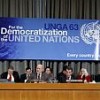
FINANCE: Revolt Against “Elite Clubs” Grows at U.N.
U.N. member states and economists challenged the neo-liberal policies of market deregulation that have long been promoted by powerful global financial institutions like the World Bank and International Monetary Fund (IMF), and called Thursday for a new, more inclusive global financial architecture.
Q&A: "We Must Rethink the International Economic System"
Archbishop Desmond Tutu is South Africa's first black Anglican bishop. An elder statesman whose moral voice and advocacy against the racist apartheid regime in South Africa first brought him to the world stage in the 1980s, Tutu received the Nobel Peace Prize in 1984.SOUTH-EAST ASIA: Financial Meltdown Prompts Return to Agriculture
As South-east Asia feels the heal of the global financial meltdown leaders are turning to the informal sector, particularly agriculture, as a potential provider of employment.FINANCE: NGOs Call for Radical Reforms as IMF Offers New Loans
Two weeks before U.S. President George W. Bush hosts an economic summit to address the six-week-old financial crisis that has wreaked havoc on the world's capital and stock markets, a coalition of nearly 600 non-governmental organisations (NGOs) from 88 countries is calling for a "fundamental and far-reaching transformation on the international financial and economic system."ECONOMY-SOUTH AMERICA: Eyes Wide Open
The reaction by South America’s Mercosur trade bloc to the current global financial crisis is limited for the time being to observing "possible impacts" on stock markets, production and unemployment, and "maintaining fluid and agile communications" regarding any measures taken by each member country.ECONOMY-US: Millions Lose Homes, As Families Plead for Help
Bank crashes in Iceland, an International Monetary Fund (IMF) bailout of Ukraine and volatile stock markets the world over - it all links back to the U.S. communities where hundreds of thousands of families are losing their homes with no let up in sight, those on the frontlines say.LABOUR-MALAYSIA: Recession to Hit Migrant Workers Hard
As recession looms large on the horizon, migrant workers like 27-year-old Kumar Palanisamy from Chennai in India are the first on the chopping block.ECONOMY: Spain Fights Exclusion from Crisis Summit
The Spanish government is taking strong diplomatic actions, calling on its fellow members of the European Union, Latin American leaders, Asian nations and even the United States presidential candidates, with the aim of not being left out of the financial anti-crisis summit scheduled for Nov. 15 in Washington.
U.S.: A Week Out, Obama and Democrats Poised for Victory
With only one week before the Nov. 4 elections, Democrats are increasingly hopeful that they will emerge next Wednesday with control of the White House and substantially increased majorities in both houses of Congress.ECONOMY: Civil Society Has Something to Say
Governments cannot deal with the current financial crisis on their own, and need the support of the people they govern, which is "best translated by the opinions of the civil society movement," said Werner H. Schleiffer, executive coordinator of CONGO, the global umbrella of NGOs with consultative status with the United Nations.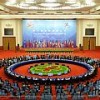
ECONOMY: Asia, EU Leaders Moot Deep Global Reforms
A two-day meeting of European and Asian leaders in Beijing has produced a joint statement pledging a coordinated response to the global financial crisis, but concrete action is seen dependant on the entry of Asia’s emerging economies into global policy-setting institutions.
AFRICA: Financial Crisis May Increase Pressure for Debt Repayment
The collapse of the financial markets may force the World Bank, the International Monetary Fund (IMF) and the United Nations Development Programme (UNDP) to come down hard on African countries to repay their debts because the huge rescue packages for collapsing banks will need to be recuperated.
RIGHTS: A Home Shouldn't Be a Luxury
Increased reliance on private banks to provide housing will cause more homelessness in cities across the world, warns a top U.N. expert on rights.EDUCATION-US: Credit Crunch Hits College Students
The credit crunch is limiting college access for some students in the United States by making it more difficult for them or their parents to obtain student loans to finance the steep cost of a four-year education.« Previous Page — Next Page »


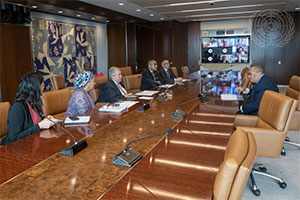 Secretary-General Meets with Members of Debt Expert Group. Credit: UN Photo/Eskinder Debeb
Financial crises are often defined by banking panics, recession, loss of market value, and deflation. Various financial crises at the turn of the 20th century, such as the Asian Crisis of 1997-1998 and the 2007-2008 Global Financial Crisis, have had immense impacts on the world economy. The COVID-19 pandemic also caused a financial crisis when mass lockdowns triggered staggering unemployment rates, a stagnation of economic growth, and led to the 2020 stock market crash. With the Russian invasion of Ukraine, the world has also witnessed a global energy crisis with shortages and increased prices in oil, gas, and electricity markets. According to UNCTAD’s World of Debt 2025, global public debt surpassed $100 trillion in 2024, with developing country debt growing twice as fast as developed economies since 2010. Burdens of debt servicing come with economic slowdowns and demands of austerity from lenders, with some economists arguing that this will lead to a new “lost decade” for the Global South. IPS brings you worldwide coverage of these financial developments and how we should manage these crises.

The Week with IPS

NEXT STOP - SDGs
Tracking global progress towards a sustainable world
Tracking global progress towards a sustainable world
