Languages
Sunday, November 1, 2026



News and Views from the Global South
Migration & Refugees

Civil Society Summit Calls for International Action on Climate Migration
Civil society leaders from more than 100 countries called for action on climate-induced displacement at a summit in Suva, Fiji last week.
The Protracted Refugee and Migrant Crisis: A Challenge to Multilateralism
It is an incontrovertible fact that more people are on the move owing to globalization. Fifteen percent of the world’s population are on the move worldwide. In other words, of the world population of 7 billion, one billion are on the move. Seven hundred and forty million people are referred to as internal or as domestic migrants within their countries of origin. The number of internally displaced persons reaches about 60 million. On top of this, the world has more than 244 million international migrants who cross borders often into the unknown. Lastly, there are 22.5 million refugees – encompassing the 5.3 million Palestinian refugees – registered by the United Nations High Commissioner for Refugees who have been forced to flee their home societies as a result of violence and armed conflict. The first two decades of the 21st century will go down in history as the era in which the world has witnessed the most complex and massive movement of people since the end of the Second World War.
A Responsibility to Prevent Genocide
Almost 70 years since the Genocide Convention was adopted, the international community still faces a continued and growing risk of genocide.
100,000 Medical Consultations in 100 Days
If Morisha's family had waited a matter of minutes before bringing her to the UN Migration Agency(IOM)'s health post in the Balukhali makeshift settlement, she would be dead. Full term, in her first pregnancy, the 20-year-old started experiencing severe convulsions and bleeding from her mouth two weeks ago.
Dr. Al Qassim: “The refugee and migrant crisis has become the symbol of the world’s inability to live up to the ideals of the Founders of the UN”
The Chairman of the Geneva Centre for Human Rights Advancement and Global Dialogue H. E. Dr. Hanif Hassan Ali Al Qassim has called for the promotion of a value-driven human rights system to guide international decision-makers in their endeavours to address the impact of the migrant and refugee crisis.
No One Country Can Do It Alone — Towards a Migration Compact
International commitment and cooperation is critical to reap the benefits and overcome the challenges of migration, stressed a leading official at the conclusion of a UN meeting.
UN Migration Agency, Government of Niger Welcome First Charter of Migrants from Libya
Following recent international discussions, the Government of Niger and IOM, the UN Migration Agency in Niger have begun the mass evacuation of the almost 4,000 migrants that have registered for voluntary return at the Embassy of Niger in Libya.
Rohingya Refugees: The Woes of Women (Part Two)
Under pouring rain, hundreds of young and expectant mothers stand in line. With her bare feet and the bottom of her dress covered in mud, Rashida is one of them, clutching her emaciated infant. She lost her husband on the treacherous trek from Myanmar to Bangladesh, and with nowhere to go and her resources exhausted, rain-drenched and standing in this long, muddy line for food and medicine for her child is her only hope.
Rohingya Refugees: The Woes of Women – Part One
Afia* lines up her bucket every morning in the refugee camp for water delivery from humanitarian relief workers. On one particularly sweltering day, she kept four water pitchers in a row with gaps between them, hoping to insert another empty container in the space when the water arrived.
Lost in Lebanon Opens Global Migration Film Festival
The second edition of the Global Migration Film Festival opened yesterday (05/12) with the screening of Lost in Lebanon, at the Graduate Institute of International and Development Studies in Geneva, Switzerland.
“Migrants Deserve Dignity” says CIVICUS While Trump Pulls out of Proposed Migrant Compact
Continuing his “America First” approach, President Donald Trump has pulled the U.S. out of a proposed United Nations global compact seeking an agreement to protect the safety and rights of migrants and refugees.
Rohingya Exodus Is a “Major Global Humanitarian Emergency”
In less than four months, over 600,000 Rohingya refugees have fled brutal persecution in Myanmar to seek safety across the border in Bangladesh. They are now crowded into camps across a stretch of 30 kms in Cox's Bazar, a southeastern coastal region of the small South Asian nation.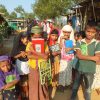
Rohingya Refugees Face Fresh Ordeal in Crowded Camps
Mariam Akhtar, 23, is desperately searching for her young daughter two weeks after arriving from Myanmar in Cox’s Bazar, a southeastern coastal district in Bangladesh.
UN Makes Record Appeal for Humanitarian Aid in 2018
The UN has made its largest appeal to work towards reaching the more than 135 million people across the world in need of humanitarian assistance and protection.
IOM UN Migration Agency Launches 2018 World Migration Report
IOM, the UN Migration Agency, yesterday (30/11) launched its flagship publication, the World Migration Report 2018, during the 108th IOM Council, in Geneva.
Climate Migration: From the Paris Agreement to the Global Compact for Migration
When Hurricane Maria hit Dominica this year, Tosca Augustine and her three children sought shelter in a nearby school as they saw their home vanish into thin air along with all their belongings.
Aid Workers Under Pressure in Calais
It was mid-morning in late June, but the warehouse in Calais was dark, cold, and drafty. I sat on the ground with “Marie,” a tall, slim French woman in her early twenties. Bent forward with a look of concentration, she described how the French police are not only harassing the hundreds of migrants in Calais, they are targeting aid workers too. “They put pressure, stopping what we are doing.”
“Every Day Is a Nightmare”
Parul Akhtar,* a Rohingya woman in her mid-twenties, may never wish to remember the homeland she and her children left about three weeks ago.
We Have Never Lived in a World Without Migration
I want to thank Director-General Lacy Swing for inviting me to address you today. My thanks also go to Ambassador Mauras, as Chair of the International Organization for Migration Council, along with Ambassador Quinn, as outgoing-Chair, for their work and commitment. Furthermore, I want to acknowledge the valuable work being done by Special Representative Arbour, and Deputy Director-General Thompson.
Violence Drives Further 1,800 Rohingya Refugees to Cross to Bangladesh as Pope Appeals for Tolerance
In just three months an estimated 624,251 Rohingya refugees have crossed into Cox’s Bazar, Bangladesh, fleeing violence and oppression in Myanmar’s Northern Rakhine State. Of these, over 1,800 have arrived in the past seven days. This brings the total population of Rohingya seeking safety in the district to over 836,000.
Migrant Promoters and Musicians Spread Message of “One Africa”
The crowd in the park gave out roars of approval as the next act was announced: Mothusi Bashimane Ndlovu, one of Zimbabwe’s most popular singers and actors, who took to the stage with a small axe in hand.« Previous Page — Next Page »





Human migration is a matter of global concern. Flows of migrants and refugees influence and change the social, economic and political dynamics of their destinations -- and the places they have left behind. IPS covers crucial issues such as migrant and refugee rights, irregular or undocumented migration, human trafficking, remittances, displaced persons and forced labour. And the positive: in many cases migration creates a new dialogue among civilisations. Migrants themselves become the building blocks of bridges connecting different cultures.

The Week with IPS

NEXT STOP - SDGs
Tracking global progress towards a sustainable world
Tracking global progress towards a sustainable world
