Languages
Thursday, November 19, 2026



News and Views from the Global South
Natural Resources
LATIN AMERICA: Reconciling Oil and the Environment
Years of public scrutiny, ever-newer technologies, more government regulations, notions of corporate responsibility and the market-driven need for greater efficiency are all factors behind improvements in the environmental policies of Latin America's petroleum industry.PERU: Mine Opponents Face Lawsuit Based on Press Clippings
Local activists and politicians in the northern Peruvian region of Piura who are facing charges of terrorism and extortion because of their activism to oppose mining investment projects supported by the government say the only evidence against them are photocopies of newspaper articles.
VENEZUELA: Bari People Left Without Land by Oil, Cattle, Coal
For 900 years, Barí indigenous hunters roamed freely throughout a vast region in western Venezuela. "Now they want to sentence us to die by locking us up in this corral, watching the white man get rich by destroying the land that used to be ours," says schoolteacher Conrado Akambio.
MIDEAST: Gaza Running on Near Empty
Ayman Eid stands as motionless as his orange Hyundai taxi. Never mind taking a passenger somewhere, Ayman has no idea how he will ever get home.
ENVIRONMENT-PERU: In Search of Less Toxic Mining
The Peruvian government is seeking to reduce the maximum allowable emissions of pollutants by the mining industry, but the proposed limits are still a long way from meeting international standards.
PERU: The Price of Mining Competitiveness
Peru has climbed from the 52nd to the 28th position in an international study on competitiveness in the global mining industry, surpassing Brazil, Argentina, Russia, South Africa and Bolivia. But how much is the local population in mineral-rich zones benefiting from the growth in competitiveness, and how does this phenomenon impact the environment?
BRAZIL: Developing "Clean" Petrochemical Products
Glycerine, a by-product of biodiesel, is currently an environmental and economic problem for companies involved in the production of plant-based fuel in Brazil and other parts of the world. It can't be dumped, because it would harm the environment, and storing it racks up additional costs.VENEZUELA: Gov’t Celebrates British Ruling Against Exxon
Venezuela celebrated, as a triumph for countries of the developing South, Tuesday’s ruling in its favour by a British court in a legal dispute with U.S. oil giant Exxon Mobil, which overturned an earlier court order to freeze around 12 billion dollars in Venezuelan assets.OIL: Price Bubble Could Burst in Medium Term
While oil prices recently soared to a record 111 dollars a barrel, fuelled by the weak U.S. dollar, analysts warn that the bubble will not last forever, and may burst in the medium term.ENVIRONMENT: Polar Bears in Limbo as Drilling Leases Go Forward
A coalition of environmental groups sued the George W. Bush administration Monday for delaying a decision to protect polar bears threatened with extinction due to the melting ice in its Arctic habitat. Polar bears could be the first species officially threatened by climate change.
CANADA: Native Leader Serving Six Months for Opposing Mine
Algonquin community leader Robert Lovelace had never been charged with an offence, but when a uranium company began prospecting for radioactive ore on unceded native land without engaging in consultation, he decided to take action, organising a non-violent blockade.EGYPT: Opposition Slams Gas Sale to Israel
On Monday, Egypt began pumping natural gas to Israel in accordance with an energy accord between Cairo and Tel Aviv. While the government defends the move as being in the country's best interest, opposition figures decry the notion of economic cooperation with Israel, especially in light of the latter's ongoing siege of the Gaza Strip.ENVIRONMENT-PHILIPPINES: Locals Oppose Open Pit Mining For Copper, Gold
Under the fertile farmland and forests of southern Mindanao sits what may be one of the biggest copper deposits in South-east Asia. But whether the owners of the Tampakan Copper-Gold Project should be permitted to tap the mineral lode is under question.VENEZUELA: ‘Exxon Will Never Again Do Business in This Country’
In his Sunday radio and TV programme "Aló Presidente", Venezuelan President Hugo Chávez said "they will never steal from us again, the Exxon Mobil bandits, imperialist white-collar thieves who corrupt and oust governments and who supported the invasion of Iraq."
ENERGY: Canada's Oil Sands a Political Hot Potato
Alberta's Parkland Institute and the Polaris Institute have a released a report calling for an emergency strategic petroleum reserve for Canada, as well as for tougher policies to cut fossil fuel consumption and revise the country's oil export regime.ENERGY: Wall Street Majors Seek Cleaner Coal Portfolios
Fear of regulation and financial loss related to climate change has spurred three leading U.S. banks to adopt environmental standards to tighten support for the coal industry.PERU: Government Generosity Swells Mining Company Profits
The Peruvian government saw its tax revenues shrink by nearly 2.7 billion dollars in 2006 and 2007 as a result of a decision not to charge mining companies royalties or a tax on windfall profits generated by the current high prices, according to a civil society umbrella group.GHANA: Pollution Forcing Farmers Into Illegal Mining?
Environmental groups have for several years accused mining companies in Ghana of destroying the environment. In a strange twist of events, it now seems that farmers have turned to illegal mining as a result of the devastation of the pollution caused by mining activities.
JAPAN/CHINA: Relations Thaw Despite Gas Reserves Issue
Prime Minister Yasuo Fukuda’s efforts at forging closer relations between Japan and China, rectifying the abrasive course set by his predecessors in office, is apparently bearing fruit.BALKANS: Serbia Signs Controversial Energy Deal with Russia
Russia and Serbia signed a "strategic" energy deal Friday.
ENVIRONMENT-MEXICO: Science Can Show the Way to Cleaner Mining
In 2010 the Mexican mining company Peñoles could be using a unique, more environmentally-friendly method for extracting gold and silver from ore - but convincing the company to consider the new approach was not easy.« Previous Page — Next Page »


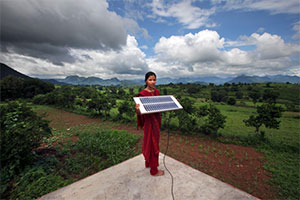 Bringing clean energy to rural India. Credit: Abbie Trayler-Smith / Panos Pictures / Department for International Development
Large reserves of oil, gas and minerals in developing countries generate opulent revenues. They could be used to stimulate economic growth and reduce poverty, but often result in environmental destruction and conflict, benefiting large companies and corrupt governments. Furthermore, competition over natural resources often manifests through geopolitical conflict. For example, before the US-Iraq war, Iraq’s domestic oil industry was nationalized. With US aggression came weakened Iraqi institutions and foreign intervention, thus eventually leading to the privatization of Iraqi oil, leaving the industry now largely dominated by Western companies. As another example, China’s rising investments within the lithium sector in South America are increasing the US-China rivalry across the Western Hemisphere. Notably, Bolivia has the largest reserves of lithium in the world, and the nation’s state-owned lithium extraction firm recently signed a contract with China’s CBC Consortium, while rejecting the entry of Western firms into the nation. In Bolivia’s case, rising Chinese investment in the nation’s lithium sector also raises concerns about environmental sustainability and the sociopolitical rights of Indigenous communities. More broadly, Sub-Saharan Africa holds nearly 30% of global reserves of critical minerals required for low-carbon technologies. Despite this, the region attracts less than 10% of global exploration investment, depicting a critical barrier to both the clean energy transitions and Sub-Saharan Africa’s economic development. Furthermore, resource wealth continues to fuel conflict like Sudan’s civil war, which has led to 9.1 million internally displaced people and is intensely connected to competition over gold, water, and agricultural land. IPS covers news about major oil, gas, and mining projects, their effects on the environment and local communities, and the ideas and actions of the interest groups involved.

The Week with IPS

NEXT STOP - SDGs
Tracking global progress towards a sustainable world
Tracking global progress towards a sustainable world
