Languages
Wednesday, November 18, 2026



News and Views from the Global South
Natural Resources
GLOBALISATION: West’s Loss of Gulf Funds East’s Gain
As politically motivated restrictions on investments by oil-rich countries intensify in the West, the sovereign wealth funds (SWFs) of the Gulf countries could opt to invest in Asia and other emerging markets despite attractive valuations in the slowing U.S and European markets.ENERGY: IEA Sees Oil Demand Moderating, Defends Speculators
The International Energy Agency (IEA) has cut its five-year forecast for global oil demand, saying high prices are forcing consumers to leave gas-guzzling vehicles in the garage.
ENVIRONMENT: Mexicans Protest Canadian Mining Company
Residents and activists from the central Mexican state of San Luis Potosí travelled to Toronto to tell the shareholders of a Canadian mining company that their investments are at risk because the billion-dollar Cerro San Pedro gold and silver mine is illegal and environmentally unsafe.OIL: Prices Won't Be Falling Anytime Soon
Although some policy-makers have blamed producing countries for steadily rising oil prices, many experts say more fundamental factors are a growing demand-supply imbalance, a weak dollar, and market speculation.MALAYSIA: Opposition Pledges Yet Unfulfilled
Even as the Anwar Ibrahim-led opposition Peoples Alliance coalition celebrates 100 days in office this week with huge rallies across the country, the public euphoria that brought them into power is beginning to cool off as people tighten their belts in the face of a slowing economy and escalating cost of living. Demands are rising for the opposition to implement their pledges.PERU: Rights Groups Warn of Authoritarian Tendencies
The government of Peruvian President Alan García has demonstrated an authoritarian bent in its intolerance of social protest or any form of criticism, and has sponsored draft laws that treat demonstrations as criminal activity, say human rights groups and academics.PHILIPPINES: Jatropha Key to Self Sufficiency?
The jatropha plant may be the key to addressing the problems of energy and food self-sufficiency in the Mekong region. Cultivating this hardy plant will not only provide biofuel but will also ensure that agricultural lands devoted to food production will not be diverted to fuel crops.ECONOMY-ANGOLA: Slowdown Will Hurt Trade Partners
Slower economic growth in Angola will have a negative effect on exports from the southwest African nation’s main trading partners, especially Portugal and Brazil.DEVELOPMENT: Gulf Eyes ‘Oil-For-Food’ Deal With Neighbours
Recent attempts by Gulf countries to invest in farmlands abroad to counter soaring inflation and guarantee long-term food security could prove to be a win-win situation in the short-term for both the oil-rich region and its investment-hungry neighbours, but continued high oil prices may neutralise the gains in the long-run, feel experts.ENERGY: Indonesia Leaves OPEC, General Motors Downsizes
Indonesia pulled out of the Organisation of Petroleum Exporting Countries (OPEC) almost at the same time as U.S. automobile giant General Motors decided to build fewer pickup trucks and make an electric car.POLITICS-AFRICA: Critics Target U.S. Military Command
In just a few months, the United States Africa Command (AFRICOM) - Washington's latest military oversight structure for the continent - is expected to be fully operational.ECONOMY-CAMBODIA: Resource Curse or Blessing?
Cambodia is facing a natural resource boom, prompting donors and non-government organisations (NGOs) to warn that without measures to improve financial transparency, promote better governance and curb corruption, the potential windfall could be squandered.OIL-MEXICO: PEMEX Reform Debate Entrenched in Dogma
The debate in the Mexican Congress over the government’s proposals to reform the state oil company, PEMEX, has placed the oft- amended constitution of 1917 and the elusive concepts of nationalism and sovereignty squarely at the centre of the controversy.MEXICO: Disappeared Oil Workers – Out of Sight, Out of Mind
Five workers and three pensioners from the Mexican state oil company PEMEX disappeared one year ago. A lawmaker suspects that they were detained by the army, but there are also signs that point to drug traffickers or the company’s own union.ENVIRONMENT-AUSTRALIA: Split Over Carbon Capture Technology
Australia’s plan to develop carbon capture and storage (CCS) technology - whereby greenhouse gas (GhG) emissions from fossil-fuel fired power stations are trapped and stored rather than released into the atmosphere - is pitting green groups against one another.MEXICO: Pemex Oozes Corruption
Funds belonging to the Mexican state oil monopoly, Pemex, have paid in recent years for liposuction treatment for the wife of the company’s chief executive, a presidential candidate’s campaign, contracts with firms facing legal action, and the whims of trade union leaders who are not required to account for their expenses.
MIDEAST: Too Quiet in the Harbour
It's been strangely quiet for some time at the port in Gaza. No clanging of hooks, no sounds of creaking cranes or of thumping of nets upon decks. Boat engines, normally puttering and spewing exhaust, lie entombed under covers.BURMA: US Oil Major Complicit in Abuses – Rights Lobby
An environmental group is warning U.S. energy giant Chevron to clean up its act in Burma or face legal proceedings where the multinational’s links to gross human rights violations in the military-ruled country could be exposed.FINANCE: Oil Majors Rapped Over Secrecy, Corruption
Leading oil firms impede efforts to stamp out poverty and corruption by shrouding their financial dealings in secrecy, says a global watchdog.INDIA: Blames West For High Food, Energy Prices
While moving firmly to curb inflationary trends, India’s coalition government, which faces a general election next year, continues to blame a poorly managed international financial system for spiralling food and energy prices at home.
ENVIRONMENT-PERU: US-Owned Smelter Fined for Pollution
The U.S. company running a large multi-metal smelter in the Peruvian city of La Oroya, one of the most polluted places on earth, is facing sanctions for violating air quality standards.« Previous Page — Next Page »


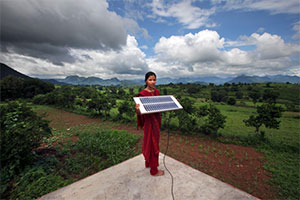 Bringing clean energy to rural India. Credit: Abbie Trayler-Smith / Panos Pictures / Department for International Development
Large reserves of oil, gas and minerals in developing countries generate opulent revenues. They could be used to stimulate economic growth and reduce poverty, but often result in environmental destruction and conflict, benefiting large companies and corrupt governments. Furthermore, competition over natural resources often manifests through geopolitical conflict. For example, before the US-Iraq war, Iraq’s domestic oil industry was nationalized. With US aggression came weakened Iraqi institutions and foreign intervention, thus eventually leading to the privatization of Iraqi oil, leaving the industry now largely dominated by Western companies. As another example, China’s rising investments within the lithium sector in South America are increasing the US-China rivalry across the Western Hemisphere. Notably, Bolivia has the largest reserves of lithium in the world, and the nation’s state-owned lithium extraction firm recently signed a contract with China’s CBC Consortium, while rejecting the entry of Western firms into the nation. In Bolivia’s case, rising Chinese investment in the nation’s lithium sector also raises concerns about environmental sustainability and the sociopolitical rights of Indigenous communities. More broadly, Sub-Saharan Africa holds nearly 30% of global reserves of critical minerals required for low-carbon technologies. Despite this, the region attracts less than 10% of global exploration investment, depicting a critical barrier to both the clean energy transitions and Sub-Saharan Africa’s economic development. Furthermore, resource wealth continues to fuel conflict like Sudan’s civil war, which has led to 9.1 million internally displaced people and is intensely connected to competition over gold, water, and agricultural land. IPS covers news about major oil, gas, and mining projects, their effects on the environment and local communities, and the ideas and actions of the interest groups involved.

The Week with IPS

NEXT STOP - SDGs
Tracking global progress towards a sustainable world
Tracking global progress towards a sustainable world
