Languages
Wednesday, November 18, 2026



News and Views from the Global South
Natural Resources
POLITICS-US: Canada’s Tar Sands Lobbyists Focus on Democrats
As the U.S. election campaign kicks into overdrive, Canadian politicians and oil executives are stepping up lobbying efforts to make sure whoever controls the White House keeps purchasing notoriously dirty oil from the Alberta tar sands.
OIL-PERU: “The Ashaninka People Will Not Allow These Abuses”
"We will not allow the oil company to come in because it will bring pollution and we will suffer," said Medaly Pancho, a member of the Ashaninka community in the central Peruvian province of Junín. "We hunt and fish, we live our peaceful lives, and we don't want that to change."
ENVIRONMENT: Amazon Increasingly Oily
More than 180 oil and natural gas fields extend across the western Amazon, shared by five South American countries and threatening biodiversity and indigenous lands, warns a study by U.S.-based organisations.BRAZIL: The Complications of Coming into Sudden (Oil) Wealth
Brazil's social and economic future may depend, according to experts, on the way it ultimately handles the sudden oil wealth discovered deep under the Atlantic ocean off the country's southeastern coast.ENVIRONMENT-ARGENTINA: Scarce Water Threatened by Gold Mine
For nearly a year and a half, local residents in the northwestern Argentine province of La Rioja have been blocking the road that climbs up to the Nevados de Famatina mountain to protest a gold mining project that they say will pollute the water in the country’s driest district.
INDIA: Mining Boom Affecting Tribals, Environment
While India has been steadily attracting foreign investment into its booming mining sector, the fact that the best prospects lie in tribal-dominated and heavily forested areas is cause for concern.DEVELOPMENT: Food, Fuel and Water Crises Converging
A spectre is haunting the cities and villages of most developing nations, warns a senior official of a World Bank-affiliated organisation.
MIDDLE EAST: In the Race for Renewable Energy Sources
As the world scrambles to develop renewable energy resources (RES), the oil-rich Gulf countries that benefit from high prices on fossil fuels are making sure that they do not get left behind.PERU: Native Groups Protest Laws Facilitating Sales of Land
Defending the state of emergency declared in three provinces in Peru to crack down on protests by indigenous communities against a law facilitating the sale of their community-owned lands, Prime Minister Jorge del Castillo said the government was safeguarding "the rights of the great majority of Peruvians."EQUATORIAL GUINEA: Human Rights Drowning in Oil
The oil interests of Angola, Brazil and Portugal could pave the way for former Spanish colony Equatorial Guinea to become the ninth member of the Community of Portuguese Language Countries (CPLP) two years from now, despite the country’s poor human rights record.ECONOMY-PERU: Easier to Extract Minerals than Accounting Information
Sixty-six percent of the Peruvian state’s revenue from the extractive industries does not appear on government accounts. Parliament is taking a hand in the matter amid pressure from oil, gas and mining companies for the government to flout an international agreement on transparency.DISARMAMENT: China Key Arms Supplier to Human Rights Abusers
As China tries to boost its international image, playing host to a summer Olympic games, the government in Beijing is being singled out as a key arms supplier to some of the world's worst human rights abusers, according to a new study released here.TRADE: ‘Increased Foreign Investment Will Not Lift All Boats’
Paul Moist, the President of Canada’s largest union, expressed concern about a free trade deal between Canada and Colombia during a recent meeting with Fabio Valencio, Colombia’s Minister of the Interior.PERU: Seeking Ways to Remedy Unequal Distribution of Mining Taxes
The Peruvian parliament is studying ways to improve the distribution of the "canon minero", the portion of the taxes paid by mining companies that is transferred to the regions, in order to benefit the country’s poorest provinces.ECONOMY: Oil Not Costly Enough to Prompt Needed Changes – Experts
Just about everyone is complaining about the high price of oil, but it does not even reflect the environmental costs and is still insufficient to promote the changes needed to ensure a less catastrophic future for humanity, experts warn.
ENVIRONMENT-US: New Push to Clean Toxic Hotspot
Two New York City Congressional representatives are calling for Newtown Creek, one of the country's most polluted waterways, to be tested for the high levels of toxic chemicals that would qualify it for Superfund clean-up.FINANCE: U.S. Accuses Trading Firm of Manipulating Oil Market
U.S. regulators are pressing charges against a global trading firm they accuse of manipulating the oil market, in a move that dovetails with heightened political agitation over rising energy and food prices.POLITICS-BOLIVIA: It’s All about the Gas Revenues
Revenues from Bolivia’s sales of natural gas, which have ballooned in the last few years, are now at the centre of the tense political polarisation threatening to tear the country apart and are a main motivation in the opposition’s attempt to undermine the leftwing government of Evo Morales.FINANCE: Developing Nations Rack up Hefty Foreign Reserves
As the global economy continues to be jolted by volatile financial markets, bank failures, a spreading credit crunch, and rising food and energy prices, some of the developing nations have accumulated three-quarters of the world's reserves, amounting to a staggering 4.3 trillion dollars.FINANCE: Lobbyists Enlist Public in Commodities Speculation Fight
Energy traders and oil-consuming businesses are enlisting the public in a tug-of-war over proposals to tame fuel and other commodity prices.PERU: Mining Companies Venture into the Amazon
The conflicts surrounding extractive industries in Peru could shift from the mountains to the jungles due to the rising number of concessions granted for the Amazonian regions of San Martín, Madre de Dios and Amazonas, and which are being strongly opposed by the local indigenous communities.« Previous Page — Next Page »


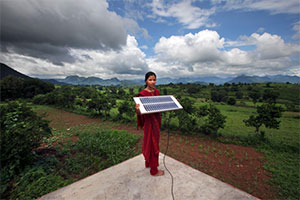 Bringing clean energy to rural India. Credit: Abbie Trayler-Smith / Panos Pictures / Department for International Development
Large reserves of oil, gas and minerals in developing countries generate opulent revenues. They could be used to stimulate economic growth and reduce poverty, but often result in environmental destruction and conflict, benefiting large companies and corrupt governments. Furthermore, competition over natural resources often manifests through geopolitical conflict. For example, before the US-Iraq war, Iraq’s domestic oil industry was nationalized. With US aggression came weakened Iraqi institutions and foreign intervention, thus eventually leading to the privatization of Iraqi oil, leaving the industry now largely dominated by Western companies. As another example, China’s rising investments within the lithium sector in South America are increasing the US-China rivalry across the Western Hemisphere. Notably, Bolivia has the largest reserves of lithium in the world, and the nation’s state-owned lithium extraction firm recently signed a contract with China’s CBC Consortium, while rejecting the entry of Western firms into the nation. In Bolivia’s case, rising Chinese investment in the nation’s lithium sector also raises concerns about environmental sustainability and the sociopolitical rights of Indigenous communities. More broadly, Sub-Saharan Africa holds nearly 30% of global reserves of critical minerals required for low-carbon technologies. Despite this, the region attracts less than 10% of global exploration investment, depicting a critical barrier to both the clean energy transitions and Sub-Saharan Africa’s economic development. Furthermore, resource wealth continues to fuel conflict like Sudan’s civil war, which has led to 9.1 million internally displaced people and is intensely connected to competition over gold, water, and agricultural land. IPS covers news about major oil, gas, and mining projects, their effects on the environment and local communities, and the ideas and actions of the interest groups involved.

The Week with IPS

NEXT STOP - SDGs
Tracking global progress towards a sustainable world
Tracking global progress towards a sustainable world
