Languages
Wednesday, November 18, 2026



News and Views from the Global South
Natural Resources
CORRUPTION-PERU: Officials Charged in Oil Contract Scandal
An anti-corruption Peruvian prosecutor brought charges against one current and three former high-level officials and 10 other people in a scandal over alleged bribes in lucrative oil contracts awarded to Discover Petroleum, a Norwegian company.ECONOMY-CUBA: “Impossible to Escape Impact” of Crisis – Experts
After three years of high growth, uncertainty is hovering over the Cuban economy once again, although experts are not yet ready to predict exactly what impact the current global financial turmoil will have on the island.
OIL SANDS-PART 3: Biggest Customer Has Second Thoughts
As Canada's tar sands extraction expands full steam ahead, a perfect storm of internal and external opposition could derail some of the voracious growth at the world's largest energy project.
OIL SANDS-PART 2: "Where I Come From Is Ground Zero"
The wheels of the Caterpillar 797B, the world's largest truck, are always going round and round at Shell Canada's Albian Sands mine.
ENVIRONMENT: Global Financial Crisis a Bad Sign for Andean Biodiversity
The crisis affecting the financial sector and stock markets around the world could fuel the expansion of extractive industries in South America's Andean region, warn experts.
OIL SANDS-PART 1: Showdown at Ft. McMoney
The sun rises in a bright, red line over flat land, small lakes, boreal forest and peat bogs as our small double engine plane bumps through early morning turbulence between Edmonton and Ft. McMurray, Canada.FRANCE: No Angolans at “Angolagate” Trial
After a decade's delay, the defendants on trial for arms trafficking to Angola include figures of the French élite and an Israeli billionaire, but not a single leader from the vast African country has been summonsed by the Paris court judge.
CHILE: Native Community in Desert Oasis Threatened by Mines
The Diaguita indigenous community in Huasco Alto, surrounded by rich gold, silver and copper deposits in the northern Chilean region of Atacama, are engaged in a struggle to prevent mining projects from infringing on their territory and destroying their way of life and ancestral identity.PERU: Mobilising to Hold President to His Promises
Social movements, trade unions, peasant farmer and indigenous organisations are holding strikes and demonstrations to demand that Peruvian President Alan García fulfil the social commitments he has made, in writing and at negotiating tables.ENVIRONMENT: Companies Scramble for Ever-Scarcer Resources
As humanity runs out of oil and minerals, the extraction of previously untouched deposits suddenly pays off - financially. But experts warn that it will likely further accelerate climate change and seriously damage the environment.
U.S.: Great Place for the Oil Business
Why do U.S. oil companies - some of the most profitable corporations on the planet - receive 20 to 40 billion dollars a year in subsidies from the U.S. government?ENERGY-LATIN AMERICA: PDVSA’s Growing Presence
Central America, Cuba, the Dominican Republic and islands in the eastern Caribbean are receiving more and more oil from Venezuela, while major refineries are planned in South America - at Pernambuco in northeastern Brazil, and at El Aromo, on Ecuador's Pacific coast.
RIGHTS: Oil Companies’ “Self-Policing” a Dismal Failure
The intersection of human rights, the environment and corporate responsibility was highlighted today at a Capitol Hill hearing featuring activists from Burma and Nigeria who underlined the failure to date of "voluntary" controls over major oil companies operating in their countries.POLITICS: U.S. Ties to Bolivian Opposition "Shrouded in Secrecy"
Who in Bolivia is receiving millions of U.S. taxpayer dollars? That is what many Latin America policy analysts in Washington want to know.VENEZUELA: Multi-Tentacled PDVSA, a State Within a State
"I would have liked to be taken on by PDVSA, but I didn't win that lottery," Antonio Jiménez, a 52-year-old father of four and grandfather of three who is a pump attendant at a petrol station on the outskirts of the Venezuelan capital, told IPS.ECONOMY-PORTUGAL: Angola Rising
Nearly seven years after rebel leader Jonas Savimbi was killed in combat, Angolans are doing such brisk business with Portugal that the southern European country’s largest former colony in Africa has a double-digit economic growth rate.NIGERIA: Niger Delta Conflict Hurting Local Economy
A thriving business climate appears to be the main casualty as armed groups agitate for the control of oil proceeds in Nigeria’s Niger Delta region.BOLIVIA: U.S. Ambassador Expelled for Allegedly Supporting Violent Opposition
Bolivian President Evo Morales has declared U.S. Ambassador to La Paz Philip Goldberg "persona non grata", after accusing him of aiding and abetting pro-autonomy opposition groups that are blocking highways and occupying government buildings, reducing the supply of natural gas to Brazil.BOLIVIA: “Twenty Families Are Obstructing Governability” – Expert
The Bolivian government's determination to hold a referendum, by presidential decree, on a new constitution that it hopes will "re-found" the nation as a "plurinational state," has ceded to pressure from the rightwing opposition. The vote has been postponed several weeks, and Congress will be setting the rules.CLIMATE CHANGE: Arctic Oil and Gas Rush Alarms Scientists
As greenhouse gas pollution destroys Arctic ecosystems, countries like Canada are spending millions not to halt the destruction but to exploit it.PERU: Small Towns Face Challenge of Using Windfall Mining Revenues
Peru is enjoying a mining boom. But while some areas lacking in minerals and oil have seen very little of the windfall profits, other districts have taken in so much money that they have only been able to actually use a tiny portion of it.« Previous Page — Next Page »


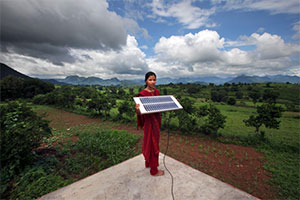 Bringing clean energy to rural India. Credit: Abbie Trayler-Smith / Panos Pictures / Department for International Development
Large reserves of oil, gas and minerals in developing countries generate opulent revenues. They could be used to stimulate economic growth and reduce poverty, but often result in environmental destruction and conflict, benefiting large companies and corrupt governments. Furthermore, competition over natural resources often manifests through geopolitical conflict. For example, before the US-Iraq war, Iraq’s domestic oil industry was nationalized. With US aggression came weakened Iraqi institutions and foreign intervention, thus eventually leading to the privatization of Iraqi oil, leaving the industry now largely dominated by Western companies. As another example, China’s rising investments within the lithium sector in South America are increasing the US-China rivalry across the Western Hemisphere. Notably, Bolivia has the largest reserves of lithium in the world, and the nation’s state-owned lithium extraction firm recently signed a contract with China’s CBC Consortium, while rejecting the entry of Western firms into the nation. In Bolivia’s case, rising Chinese investment in the nation’s lithium sector also raises concerns about environmental sustainability and the sociopolitical rights of Indigenous communities. More broadly, Sub-Saharan Africa holds nearly 30% of global reserves of critical minerals required for low-carbon technologies. Despite this, the region attracts less than 10% of global exploration investment, depicting a critical barrier to both the clean energy transitions and Sub-Saharan Africa’s economic development. Furthermore, resource wealth continues to fuel conflict like Sudan’s civil war, which has led to 9.1 million internally displaced people and is intensely connected to competition over gold, water, and agricultural land. IPS covers news about major oil, gas, and mining projects, their effects on the environment and local communities, and the ideas and actions of the interest groups involved.

The Week with IPS

NEXT STOP - SDGs
Tracking global progress towards a sustainable world
Tracking global progress towards a sustainable world
