Languages
Wednesday, November 18, 2026



News and Views from the Global South
Natural Resources

PERU: Open-Pit Mine Continues to Swallow City
An immense open-pit mine located 4380 metres above sea level is swallowing up the centre of the city of Cerro de Pasco in Peru’s central highlands, while the damages, in the form of toxic waste, spread to nearby villages.
VENEZUELA: The Cost of the World’s Cheapest Gasoline
The world’s most inexpensive gasoline is sold in Venezuela, through a longstanding subsidy programme that benefits car owners while depriving the oil industry of a large source of funds for reinvesting.
MEXICO: Manganese Mines Harm Children’s Mental Development
The Mexican mining company Autlán maintains that there is no evidence that manganese causes any harm to human health. But in the central state of Hidalgo, where the metal is mined, adults shake as if they suffered from Parkinson's disease and children's mental development lags behind normal.
ECONOMY-IRAN: From Bad to Worse?
As the price of crude oil continued its tumble to less than 35 dollars a barrel Friday, Iranian economists are warning that the fourth-largest oil producer in the world will enter an even deeper crisis should the price remain low, with many also blaming the government's economic policies.POLITICS: Scant Support for U.S. Naval Forces in the Gulf
A new poll by WorldPublicOpinion.org conducted in 21 nations around the world finds widespread opposition to the United States maintaining naval forces based in the Persian Gulf.CLIMATE CHANGE: Arctic Is the Canary in the Coalmine
Nearly 1,000 scientists and representatives of indigenous peoples from 16 countries have braved a major winter storm to share their findings and concerns about the rapidly warming Arctic region at the International Arctic Change conference in Quebec City.EL SALVADOR: Gold Mining ‘Is a Huge Rip-Off’ – Environmentalists
A black coffin was consigned to the flames amid music and fireworks as dozens of people from Salvadoran communities that fear the impacts of gold and silver mining celebrated a "symbolic burial" of the Pacific Rim Mining Corporation, a Canadian-based company.
ARGENTINA: Frustration Over Veto of Glacier Protection Law
The decision by the administration of Cristina Fernández to veto a law to protect Argentina's glaciers - important reserves of freshwater - has caused deep concern among scientists and environmentalists who participated in writing the legislation.
PERU: My Mining Deposits Are Under Your House
"Just imagine you’re told you have to leave your house, your livestock, the graves of your loved ones, and then they take you to an unfamiliar place without even asking you what you think about it. How would you feel?" asks Eduardo Sueldo, the local environment delegate in a highlands village in southern Peru.
ARGENTINA: Companies Pocketing Gas Subsidy for the Poor
Companies that produce and distribute liquefied petroleum gas (LPG) in Argentina are benefiting from large government subsidies aimed at bringing down the price of the fuel, which 40 percent of the population depends on for cooking and heating.
LATIN AMERICA: Elusive Right to Land Inflames Indigenous Protests
In the past two decades Latin America has made advances in signing international and national instruments that recognise and protect the rights of indigenous peoples. The problem is that these laws are not always heeded by governments, and the lack of enforcement has fuelled protests.VENEZUELA-RUSSIA: Business Deals Consolidate Alliance
"Tovariches! Comrades! Today I feel I must say to you: let us work to find gas and oil under these waters!" said Alexander Medvedev, deputy chairman of the Russian firm Gazprom, when drills on the Escorpión Vigilante marine platform finally perforated the Venezuelan sea bed.
ENVIRONMENT: Costa Rica at a Crossroads
The Crucitas open-pit gold mining project in northern Costa Rica could become an environmental cross to bear for the government of Óscar Arias.ECONOMY-BRAZIL: Crisis Delays Threat of ‘Venezuelan Disease’
The global financial crisis has corrected the extreme overvaluation of Brazil's local currency, caused by the policies of its Central Bank, thus temporarily chasing away fears of "Dutch disease", which in the developing world could well be called "Venezuelan disease".FINANCE: Watchdogs Criticise World Bank, IMF Mega Projects
The World Bank and International Monetary Fund (IMF) came under fire last week for failing to adequately promote transparency in extractive industry operations in resource-rich countries where the two institutions work.
PERU: Free Trade Opens Environmental Window
Legislative decree 1090, which modifies Peru's forest policy, is worrying U.S. trade authorities because it contravenes environmental clauses of the Free Trade Agreement (FTA) that is to enter force between the two countries in January 2009.PERU: Prosecutors Investigate Wiretapping Operation
Prosecutors in Peru are investigating illegal wiretapping allegedly committed by private security companies or police and military intelligence bodies.CUBA-US: A Thaw Fuelled by Oil?
The discovery of a significant offshore oilfield in Cuban waters in the Gulf of Mexico could persuade the United States to modify its policy towards the Caribbean island nation, experts say, while warning that this possibility could also entail risks.MEXICO: Oil Reforms Leave State in the Red
The oil industry reforms approved by the Mexican Congress and applauded by the government and most of the country’s parties, with the exception of factions on the left and part of the business community, will deprive the state of a source of funding that currently finances 40 percent of the public budget.ENERGY: Harsh Blow for OPEC
In an unexpected reaction, oil prices continued to slide, by up to six percent Friday, despite OPEC’s decision to cut output by 1.5 million barrels a day as of Nov. 1.
MINING-WEST AFRICA: ECOWAS Stirs Up Trouble With MOU
The Economic Community of West African States has taken the unprecedented step of inviting Oxfam America to coordinate the drawing up of a mining code for the region. The decision has infuriated some civil society organisations.« Previous Page — Next Page »


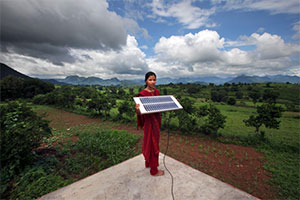 Bringing clean energy to rural India. Credit: Abbie Trayler-Smith / Panos Pictures / Department for International Development
Large reserves of oil, gas and minerals in developing countries generate opulent revenues. They could be used to stimulate economic growth and reduce poverty, but often result in environmental destruction and conflict, benefiting large companies and corrupt governments. Furthermore, competition over natural resources often manifests through geopolitical conflict. For example, before the US-Iraq war, Iraq’s domestic oil industry was nationalized. With US aggression came weakened Iraqi institutions and foreign intervention, thus eventually leading to the privatization of Iraqi oil, leaving the industry now largely dominated by Western companies. As another example, China’s rising investments within the lithium sector in South America are increasing the US-China rivalry across the Western Hemisphere. Notably, Bolivia has the largest reserves of lithium in the world, and the nation’s state-owned lithium extraction firm recently signed a contract with China’s CBC Consortium, while rejecting the entry of Western firms into the nation. In Bolivia’s case, rising Chinese investment in the nation’s lithium sector also raises concerns about environmental sustainability and the sociopolitical rights of Indigenous communities. More broadly, Sub-Saharan Africa holds nearly 30% of global reserves of critical minerals required for low-carbon technologies. Despite this, the region attracts less than 10% of global exploration investment, depicting a critical barrier to both the clean energy transitions and Sub-Saharan Africa’s economic development. Furthermore, resource wealth continues to fuel conflict like Sudan’s civil war, which has led to 9.1 million internally displaced people and is intensely connected to competition over gold, water, and agricultural land. IPS covers news about major oil, gas, and mining projects, their effects on the environment and local communities, and the ideas and actions of the interest groups involved.

The Week with IPS

NEXT STOP - SDGs
Tracking global progress towards a sustainable world
Tracking global progress towards a sustainable world
