Languages
Wednesday, October 7, 2026



News and Views from the Global South
Poverty & SDGs

Bottled Water Masks World’s Failure to Supply Safe Water for All, Can Slow Sustainable Development: UN
The rapidly-growing bottled water industry can undermine progress towards a key sustainable development goal: safe water for all, says a new United Nations report.
Health – It’s Time for Women to Lead the Sector
Women health workers are more than two thirds of the health workforce and represent 90% of the world’s frontline health workers, yet hold less than a quarter of senior leadership roles - a situation which is unfair and a significant risk for global health security.
Terrorism & its Impacts on Water Access in the Sahel
Burkina Faso’s interim President Captain Ibrahim Traoré spoke late last year of the conflicts that are now blighting his country and much of his region. He described the situation in Burkina Faso as predictable given the endemic weaknesses in governance that he believes have led to the economic abandonment of many young people, particularly outside of urban areas.
Parliamentarians Pledge to Act on Grim Realities of Child Marriage, Gender-Based Violence
Child marriage, gender-based violence (GBV), sexuality education, religion, and tradition came under the spotlight during a conference, Arab and Asian Parliamentarians’ Meeting to Follow-Up on ICPD25 Commitments: Addressing Youth Empowerment and Gender-Based Violence, held in Jakarta, Indonesia.
Pandemic Accord Text Falls Short of Expectations
As countries recently gathered in Geneva for the fourth round of negotiations on the WHO proposed pandemic treaty or accord, close examination of the current text by civil society experts has revealed significant gaps.
Vanuatu Twin Cyclones Underscore the Pacific’s Vulnerability to Compounding Climate-Disaster Risks
Two destructive Category 4 tropical cyclones, Judy and Kevin, and an earthquake of 6.5 magnitude impacted over 80 per cent of the Vanuatu population from 1 to 3 March 2023. To address this emergency situation, the UN, along with Pacific member States have deployed personnel on the ground to coordinate humanitarian assistance and prepare post-disaster damage assessment.
Breaking Barriers: Why Free & Public Education Should be Every Woman’s Right
This month, government and civil society organization representatives gathered in New York for the United Nations’ 67th session of the Commission on the Status of Women (CSW) to discuss technology as a tool to facilitate access to education for women and girls.
Breaking the Link between ‘Polycrisis’ and Poverty
This year marks the halfway point— eight years in and eight years out— of the UN Sustainable Development Goals to end poverty and reduce inequalities.
The Caribbean’s Role in the Transformation of Agri-Food Systems
The global food security crisis reveals an increase in the undernourishment prevalence, reaching higher than in 2015, when countries first agreed to eradicate hunger by 2030 as one of the SDG targets. In the Caribbean, between 2014 and 2021, hunger increased by 2.3 percentage points, affecting 16.4 percent of its population by 2021. Moreover, the Caribbean is a net importer of almost all the main food groups such as cereals, dairy products, fruits and vegetables (except the Dominican Republic), meat and vegetable oils.
International Women’s Day, 2023
Women and Girls: Innovation and Higher Education
In September 2020, the Beijing Declaration and Platform for Action for women’s rights celebrated its 25th anniversary. It was, however, a bittersweet commemoration, mixing joy for the progress in gender equality achieved since 1995, and the stark realization about the multidimensional gaps awaiting tackling and the new divides brought by the social consequences of COVID-19.

International Women’s Day, 2023
Digital Inclusion is Vital for Strengthening Women’s Rights in Africa
The internet has a pivotal role to play in empowering women and girls across Africa, but preexisting forms of gender discrimination and marginalization are underpinning a widening digital gender divide.

International Women’s Day, 2023
The Power of Technology—& the Increased Exclusion, Inequalities & Gender Discrimination
Since the onset of the COVID-19 pandemic, the tremendous power of technology and innovation has become clear to the world.
However, it has also increased exclusion, discrimination, and inequalities -- especially for women and girls.

International Women’s Day, 2023
Empower Her
On International Women’s Day, let us remind ourselves of the power of education. We have all benefited from an education that less than a century ago was not a given for a girl and which still remains a distant utopia for millions of young girls.

Why Do 800 Mothers a Day – 1 Every 2 Minutes– Die from Preventable Causes?
The answer is that there are alarming setbacks for maternal health care and, in many cases, even a total lack of maternity services, which threaten to further raise the number of these tragic preventable deaths one million or more a year by 2030.
Our AIDS Response Must Acknowledge and Bridge Gendered Digital Inequalities
Recent crises have pushed the gender inequality gap even wider and new technology has brought new threats to women’s autonomy and safety. This year’s International Women's Day celebrated under the theme “DigitALL: Innovation and technology for gender equality” is an opportunity to strengthen efforts to uplift and empower women and girls’ digital participation to ultimately improve their lives.
International Women’s Day, 2023
Promoting Gender Equality and Closing the Digital Divide
The accelerating pace of digitalization has ushered humanity into a whole different era of information and communication. Today, digitalization permeates every aspect of our lives, socio-economically and politically.

International Women’s Day, 2023
Her Land, Her Rights: Advancing Gender Equality & Land Restoration Goals
When it comes to land, gender inequalities are pervasive. Today, nearly half of the global agricultural workforce is female – yet less than one in five landholders worldwide are women 1.

International Women’s Day, 2023
To Strengthen Women’s Resilience to Disasters, Make Wealthiest Pay Their Fair Share
She will be called Aya. This is the name that nurses gave to the infant baby pulled from the rubble of a five-story building in Jinderis, northern Syria. A miracle. Beside her, the rescuers found her mother, dead.

International Women’s Day, 2023
A New Global Architecture to Defend & Promote Rights of Women & Girls
If you want to have a good reading on women and young girls’ activism, there is a high chance that you have missed an incredibly interesting report.

Nigeria’s Unbanked, Poor Get Reprieve After Court Rules Naira Deadline Unconstitutional
Nigerians confronted by hardships over the scarcity of the newly redesigned naira notes in conjunction with the country's cashless policy introduced by the apex bank have had a last-minute reprieve from a policy that had disrupted their lives and exacerbated hunger.
Most African Govts (3 in 4) Spend More on Arms, Less on Farms
The data is shocking: three-quarters of African Governments have already reduced their agricultural budgets while paying almost double that on arms.« Previous Page — Next Page »





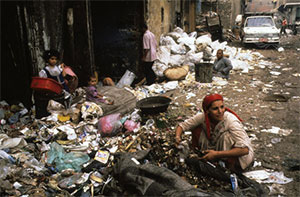 Romani people in Cairo, Egypt, forage through trash. Credit: UN Photo/Armineh Johannes
In 2015, the United Nations adopted the Sustainable Development Goals (SDGs) in an effort to promote “peace and prosperity for people and the planet.” To achieve that goal, it is essential to provide equal opportunities and access to basic services to all people. The 2025 UN SDG Report found that 35% of the 169 SDG targets are on track or making moderate progress, while 18% have reversed compared to the 2025 baseline. One in ten people still live in extreme poverty, one in eleven experience food insecurity, and over 1.1 billion people live in slums without access to clean water and sanitation. It is imperative to acknowledge the societal, technological, economic, and political issues that sustain poverty in countries around the world. Eradicating poverty will require significant frameworks in policy and governance on a national and international scale to ensure that all people will have equal access to basic services and economic opportunities by 2030. Furthermore, a dramatic reduction of United States foreign aid in 2025, including the termination of 83% of USAID programmes, threatens to erode years of fragile development gains.
Throughout the world, violent conflict and natural disasters also contribute to extreme poverty. The complete destruction of infrastructure and blockage of aid has significantly impoverished Palestine since October 7th. The destructive impact of Hurricane Maria in Puerto Rico left $91 billion in damage. An inadequate US government response also revealed significant and enduring questions within the issue of mitigating poverty: how do we rebuild infrastructure after its destruction? How do we restimulate economic development and bring in financial aid after disasters? Similar questions have been raised in the realm of regional cooperation, as devastating floods have wrecked hundreds of thousands of homes across multiple Southeast Asian nations in the past few years. Furthermore, the COVID-19 pandemic has greatly exacerbated the global poverty crisis, particularly in developing countries, setting back the United Nations goal of eradicating poverty by 2030.
IPS is committed to providing comprehensive features that focus on the persisting environmental, sociopolitical, and systemic issues that sustain poverty, and the steps taken worldwide towards poverty eradication.

The Week with IPS

NEXT STOP - SDGs
Tracking global progress towards a sustainable world
Tracking global progress towards a sustainable world

