Languages
Thursday, October 8, 2026



News and Views from the Global South
Poverty & SDGs

The Dynamics of Violent Extremism in sub-Saharan Africa
There is no better environment for the expansion of violent extremist groups than a vacuum in state authority. It provides ideal conditions for these groups to prey on existing and historical grievances, fill the void with promises of financial support, access to services and attention for marginalized, neglected communities.
Wildlife Is Much More than a Safari. And It Is at Highest Risk of Extinction
Wildlife is indeed far much more than a safari or an ‘exotic’ ornament: as many as four billion people –or an entire half the whole world's population– rely on wild species for income, food, medicines and wood fuel for cooking.
International Women’s Day, 2023
Unleashing Our Region’s Most Untapped Potential: Harnessing the Digital Age to Empower Women & Girls
New technologies and innovations are reshaping our world and its future, often at a dizzying pace. Yet women and girls continue to be left behind in this burgeoning digital universe. How, then, can we harness these developments to create a better future for all of us?

Climate Displacement & Migration in South East Asia
Global warming and climate breakdown are going to be disruptive to say the least. Humanity’s insistence on unsustainable development and rising greenhouse gas emissions will make the settlements of millions of people increasingly prone to extreme weather events and full-blown natural disasters.
Welcome To the Vegetable Garden of Europe – ‘The Greenhouses of Death’
Chances are that the fruits and vegetables sold in European supermarkets have been picked and packed by a migrant worker in southern Spain. By the tens of thousands, they work there, in sweltering hot plastic greenhouses - often underpaid and without residence permit - in the vegetable garden of Europe. "Cheap vegetables, yes. But at what price?"
‘Ticking Time Bombs’ for the Most Defenceless: The Children (II)
While the world’s biggest powers and their giant private corporations continue to attach high priority to their military –and commercial– dominance, both of them being shockingly profitable, entire generations are being lost to deadly armed conflicts, devastating climate catastrophes, diseases, hunger and more imposed impoverishment.
‘Ticking Time Bombs’ for the Most Defenceless: The Children (I)
Today, there are more children in need of desperate humanitarian assistance than at any other time since World War II.
A Vital Partnership for the 2030 Agenda
Flexible and predictable funding allows UN agencies to respond promptly and with agility in times of crisis. In countries such as Afghanistan, Yemen, and Ukraine, UNDP implements projects and programmes that help protect livelihoods and enhance the resilience of vulnerable communities.
Bhutan’s Civil Servants are Building a Digital Government System — Here’s How
New UNCTAD software does to digital government what IKEA did to furniture, allowing Bhutan’s government employees to create their own user-friendly services for citizens online.
Video: Roraima in Search of Safe and Sustainable Energy Autonomy
 Roraima, the northernmost state of Brazil, on the border with Guyana and Venezuela, is undergoing an energy transition that points to the dilemmas and possible solutions for a safe and sustainable supply of electricity in the Amazon rainforest.
Race to Prosperity as Least Developed Countries Top Agenda at UN Conference
It is a race against time to form a new global partnership to secure a better future for the world’s poorest and most vulnerable nations by 2030 in line with the UN’s SDGs. All 46 countries classified as Least Developed Countries (LDCs) are pressed for time in a bid to deliver critical development goals.
“I Was Blind, But Now I See” – Celebrating Malawi’s Progress on World NTD Day
“I was blind, but now I see.” This is what Vainesi, from Salima District in Central Malawi, said after surgery to treat trachoma. A mother of three, Vainesi had been unable to work or provide for her family once the disease began to affect her eyesight.
As the Climate Crisis Bites, Soil Needs Doctors Too
In a wiser world, the term ‘treating someone like dirt’ would be a good thing. After all, 15 of the 18 nutrients essential to plants are supplied by soils and around 95% of the food we eat comes directly or indirectly from them, according to the United Nations Food and Agriculture Organization (FAO). So dirt is actually a precious resource that deserves to be treated with respect, care and perhaps even a little love.
How (Much) Are You Today?
Gone are those times when catastrophes were measured in terms of human suffering. Now, with an exception: Ukrainians victims of the Russian invasion, everything is calculated in just money.
Delivering On Our Promise of Universal Education
As we mark the International Day of Education, world leaders must make good on their promise of providing quality education for all by 2030. Education is our investment in peace where there is war, our investment in equality where there is injustice, our investment in prosperity where there is poverty.
Demography Doesn’t Care
Demography doesn’t care about such things as national strikes over pension retirement ages, public protests about contraception and abortion rights, sexual orientation, habits and preferences, political ideology and party affiliation, dress codes and head coverings, and religious identity, beliefs and practices.
Rebuilding Climate-Devastated Pakistan will Run in Excess of 16 Billion Dollars
For decades, I have been privileged to witness the boundless generosity and resilience of the Pakistani people amidst grave threats and upheaval.
Greening the City Gets Community Treatment in Zimbabwe
It's a typical story in Bulawayo, Zimbabwe's second-largest city. With the failure to provide services such as refuse collection by the local municipality, township residents dump garbage wherever they fancy, and with time, dumpsites become "official."
Can the UN do a Better Job with Democracy?
The UN Democracy Fund, also known as UNDEF, is an interesting tool but it is too small and lacking resources to mark a difference. How can the UN do a better job at promoting democracy? This is a key question that high-ranking policy makers at the UN should ask themselves.
African Parliamentarians Strongly Committed to Population and Development
Many Ghanian Members of Parliament (MPs) champion adolescent reproductive health rights to stop the practice of child marriage, which is prevalent in some areas of the country even though the country’s Constitution and Children’s Act outlaw it, Dr Rashid Pelpuo (MP) told IPS in an exclusive interview.
Africa’s Maternal Deaths Need Urgent Action to Meet SDG Goals
As the effects of COVID-19 on Africa’s health sector become clearer, it looks the continent will need to take urgent steps to overcome the disruptions suffered in the breakdown in antenatal and postnatal care for women and newborns and neonatal intensive care units. The pandemic brought some setbacks to the gains achieved in maternal mortality over the past decade.« Previous Page — Next Page »





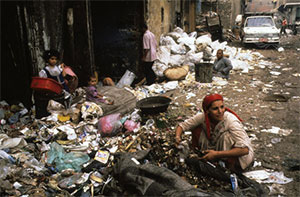 Romani people in Cairo, Egypt, forage through trash. Credit: UN Photo/Armineh Johannes
In 2015, the United Nations adopted the Sustainable Development Goals (SDGs) in an effort to promote “peace and prosperity for people and the planet.” To achieve that goal, it is essential to provide equal opportunities and access to basic services to all people. The 2025 UN SDG Report found that 35% of the 169 SDG targets are on track or making moderate progress, while 18% have reversed compared to the 2025 baseline. One in ten people still live in extreme poverty, one in eleven experience food insecurity, and over 1.1 billion people live in slums without access to clean water and sanitation. It is imperative to acknowledge the societal, technological, economic, and political issues that sustain poverty in countries around the world. Eradicating poverty will require significant frameworks in policy and governance on a national and international scale to ensure that all people will have equal access to basic services and economic opportunities by 2030. Furthermore, a dramatic reduction of United States foreign aid in 2025, including the termination of 83% of USAID programmes, threatens to erode years of fragile development gains.
Throughout the world, violent conflict and natural disasters also contribute to extreme poverty. The complete destruction of infrastructure and blockage of aid has significantly impoverished Palestine since October 7th. The destructive impact of Hurricane Maria in Puerto Rico left $91 billion in damage. An inadequate US government response also revealed significant and enduring questions within the issue of mitigating poverty: how do we rebuild infrastructure after its destruction? How do we restimulate economic development and bring in financial aid after disasters? Similar questions have been raised in the realm of regional cooperation, as devastating floods have wrecked hundreds of thousands of homes across multiple Southeast Asian nations in the past few years. Furthermore, the COVID-19 pandemic has greatly exacerbated the global poverty crisis, particularly in developing countries, setting back the United Nations goal of eradicating poverty by 2030.
IPS is committed to providing comprehensive features that focus on the persisting environmental, sociopolitical, and systemic issues that sustain poverty, and the steps taken worldwide towards poverty eradication.

The Week with IPS

NEXT STOP - SDGs
Tracking global progress towards a sustainable world
Tracking global progress towards a sustainable world

