Languages
Tuesday, October 27, 2026



News and Views from the Global South
Trade & Investment

China & India Ranked World’s Biggest Military Spenders Trailing US
China and India, which went to war back in 1962 largely over a disputed Himalayan border-- and continue a longstanding battle for military supremacy in Asia-- have set a new record in arms spending.
Time to Raise the Ambition for Climate Action
In recent days we have seen the understandable decision reached to postpone the UN climate change conference – COP26 – which was due to take place this November. As the world reels from the widespread impacts of the coronavirus crisis, it is the right call.
Asia-Pacific Response to COVID-19 and Climate Emergency Must Build a Resilient and Sustainable Future
The unprecedented public health emergency triggered by the COVID -19 pandemic and its multi-faceted impact on people’s lives around the world is taking a heavy toll on Asia and the Pacific. Countries in our region are striving to mitigate the massive socioeconomic impact of the pandemic, which is also expected to affect the region’s economic health. In its annual Economic and Social Survey of Asia and the Pacific 2020 launched today, the United Nations Economic and Social Commission for Asia and the Pacific (ESCAP)expectsgrowth in Asia-Pacific developing economies to slow down significantly this year.
Can We Use Digital Technology to Cushion the Pandemic’s Blow?
As the world grapples with COVID-19, governments face a daunting challenge: limiting the adverse impact of a pandemic that has ground economic activity to a halt, affecting people at a scale rarely seen before.
Harness Youth to Change World’s Future
Vanessa Nakate of Uganda may have been cropped out of a photograph taken at the World Economic Forum, but she along with Swedish activist Greta Thunberg have made the climate crisis centre stage.
Stronger UN Leadership Needed to Cope with Coronavirus Threat
The economic impact of the coronavirus pandemic is hard to predict as events are still unfolding, and estimates vary dramatically. UNCTAD estimates lost output in the order of US$1 trillion, just over a third of Bloomberg’s expectation of US$2.7 trillion in losses. The OECD expects global economic growth to halve from already anaemic levels.
Women & Climate: Planting a Global Forest in a Connected World
In January of this year, Britain’s Prince Harry and his wife Meghan, the Duke and Duchess of Sussex, shocked much of the world when they announced they would be stepping down from their roles as senior royals.
State Intervention Necessary to Overcome Covid-19 Threats
It is now clear that most East Asian government responses to novel coronavirus or Covid-19 outbreaks have been effective. In Hong Kong, Japan, Singapore and Taiwan, the number infected have remained relatively low despite their proximity and vulnerability, while containment in China and South Korea has been impressive.
Use Stimulus Packages for Longer Term Progress
The coronavirus pandemic seems to have finally forced governments around the world to ditch their obsession (at least for the moment) with delivering budget surplus. As stock markets tumble, stimulus measures, worth billions of dollars, are announced to boost investor confidence and consumer spending to keep economies running.
Share Buybacks Enable Predatory Value Extraction
‘Getting government out of the way’, the neoliberal ‘free market’ mantra, was supposed to boost private investment. Instead, business investment has declined as a consequence. Many economies now seem incapable of making much needed investments to sustain growth, apparently due to ‘capital allocation’ problems.
CORRECTED VERSION: Stock Market Bubble Threat
The US is currently still in a stock market bubble which, if history is any guide, is likely to end, as argued by Thomas Palley. While President Trump would, of course, like to sustain it to strengthen his November re-election prospects, the Covid19 black swan is already showing signs of pricking the bubble
Brazil: Low on FSI but Much to Offer the South
Brazil is one of the world’s largest producers and exporters of coffee, sugar, beef, soya, cotton, and ethanol but due to its environmental and water footprint it ranks low on sustainability. Brazilian agriculture’s contribution to the loss of rainforest is a case in point – the Amazon lost as much as 3,465 square miles of forest due to fires last year – triggering widespread international outrage over the lax environment policies that allowed all of this to happen. Its large commercial cattle herd is also a source of greenhouse gas emissions. Brazil’s challenge is to make its model of agricultural development more environment-friendly.
An Ambitious Year for Climate Action Is a Big Year for Women’s Empowerment
This year, the Paris Agreement’s effectiveness as a global response to the climate crisis is being tested as governments are preparing to submit more ambitious national targets for mitigation and adaptation.
Lucky Trump Looking Smug
Meeting the President of the Republic of Korea in September 2019, President Donald J Trump bragged that the “US economy is the envy of the world”. Trump reiterated such claims in his State of the Union address in early February, hailing his own policies with typical humility.
Global Economy Still Slowing, Dangerously Vulnerable
In an annual ritual early in the year, most major economic organizations have released forecasts for the global economy in 2020. Incredibly, almost as a reminder of where financial power resides in this day and age, the International Monetary Fund (IMF) released its forecasts at the World Economic Forum’s 50th annual meeting in Davos.
Tackling Climate Change and Preserving the Water Body: A Bangladeshi Perspective
For any riverine country, the state of the water body around big cities and conditions of major rivers hold a leadership position in the overall climate effects and how the water body is protected and preserved impacts the entire economy and living standards of that country. Bangladesh is renowned for the geomorphic features that include massive rivers flowing throughout the country. Within the border of Bangladesh lie the bottom reaches of the Himalayan Range water sources that flow into the Bay of Bengal totaling the number of rivers by a count of 700. The length of river bodies is about 24,140 km. There are predominantly four major river systems: the Brahmaputra-Jamuna, the Ganges-Padma, the Surma-Meghna, and the Chittagong Region river system. The Brahmaputra is the 22nd longest (2,850 km) and the Ganges is the 30th longest (2,510 km) river in the world. (1) The river system works as a backbone for agriculture, communication, drinking water source, energy source, fishing and as the principal arteries of commercial transportation in Bangladesh. During the annual monsoon period between June and October, the rivers flow about 140,000 cubic meters per second and during the dry period, the numbers come down to 7000 cubic meters per second.
From Cocoa to Chocolate, Made With Love in Africa
A premium chocolate maker in São Tomé and Príncipe is on a drive to promote the taste for "made in Africa" chocolate, and tap into a $100 billion global indulgence associated with Valentine’s Day.
Intellectual Property Raises Costs of Living
Many medicines and medical tests are unaffordable to most of humanity owing to the ability of typically transnational pharmaceutical giants to abuse their monopoly powers, enforced by intellectual property laws, to set prices to maximize profits over the long-term.
Financialization Increases Inequality
Financialization has worsened inequality through various channels, including macroeconomic policies. For example, quantitative easing and low, if not negative interest rates have fuelled credit and asset price bubbles, while fiscal spending cuts have adversely affected those depending on government assistance.
Kenya Leapfrogging on 4 SDGS- Building Bridges Between Silicon Savannah and Silicon Valley
One year ago, the UN began implementing reforms meant to make it more effective in delivering on sustainable development. Now, with the start of 2020, the global body has declared this as the "decade of action" to turn the ambitious Sustainable Development Goals (SDGs) into a living reality for all humanity. But what does this look like, on the ground?
Exchange Rate Undervaluation for Export-Led Growth Promotion
One mercantilist view is that exchange rate undervaluation – e.g., via accumulation of foreign exchange reserves in China’s case – is ‘industrial policy’ to promote export-led growth, benefiting producers of exports while discouraging imports.« Previous Page — Next Page »





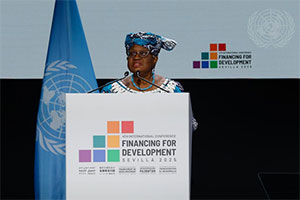 Opening of 4th International Conference on Financing for Development. Credit: UN Photo/Mariscal
International trade and investment are crucial elements of the world economy. While they can be powerful stimulators of development, they can also lead to global imbalances and dynamics of exploitation. In 2025, international trade entered a period of immense disruption, driven in part by a new wave of United States tariffs that reshaped global supply chains and investment flows. The increase in the US tariff rate, the highest since the 1930s, has forced bilateral renegotiations with global trading partners. Furthermore, the debt crisis in developing nations has accelerated while Official Development Assistance (ODA) has substantially dropped 7.3% in 2024.
In the 21st century, advancements in economic diversification in formerly colonized nations have propelled them into more central roles in the global economy. For example, both China and Mexico were able to develop their manufacturing sector and channel this development into booming export flows, thus advancing into the position of emerging economies. Foreign investment also plays an essential role in providing capital for developing countries, although they are oftentimes accompanied by social and environmental exploitation. For example, rising Chinese investments in natural resources in Latin America have often been met with tension as these investment projects fail to properly mitigate environmental risks and protect workers’ rights. In a more multifaceted vein, Sino-African relations have led to infrastructure development in Sub-Saharan Africa while also heightening the region’s economic dependency on China. IPS reports on global news in trade and investment, while shining a light on the nuanced nature of these endeavors.

The Week with IPS

NEXT STOP - SDGs
Tracking global progress towards a sustainable world
Tracking global progress towards a sustainable world
