Languages
Tuesday, October 6, 2026



News and Views from the Global South
Trade & Investment

Belém’s Hunger, Poverty Declaration Places World’s Most Vulnerable Populations at Centre of Global Climate Policy
A young woman at COP30 speaks about retracing her father’s footsteps. At only 16, her father and her grandfather were among the first families displaced by an unfolding climatic crisis of erratic weather and worsening climate conditions that goes on to date from their ancestral village in Sundarbans. Nearly 60 years later, she is on a mission to reclaim her ancestral lands.
The AI Revolution – A Way Forward
Artificial intelligence (AI) is rapidly changing our world. It has helped a few companies in developed countries set record-breaking profits. Last month, Nvidia, a leading US AI company, hit a market value of USD 5 trillion.
World Must Pay to Make America Great Again
US President Trump’s economic strategy for his second term aims to get the rest of the world, especially its wealthy allies with greater means, to pay more to help strengthen the US economy.
Turning Indigenous Territories From ‘Sacrifice’ Zones to Thriving Forest Ecosystems
A report by the Global Alliance of Territorial Communities (GATC) and Earth Insight paints a stark picture of how extractive industries, deforestation, and climate change are converging to endanger the world’s last intact tropical forests and the Indigenous Peoples who protect them.
In Zimbabwe, Secondhand Clothes From the West Are Collapsing the Local Textile Industry
Shamiso Marambanyika assists a male customer in selecting a pair of jeans on a Saturday morning in Mutare, a city in the eastern part of Zimbabwe.
No African Development from Western Trade Policies
The World Bank’s 1981 Berg Report provided the blueprint for structural adjustment, including economic liberalisation in Africa. Urging trade liberalisation, it promised growth from its supposed comparative advantage in agriculture.
Drought-hit Tanzania’s Villages Confront Harshest Reality of Climate Change
The dust was already swirling when Asherly William Hogo lifted himself from a makeshift bed before dawn. The 62-year-old pastoralist, lean from a lifetime of walking these plains, slipped into his sandals and stepped outside. Stars glittered over Dodoma, but the air was warmer than it used to be, Hogo swears. He whistled for his cows. Years ago, this hour meant an arduous trek to distant waterholes.
Historical Expansion and Sustainability in Chile’s Main Port
The port of San Antonio, Chile's main port, is promoting a historic and sustainable expansion with its own investment and that of international consortiums, aiming to improve its current ninth place among the largest and busiest ports in Latin America.
Beware Independent Central Banks
US President Trump’s snide barbs against his appointee, US Federal Reserve Bank Chairman Jerome Powell, have revived support for central bank independence – long abused by powerful finance interests against growth and equity.
Frontline of a Planetary Emergency: Africa Demands Climate Justice and Action
The room at the Swiss Inn Nexus Hotel in Bole was silent but tense as Sunita Narain, one of the world’s most influential environmental voices, fixed her gaze on rows of African journalists, scientists, and policymakers. Her tone was gentle, but the words cut deep.
Why the Awaza Declaration Could Rewrite the Future for the World’s Landlocked Nations
The theater of diplomacy can be more revealing than the speeches. Under a scorching Caspian sun in Awaza, two marines lowered their flags with the precision of a ballet. The green silk of Turkmenistan, folded into a neat bundle before the UN’s blue-and-gold standard, fluttered briefly and vanished into waiting hands.
Inside Africa’s Big Bet on Youth to Feed the Continent and Who’s Actually Getting Funded
Winnie Wambui leans forward on the panel stage, microphone in hand, scanning the room until she spots a raised hand.
AI Governance: Human Rights in the Balance As Tech Giants and Authoritarians Converge
Algorithms decide who lives and dies in Gaza. AI-powered surveillance tracks journalists in Serbia. Autonomous weapons are paraded through Beijing’s streets in displays of technological might. This isn’t dystopian fiction – it’s today’s reality. As AI reshapes the world, the question of who controls this technology and how it’s governed has become an urgent priority.
Chile Aims to Become a Latin American Hub for Data Storage and Transmission
Chile wants to be a hub in Latin America in data storage and transmission by developing data centers, leveraging its wealth of renewable energy, and its optimal digital interconnection.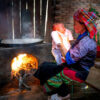
Can the Asia-Pacific Region Deliver Clean, Affordable Energy by 2030?
The future of the global energy landscape will be shaped by Asia and the Pacific. Over the past two decades, our region has been the principal driver of global energy demand and emissions. Energy has powered prosperity, lifted millions out of poverty and transformed societies.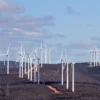
Rare Earths, a New Technological and Industrial Dream in Brazil
Brazil, which stands out for exporting basic products such as iron ore, oil, coffee, and soybeans, rather than industrialized goods with higher added value, now intends to make a shift regarding rare earths, a key component in new technologies that it has in abundance.
Government Constructions Hit Water Recharge Area in El Salvador
Two construction projects pushed by the government of El Salvador, in a water recharge area adjacent to the country's capital, on the slopes of the San Salvador volcano, threaten to make the area more vulnerable and increase the risk of flooding in the city's poor neighborhoods downstream.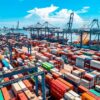
Boosting Trade in the World’s Least Developed Countries – The Power of Technology
Artificial intelligence and the use of frontier technologies are already transforming trade and boosting prosperity, particularly for developed and some developing countries. This ranges from the digital exchange of documents, the digitalisation of trade processes and leveraging online platforms to fast-track cross-border trade.
Environmentalists Confident Case Against US Funding of Mozambique LNG Project Will Succeed
Environmental campaign groups are confident that a suit filed in the United States, seeking to stop the country’s Export-Import Bank (EXIM) from the ‘unlawful’ lending of nearly USD 5 billion to the controversial Mozambique Liquefied Natural Gas (LNG) project, will succeed.
Landlocked Developing Countries to Start ‘New Decade of Delivery’
As the Third United Nations Conference on Landlocked Developing Countries (LLDC3) concludes today (Friday, August 8) in Awaza, Turkmenistan, with the adoption of the Awaza Political Declaration and the formal endorsement of the Awaza Programme of Action (2024–2034), there is optimism that LLDCs are finally at the dawn of a new era.
Beyond Lives Saved: Why Early Warning Systems Are a Smart Investment
Significant progress has been made globally in implementing national and local disaster risk reduction strategies. Yet, the impact of disasters on lives and economies persists and disaster resilience is one of the most regressed areas in Sustainable Development Goal implementation.« Previous Page — Next Page »





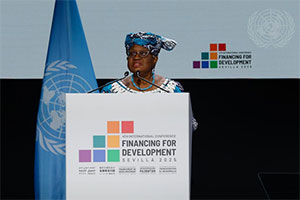 Opening of 4th International Conference on Financing for Development. Credit: UN Photo/Mariscal
International trade and investment are crucial elements of the world economy. While they can be powerful stimulators of development, they can also lead to global imbalances and dynamics of exploitation. In 2025, international trade entered a period of immense disruption, driven in part by a new wave of United States tariffs that reshaped global supply chains and investment flows. The increase in the US tariff rate, the highest since the 1930s, has forced bilateral renegotiations with global trading partners. Furthermore, the debt crisis in developing nations has accelerated while Official Development Assistance (ODA) has substantially dropped 7.3% in 2024.
In the 21st century, advancements in economic diversification in formerly colonized nations have propelled them into more central roles in the global economy. For example, both China and Mexico were able to develop their manufacturing sector and channel this development into booming export flows, thus advancing into the position of emerging economies. Foreign investment also plays an essential role in providing capital for developing countries, although they are oftentimes accompanied by social and environmental exploitation. For example, rising Chinese investments in natural resources in Latin America have often been met with tension as these investment projects fail to properly mitigate environmental risks and protect workers’ rights. In a more multifaceted vein, Sino-African relations have led to infrastructure development in Sub-Saharan Africa while also heightening the region’s economic dependency on China. IPS reports on global news in trade and investment, while shining a light on the nuanced nature of these endeavors.

The Week with IPS

NEXT STOP - SDGs
Tracking global progress towards a sustainable world
Tracking global progress towards a sustainable world
