Languages
Tuesday, October 6, 2026



News and Views from the Global South
Nuclear Energy - Nuclear Weapons

Iran Sanctions Regime Could Unravel with Failed Nuclear Deal
Internationally supported sanctions against Iran could begin to crumble if talks over Iran's nuclear programme fail to produce a final deal, according to Germany’s envoy to the United States.
Failure of Review Conference Brings World Close to Nuclear Cataclysm, Warn Activists
After nearly four weeks of negotiations, the Nuclear Non-Proliferation Treaty (NPT) Review Conference ended in a predictable outcome: a text overwhelmingly reflecting the views and interests of the nuclear-armed states and some of their nuclear-dependent allies.
Opinion: Universalisation and Strengthening Nuke Treaty Review Need to be Qualitative
"Strengthening the Review Process" and "Universalisation of the Non-Proliferation Treaty" (NPT) are distinctly substantive issues, that require consideration with their specificities in view.
Q&A: Nuclear Disarmament a Non-Starter, “But I Would Love to Be Proven Wrong”
Albert Einstein, the internationally-renowned physicist who developed the theory of relativity, once famously remarked: “I know not with what weapons World War III will be fought, but World War IV will be fought with sticks and stones.”
Analysis: Global Politics at a Turning Point – Part 2
In the following months, reports of the use of chemical weapons by Syrian forces multiplied. The most serious was an allegation that the Syrian army had used sarin gas on Mar. 19, 2013 at Khan al Assal, north of Aleppo, and in a suburb of Damascus against its opponents. This was followed by two more allegations of small attacks in April.
Analysis: Global Politics at a Turning Point – Part 1
President Barack Obama’s Nowroz greeting to the Iranian people earlier this year was the first clear indication to the world that the United States and Iran were very close to agreement on the contents of the nuclear agreement they had been working towards for the previous 16 months.
Faith-Based Organisations Warn of Impending Nuclear Disaster
As the month-long review conference on the Nuclear Non-Proliferation Treaty (NPT) continued into its second week, a coalition of some 50 faith-based organisations (FBOs), anti-nuclear peace activists and civil society organisations (CSOs) was assigned an unenviable task: a brief three-minute presentation warning the world of the disastrous humanitarian consequences of a nuclear attack.
The U.N. at 70: Impressive Successes and Monumental Failures
The United Nations was created to save succeeding generations from the scourge of war, protect human rights, maintain international peace and security, and uphold international law. Its 70-year history is marked with many successes, but also disappointments. We need to look at both sides so that we can make the U.N. more effective in the future.
Q&A: Comprehensive Ban on Nuclear Testing, a ‘Stepping Stone’ to a Nuke-Free World
With the four-week-long review conference of the Nuclear Non-Proliferation Treaty (NPT) underway at the United Nations, hopes and frustrations are running equally high, as a binding political agreement on the biggest threat to humanity hangs in the balance.
As Nuke Talks Begin, U.N. Chief Warns of Dangerous Return to Cold War Mentalities
Against the backdrop of a new Cold War between the United States and Russia, two of the world’s major nuclear powers, the United Nations is once again playing host to a four-week-long international review conference on the Nuclear Non-Proliferation Treaty (NPT).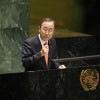
Opinion: Challenging the Nuclear Powers’ Extremism
On the eve of the Nuclear Non-Proliferation Treaty (NPT) Review Conference five years ago, U.N. Secretary-General Ban Ki-moon warned that governments alone will not rid the world of the specter of nuclear annihilation.Spiritual Leaders Urge Action On Nuclear Disarmament
Religious leaders addressed the United Nations in New York last week, pleading on moral grounds for global nuclear disarmament.
U.N. Warns of Growing Divide Between Nuclear Haves and Have-Nots
As she prepared to leave office after more than three years, High Representative for Disarmament Affairs Angela Kane painted a dismal picture of a conflicted world: it is “not the best of times for disarmament.”
Opinion: Moment of Truth for the Nobel Peace Prize
The Nobel Peace Prize is about to bow out to critics. As of Jan. 1, the Oslo-based Norwegian Nobel Committee that selects the winners has a new secretary, Olav Njølstad, who announced that “changes loom” in a recent interview.
Opinion: Shared Action for a Nuclear Weapon Free World
From the end of April, the Nuclear Non-Proliferation Treaty (NPT) Review Conference will be held in New York. In this year that marks the seventieth anniversary of the atomic bombings of Hiroshima and Nagasaki, I add my voice to those urging substantial commitments and real progress toward the realisation of a world without nuclear weapons.
Obama Prepares for Showdown with Congress Over Iran Deal
Two days after the deadline for reaching a deal over Iran’s nuclear programme had passed, negotiators looked like they would be going home empty handed. But a surprisingly detailed framework was announced Apr. 2 in Lausanne, Switzerland, as well as in Washington, and in the same breath, U.S. President Barack Obama acknowledged the battle he faces on Capitol Hill.
Nuclear Threat Escalating Beyond Political Rhetoric
As a new cold war between the United States and Russia picks up steam, the nuclear threat is in danger of escalating – perhaps far beyond political rhetoric.
Opinion: A Legally-Binding Treaty to Prohibit Nuclear Weapons
Five years after the adoption of the NPT (Nuclear Non-Proliferation Treaty) Action Plan in 2010, compliance with commitments related to nuclear disarmament lags far behind those related to non-proliferation or the peaceful uses of nuclear energy.
The Two Koreas: Between Economic Success and Nuclear Threat
The two Koreas are an odd match – both are talking about possible dialogue but both have different ideas of the conditions, and that difference comes from the 62-year-old division following the 1950-53 Korean War.
Israel’s Obsession for Monopoly on Middle East Nuclear Power
As the Iranian nuclear talks hurtle towards a Mar. 24 deadline, there is renewed debate among activists about the blatant Western double standards underlying the politically-heated issue, and more importantly, the resurrection of a longstanding proposal for a Middle East free from weapons of mass destruction (WMD).Marshall Islands Nuclear Proliferation Case Thrown Out of U.S. Court
A lawsuit by the Marshall Islands accusing the United States of failing to begin negotiations for nuclear disarmament has been thrown out of an American court.« Previous Page — Next Page »





At first it was the United States. Then came Russia, China, Britain and France. Everyone wanted their own atomic bombs and atomic energy. While Israel quietly nurtured its nuclear programme, in Asia, rivals India and Pakistan, and most recently North Korea, joined the global nuclear club. Are nuclear weapons stockpiles adequately safeguarded? Is nuclear energy worth the risk? Read IPS.

The Week with IPS

NEXT STOP - SDGs
Tracking global progress towards a sustainable world
Tracking global progress towards a sustainable world
