Languages
Thursday, November 19, 2026



News and Views from the Global South
Regional Categories

‘Ticking Time Bombs’ for the Most Defenceless: The Children (II)
While the world’s biggest powers and their giant private corporations continue to attach high priority to their military –and commercial– dominance, both of them being shockingly profitable, entire generations are being lost to deadly armed conflicts, devastating climate catastrophes, diseases, hunger and more imposed impoverishment.
How Emerging Economies Are Reshaping the International Financial System
It’s been 25 years since the 1997 Asian financial crisis led to the creation of the G20 forum for finance ministers; and 15 years since this became a leader-level meeting following the global financial crisis. During this period, there has been significant shift in the global finance and economic landscape.
In Zimbabwe, Economic Crisis Pushes Underaged Girls to Sex Work
After other adolescent girls her age have gone to bed at around 10 pm, Kudzai commutes to a shopping centre near her home in Penhalonga, a mining area 25 kilometres outside the third largest Zimbabwean city of Mutare, to look for men to solicit sex.
BRAC ‘Resets’ Program Aimed at Empowering Adolescent Girls in Africa
BRAC’s Empowerment and Livelihood Program (ELA) has benefitted tens of thousands of girls, and its recently released report shows an organization willing to adapt to the circumstances to continue to ensure adolescent girls and young women receive meaningful sexual and reproductive health rights support.
‘Ticking Time Bombs’ for the Most Defenceless: The Children (I)
Today, there are more children in need of desperate humanitarian assistance than at any other time since World War II.
Pakistan’s Free Healthcare Insurance Benefits Women, Poor
A free health insurance initiative started in Pakistan has benefited poor patients, especially women who have outnumbered men in using the cashless health services under the Sehat Card Plus programme. "The initiative is in line with the ICPD25 Programme of Action, under which 4.5 million people have received free services, with 62 percent of them women. In the last three years, we have been able to cut down maternal mortality rate from 186 deaths per 100,000 live births to 172," Dr Muhammad Riaz Tanoli, CEO of the Sehat Card Plus (SCP), told IPS.
A Vital Partnership for the 2030 Agenda
Flexible and predictable funding allows UN agencies to respond promptly and with agility in times of crisis. In countries such as Afghanistan, Yemen, and Ukraine, UNDP implements projects and programmes that help protect livelihoods and enhance the resilience of vulnerable communities.
Nicaragua: An Opportunity for Democratic Solidarity
On 9 February, Nicaragua’s dictator, Daniel Ortega, unexpectedly ordered the release of 222 political prisoners, including several former presidential candidates, opposition party leaders, journalists, priests, diplomats, businesspeople and former government supporters branded as enemies for expressing mild public criticism.
“An Israeli Senior Minister Asked Me To Commit Hate Crimes”
Harassing Palestinians, vandalizing their cars and houses, occupying their lands: Gilad Sade, a 36-year-old Israeli, recalls his day-to-day life when he belonged to a Jewish supremacist organization.
Tanzania Should Halt Plan to Relocate Maasai Pastoralists
Tanzania’s policies on conservation and its ongoing impacts on Maasai people in Ngorongoro district highlight how communities historically marginalized by oppression still wrestle with colonial policies.
Fear of Population Ageing
Fear of population ageing is all over the news media and in government offices of country capitals worldwide. Planet Earth is becoming “planet ageing”.
Role of Regional Economic Cooperation in Inclusive Digital Transformation in Asia
Digitalization is a key driver of competitiveness and development. As the world takes the path to unprecedented digital advancement, Asia continues to be a powerhouse of digital transformations in a wide range of areas from microchip manufacturing to electric vehicles, from digital currency to e-commerce.
UN Hobbled by Junta and Under Pressure Over Myanmar Aid Crisis
Nearly 18 million people – about one-third of Myanmar’s population – need humanitarian aid this year because of civil war and the post-coup economic crisis, according to the latest United Nations estimates.
UN Confronts Existential Challenge After Russia’s Invasion of Ukraine
Paralysed by its own Charter and structure, the world organisation that is charged with preventing wars confronts an existential challenge from Russia’s invasion of Ukraine.
A Last-Ditch Effort to Save a High Seas Treaty from Sinking
When the United Nations began negotiations on a legally binding treaty to protect and regulate the high seas, one diplomat pointedly remarked: “It’s a jungle out there”—characterizing a wide-open ocean degraded by illegal and over-fishing, plastics pollution, indiscriminate sea bed mining and the destruction of marine eco-systems.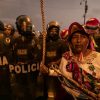
Privilege and Centralism in Lima Goad Protesters in Peru
The current political and social upheaval in Peru is not a temporary problem, but has to do with deeply-rooted inequality and social hierarchies, according to historian José Carlos Agüero.
Climate Crisis is a Child Crisis and Climate-Resilient Children, Teachers and Schools Must Become Top International Agenda
From southern Ethiopia to northern Kenya and Somalia, the most severe drought in the last 40 years is unfolding. It is simply too hot to go to school on an empty stomach, and close to 3 million children are out of school, with an additional 4 million at risk of dropping out entirely across the Horn of Africa.
‘Hate Speech Loads the Gun, Misinformation Pulls the Trigger’ – And It Is Profitable
In this world of wars, massive weapons production, sales and use; of sharpening inequalities and deadly climate emergencies, hate speech and its inhumane impact, is being amplified at ‘unprecedented scale’ by new technologies.
Taking a Stance on Feminists’ Prejudice Against Religious Minority Women
Since researching the experiences of gender discrimination against women in poverty who belong to religious minorities, many fellow feminists have turned their back on me.
Act on the Taliban and Secure Our Right to Education, Afghan Women and Girls’ Plea
It has been more than 500 days since the Taliban regime in Afghanistan shut down schools and shattered the education dreams of girls and women like Somaya Faruqi, who has been forced to leave her homeland to continue her education.
ECW High-Level Financing Conference Raises More than 826 Million USD to Keep Crisis-Impacted Children in School
As an unparalleled, unprecedented global education crisis unfolds, an estimated 222 million crisis-impacted children are desperate to learn. As barriers to accessing education increase, darkness beckons, and education is their last hope.« Previous Page — Next Page »


The Week with IPS

NEXT STOP - SDGs
Tracking global progress towards a sustainable world
Tracking global progress towards a sustainable world
