Languages
Sunday, November 15, 2026



News and Views from the Global South
Education
EDUCATION-CAMEROON: Schools for Scandal
Authorities in Cameroon are engaged in a battle to stem corruption in the education system where, as mathematics teacher Victor Pene describes it, graft "is in the process of institutionalizing itself".THAILAND: Amid Violence, Final Bell Tolls for Islamic Schools
As the violence in Thailand's south threatens to spiral out of control, the government has begun sharpening its knives with a view to cracking down on Islamic schools in the region.EDUCATION: Basic Schooling the Foundation of Development – Report
Investing in universal primary education is one of the best ways for poor nations to boost economic growth, their citizens' health and other indicators of development, says a new report released by a group of 16 private U.S. development and relief agencies.ASIA: Region’s Report Card in Education Needs Improvement
A disturbing report card on the state of primary education in Asia highlights the daunting task that governments face in meeting the goal of ensuring universal primary education by 2015.EDUCATION: Zimbabwe’s Miracle Fades
It was once celebrated as a rare African success story, an example of what committed leadership can do.EDUCATION-SWAZILAND: A New Policy to Keep AIDS Orphans in School
A new education initiative has been started in Swaziland to assist children who have lost parents to the AIDS pandemic.EDUCATION-UGANDA: Universal Primary Schooling Succeeds to a Fault
Martin Oketch, 13, sat his Primary Leaving Examinations in Uganda late last year. His first choice for secondary education was St Mary's College Kisubi, one of the country's best boys' schools. "I want to become a doctor like Uncle Nathan," he says, pointing to his relative.SCIENCE-MEXICO: Kids’ Museum Offers a Passport to the Stars
Mexico is a long way from the "space race", but is opening the door for people to leave Earth and the Milky Way for the edge of the known universe, in a virtual voyage that is impossible in any other Latin American country.EDUCATION-SWAZILAND: English a Passport to Success?
A heated debate is underway in Swaziland about whether children who fail English should be forced to repeat the academic year.EDUCATION-SRI LANKA: For Poor Students, English Makes a Difference
The children trudge into the Mohoththawagoda Secondary School, a few wearing white shoes and socks, some in rubber slippers but most of them barefoot.EDUCATION-ZAMBIA: Spare the Rod and Spoil the Child?
Human rights activists in Zambia scored another victory recently when they got parliament to outlaw corporal punishment in the country.EDUCATION-KENYA: Ongoing Claims About AIDS Discrimination in Schools
A decision by the guardians of 72 HIV-positive children to sue Kenya's government for alleged discrimination in public schools appears to have struck a nerve in the East African country. AIDS organisations say this trend may be widespread, and they are calling on government to take action in the matter.HAITI: Student Opposition Bodes Ill for Government
When over 15,000 people marched through the streets of Haiti's capital Monday, psychology student Vladimir Jean Charles was in the lead.EDUCATION-KENYA: Too Much, Too Soon?
As Kenya enters 2004, it appears likely that the country's education system will come under increased scrutiny. Many teachers want the current syllabus to be overhauled, saying it places undue pressure on staff and children alike.EDUCATION: Thailand Has Good Marks, But Needs Improvement
Thailand remains a model for Asian developing countries for its economic development that has brought impressive gains in education, but it has some catching up to do in the fewer number of girls in primary schools.SOUTH AFRICA: Education a Beacon of Hope for the Girl Child
South Africa has become a beacon of hope for the girl child in Sub-Saharan Africa, where poverty and outdated traditions have prevented girls from attending schools.EDUCATION: More Girls in School Benefits Everyone, Says UNICEF
Shamim Cairo Atwine, a 15-year-old Ugandan girl, speaks with great pride of the success of the Girls' Education Movement (GEM) at her school in Nakulabye, a poor and densely populated neighbourhood of Kampala.EDUCATION-CUBA: Rural Students Benefit from Computers, Solar Panels
"My kids didn't know what traffic lights were. Now they even understand how they work," says the director of a childcare centre in rural Pinar del Río province, in western Cuba. The change is the result of the arrival of technology to remote towns.HEALTH-THAILAND: Students Want Universities to be Condom-Free Zones
Just as Thailand was basking in another round of praise for combating HIV/AIDS through an effective condom campaign, it has been reminded by its future leaders - university students - that its triumph is not worthy of repetition.EDUCATION-MALAWI: Making Universal Primary Schooling a Reality
When the Commonwealth heads of government gather in Nigeria next month for their bi-annual meeting, the agenda will probably be dominated by politics. But, if activist Julita Msanjama had her way, the leaders would spend most of their time discussing education.EDUCATION: Expiration Dates and Refresher Courses for Graduates
University degrees should have a sort of ''expiration date'', and professionals should be required to renew them every five years by taking refresher courses, to keep up in a world where knowledge is expanding at a dizzying pace.« Previous Page — Next Page »


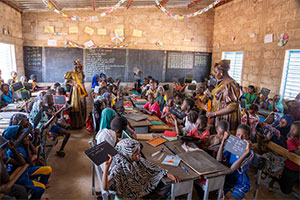 Two teachers work in a classroom in Forces Vives School in Dori, Burkina Faso. Credit: UNICEF/UNI978361
Safe and uninterrupted education is a fundamental right for all children. Education is paramount to global development, as it has been proven that investing in education – especially for girls and children – contributes significantly to economic growth and prosperity. Although more than 1 billion children go to school, many are subjected to conditions that are not conducive to a proper learning environment, including makeshift facilities, a lack of supplies, violence in classrooms, inadequate sanitation, untrained instructors, and widespread school closures. Since 2015, there have been immense gains in education with an increase of 109 million children in school. However, as of 2023, 272 million children are still out of school.
High poverty levels in developing countries also impede children’s access to a proper education. For example, from the early to mid 2000s, Sub-Saharan African nations witnessed a dramatic decline in trained teachers due to inadequate funding in the education sector. Furthermore, major cuts to United States international aid threaten an estimated 23 million additional children's access to education, as USAID‑funded school programmes across Africa and Asia face closure.
Various other factors contribute to the decline of education, notably hunger, which has increased as conflict and climate change interfere with global food production and dissemination. Meanwhile, certain social and cultural practices also impede children’s access to education, with gender inequality, discrimination, child labour, and child marriages preventing millions of children from attending school. Economic conditions such as the inaccessibility of higher education also affect disenfranchised communities across the world. In extreme situations, such as warfare where educational facilities are destroyed in their totality, notably in Gaza and Sudan, entire generations of children might grow up without access to education. Rebuilding educational infrastructure is a long and arduous process, especially when violence persists across generations, and this significantly stunts the development of societal prosperity and stability.
IPS is dedicated to telling the shocking truths about worldwide education through impassioned opinion pieces and comprehensive articles, highlighting global issues that impede worldwide education and the courses of action being taken by organizations such as UNICEF and Education Cannot Wait.

The Week with IPS

NEXT STOP - SDGs
Tracking global progress towards a sustainable world
Tracking global progress towards a sustainable world
