Languages
Sunday, November 15, 2026



News and Views from the Global South
Education
RIGHTS-PAKISTAN: Call to Spare the Rod in Schools Grows Louder
Schoolchildren in Pakistan have routinely been slapped, caned or spanked in an effort to get them to behave or perform better, but only after a federal minister's son was given the same treatment has the spotlight been turned onto an archaic, 143-year-old law which permits corporal punishment in schools.CULTURE: U.S. Students Must Open Avenues to the World – Panel
America's global woes can be solved only with a greater understanding of different cultures and languages, attainable only if more U.S. students study abroad, said a panel of experts Tuesday.HEALTH-PAKISTAN: Dearth of Trained Midwives Plagues Planners
In the village of Talhi, in Pakistan's Sindh province, water still tends to be transported on camel-back. That is how a midwife too gets her supply of water to carry out a delivery, and such a midwife is Margaret Gill.DEVELOPMENT: Jamaica Suggests "Managed" Brain Drain
Struggling to cope with a growing brain drain of professionals to industrialised countries, Caribbean leaders are mooting ideas like "managed migration" and training professionals for "export" as ways to curtail the problem.EDUCATION-KENYA: Striking Lecturers Say They Live ‘Hand-to-Mouth’
Winnie Mitullah was in no mood to take part in this year’s "Africa University Day" celebration on Wednesday (Nov. 12). She has joined other striking university lecturers in a demand for better pay.IRAQ: War Comes to the Classroom
Shams Mohammed Ali is a shy 10-year-old girl. Sitting in her school principal's office in Baghdad, she tries to explain why she missed school last Saturday.POLITICS: Middle East, Muslim Students Shun U.S. Schools
For many years, students from all over the globe have streamed into U.S. universities in search of a good education, career opportunities and, at times, freedoms not available at home, thanks to a relatively open and streamlined student visa process.POLITICS-ZIMBABWE: Greatest Cheers for New College Confined to State Media
Never had the rural outpost of Lupane received so much attention, not even when it was declared the capital of Zimbabwe's Matabeleland North province four years ago.EDUCATION: 39 Years After Independence, British System Still Wows Zambians
Martin Mubanga's parents have changed his schools twice this year, because his class got too large, 15 pupils.RIGHTS-COLOMBIA: Impunity Surrounds Murders of 650 Teachers
The special United Nations rapporteur on the right to education expressed concern over the impunity surrounding the murders of 650 teachers in the past decade in Colombia, on her recent 10-day visit to this war-torn South American country.EDUCATION: Private Sector Could Offer Solutions to African Universities
Radical solutions are being sought for the crisis in African universities, including new sources of funding to supplement government efforts.ENVIRONMENT: UN Conference Stresses Need Of Disaster Reduction
The impacts of disasters across the globe have grown rapidly over the past three decades, with thousands of fatalities, hundreds of millions of people affected and tens of billions of dollars of losses.HEALTH-CARIBBEAN: Community Programmes Help Stem Wave of Violence
Nineteen-year-old Dwayne Hutchinson knows firsthand the effects of violence. Living in one of the most volatile areas of Jamaica's capital, Kingston, he became involved with gangs, guns and knives as early as 13 years old.EDUCATION-BANGLADESH: Private Sector Thrives at Students’ Expense
Exploiting the need of droves of students looking for higher education, private universities in Bangladesh are raking in cash. But their many critics accuse the parallel instruction structures of being little more than glorified coaching centres.EDUCATION-VENEZUELA: University Doors to Open Wider
A half-million secondary school graduates in Venezuela will have the chance to enter university after two decades in which they have been refused admission due to limited space.PAKISTAN: Arrests Put Spotlight on Reforms in Religious Schools
While Islamic schools and government officials remain in a tussle over 19 Asian students recently arrested for supposed links to terrorist groups, these detentions have put the spotlight back on the issue of reforms in Pakistan's religious schools.EDUCATION-BRAZIL: Final Offensive Against Illiteracy
Brazil is taking another stab at illiteracy, after setting the ambitious goal of teaching 20 million people over 15 to read and write during President Luiz Inácio Lula da Silva's four-year term, which ends in 2006.CULTURE-NIGERIA: ‘Indecent’ Dressing Banned on the Campus
Sexual harassment of female students in Nigeria has often been blamed on randy lecturers, but the university authorities are fighting back.RIGHTS-SRI LANKA: Children Speak up to Shape Education Policy
Once, at a workshop for children, government officials were busy praising the efforts of a special desk for women and children in Sri Lankan police stations, until one child asked: "But how can it be successful if no one is at the desk?"PAKISTAN: Students Get Real Lessons from Virtual University
Ali Haider is into the third semester of a bachelor of computer science degree course and is enthusiastic about his subject. The 22-year-old however wishes his teachers would answer the questions he has a little sooner - it is usually a day before he gets a reply.EDUCATION-VIETNAM: Too-Successful Policy Leads to Brain Drain
Le Thi Xuan has all her plans neatly laid out, now that she has been admitted to the National University of Singapore (NUS) in September.« Previous Page — Next Page »


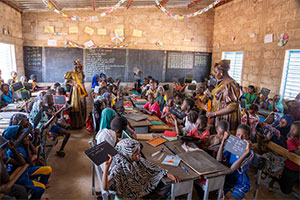 Two teachers work in a classroom in Forces Vives School in Dori, Burkina Faso. Credit: UNICEF/UNI978361
Safe and uninterrupted education is a fundamental right for all children. Education is paramount to global development, as it has been proven that investing in education – especially for girls and children – contributes significantly to economic growth and prosperity. Although more than 1 billion children go to school, many are subjected to conditions that are not conducive to a proper learning environment, including makeshift facilities, a lack of supplies, violence in classrooms, inadequate sanitation, untrained instructors, and widespread school closures. Since 2015, there have been immense gains in education with an increase of 109 million children in school. However, as of 2023, 272 million children are still out of school.
High poverty levels in developing countries also impede children’s access to a proper education. For example, from the early to mid 2000s, Sub-Saharan African nations witnessed a dramatic decline in trained teachers due to inadequate funding in the education sector. Furthermore, major cuts to United States international aid threaten an estimated 23 million additional children's access to education, as USAID‑funded school programmes across Africa and Asia face closure.
Various other factors contribute to the decline of education, notably hunger, which has increased as conflict and climate change interfere with global food production and dissemination. Meanwhile, certain social and cultural practices also impede children’s access to education, with gender inequality, discrimination, child labour, and child marriages preventing millions of children from attending school. Economic conditions such as the inaccessibility of higher education also affect disenfranchised communities across the world. In extreme situations, such as warfare where educational facilities are destroyed in their totality, notably in Gaza and Sudan, entire generations of children might grow up without access to education. Rebuilding educational infrastructure is a long and arduous process, especially when violence persists across generations, and this significantly stunts the development of societal prosperity and stability.
IPS is dedicated to telling the shocking truths about worldwide education through impassioned opinion pieces and comprehensive articles, highlighting global issues that impede worldwide education and the courses of action being taken by organizations such as UNICEF and Education Cannot Wait.

The Week with IPS

NEXT STOP - SDGs
Tracking global progress towards a sustainable world
Tracking global progress towards a sustainable world
