Languages
Monday, November 16, 2026



News and Views from the Global South
Education
RIGHTS-BRAZIL: Leading University Joins Fight Against Racism
The leading public university and the bar association of Brazil have recognised the need to fight racism and created commissions to seek ways to combat the discrimination suffered by blacks.EDUCATION-NIGERIA: Teachers’ Strike Paralyses Schools
Primary schools throughout Nigeria have been paralysed by teachers' strike over a new minimum wage.EDUCATION: Schooling Crisis in Developing Nations
Any hope of promoting global access to basic education by the turn of the century had been dashed because of problems - mainly in the developing world - encountered during the past 10 years, a UN conference heard here.DEVELOPMENT-MEXICO: Closing the Research Gap
Mexico is taking steps to end the long- standing policy of ignoring research in the fields of science and technology - where only .38 percent of the gross national product (GNP) was spent in the past.EDUCATION-CANADA: University Coming to the Arctic
The University of the Arctic, an institution without walls, will begin enrolling students next year in areas north of the 60th parallel.EDUCATION-CHINA: Bored Students Spell Trouble for Economic Future
The Chinese government has taken bold steps toward market reforms, but the lack of creativity among its youth may well hinder its lofty economic ambitions.EDUCATION-ARGENTINA: Two Years Camping Out and Fasting
Teachers from all over Argentina have been taking turns over the past two years camping out in front of Congress and fasting for periods of 15 days to protest low salaries and the small slice of the budget allocated to education.EDUCATION-US: Public Schools go Commercial
US commercial firms, forever hunting new markets, are moving more and more into the public schooling system in their eagerness to strike deals to increase revenues.EDUCATION-VENEZUELA: Drop-Outs and Gap Between School, Real Life
One-third of youngsters who should be in school in Venezuela remain outside of the school system, where the alarm has been sounded because part of the problem is that educational programmes are, simply, boring and out of sync with "real life."EDUCATION-SENEGAL: Children In Rural Schools To Receive Lunch
A new World Food Programme (WFP) project will encourage school attendance in rural Senegal and ensure that while in school, children will receive a nourishing lunch.EDUCATION: Latin America Gets Poor Marks
Latin America is noticeably lagging behind other regions of the developing South in the education sector and the majority of students are unable to obtain a top quality education, say researchers.EDUCATION-LATAM: Public Universities Serve the Rich
Far from helping the poor, the public universities of Latin America have in fact been subsidising the rich for years, claims US economist Darrel Lewis.EDUCATION: Africa Urged To Invest In Girls To Reduce Poverty
Investing more in the education of girls can make a significant contribution to the reduction of poverty in Africa, an official of the Forum for African Women Educationalists (FAWE) says.EDUCATION: Is What Is Taught In African Schools Irrelevant?
A lot of what is taught in schools in Africa is irrelevant to the needs of the continent, claim a group of African educationalists.EDUCATION-GUATEMALA: Literacy For All a Distant Dream
Nearly one-third of the 11.6 million people of Guatemala cannot read or write - despite government efforts to boost the rate of literacy.EDUCATION: Womens’ Education a Priority Need
World governments must make girls' education a priority if their countries are to make any real advance in the future , senior United Nations officials noted Monday - International Women's Day.EDUCATION: Shocking Report On Racism In South African Schools
White supremacist belief systems still continue to affect inter-racial schooling in South Africa five years after a new government came to power.CULTURE-TRINIDAD AND TOBAGO: Women Take Over Town at Carnival Time
Almost 10 years ago, young balladeer-turned-calypsonian, Denyse Plummer, won the "Young Kings" Calypso Competition and raised a controversy that rages to this day.ENVIRONMENT-ASIA: Keeping Tiger Habitats Will Help Save Big Cats
For several months now, machete-wielding conservationists have been carving a trail deep into this national park and setting a series of traps -- of cameras, that is.ENVIRONMENT: Millions of Urban Indian Children Exposed To Lead
Developing countries like India need to take stringent action to reduce the high level of lead in the atmosphere which is poisoning children in the cities, experts said at an international conference in this southern city.ECONOMY-BOSNIA: Problems of Privatization
Delayed and heavily criticised plans to privatize Bosnia's economy have come under renewed fire, this time from representatives of two of the country's religious communities.« Previous Page — Next Page »


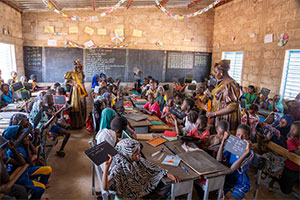 Two teachers work in a classroom in Forces Vives School in Dori, Burkina Faso. Credit: UNICEF/UNI978361
Safe and uninterrupted education is a fundamental right for all children. Education is paramount to global development, as it has been proven that investing in education – especially for girls and children – contributes significantly to economic growth and prosperity. Although more than 1 billion children go to school, many are subjected to conditions that are not conducive to a proper learning environment, including makeshift facilities, a lack of supplies, violence in classrooms, inadequate sanitation, untrained instructors, and widespread school closures. Since 2015, there have been immense gains in education with an increase of 109 million children in school. However, as of 2023, 272 million children are still out of school.
High poverty levels in developing countries also impede children’s access to a proper education. For example, from the early to mid 2000s, Sub-Saharan African nations witnessed a dramatic decline in trained teachers due to inadequate funding in the education sector. Furthermore, major cuts to United States international aid threaten an estimated 23 million additional children's access to education, as USAID‑funded school programmes across Africa and Asia face closure.
Various other factors contribute to the decline of education, notably hunger, which has increased as conflict and climate change interfere with global food production and dissemination. Meanwhile, certain social and cultural practices also impede children’s access to education, with gender inequality, discrimination, child labour, and child marriages preventing millions of children from attending school. Economic conditions such as the inaccessibility of higher education also affect disenfranchised communities across the world. In extreme situations, such as warfare where educational facilities are destroyed in their totality, notably in Gaza and Sudan, entire generations of children might grow up without access to education. Rebuilding educational infrastructure is a long and arduous process, especially when violence persists across generations, and this significantly stunts the development of societal prosperity and stability.
IPS is dedicated to telling the shocking truths about worldwide education through impassioned opinion pieces and comprehensive articles, highlighting global issues that impede worldwide education and the courses of action being taken by organizations such as UNICEF and Education Cannot Wait.

The Week with IPS

NEXT STOP - SDGs
Tracking global progress towards a sustainable world
Tracking global progress towards a sustainable world
